Frozen shoulder: how long it lasts and what actually helps
Last Reviewed:
11 August, 2026
~12 min read
Reviewed by:
Dr. Ramneek Mahajan
Dr. Mahajan is Chairman Orthopaedics, Joint Replacement & Chief Robotic Joint Replacement at Max Smart Super Speciality Hospital, Saket.
This guide is for someone whose shoulder has slowly become painful and then stiff - to the point where reaching behind your back, fastening a seatbelt, or sleeping on that side has become hard. If your shoulder stiffened without a clear injury, and especially if you have diabetes or a thyroid condition, this is the pattern the guide describes. It is written for the person living with it, not only the doctor treating it.
This guide is not for a shoulder that became painful right after a fall or a dislocation, or for weakness and catching that point to a rotator cuff tear - those follow a different path and have their own pages on this site. It also does not replace an in-person assessment of your shoulder.
01 What is a frozen shoulder?
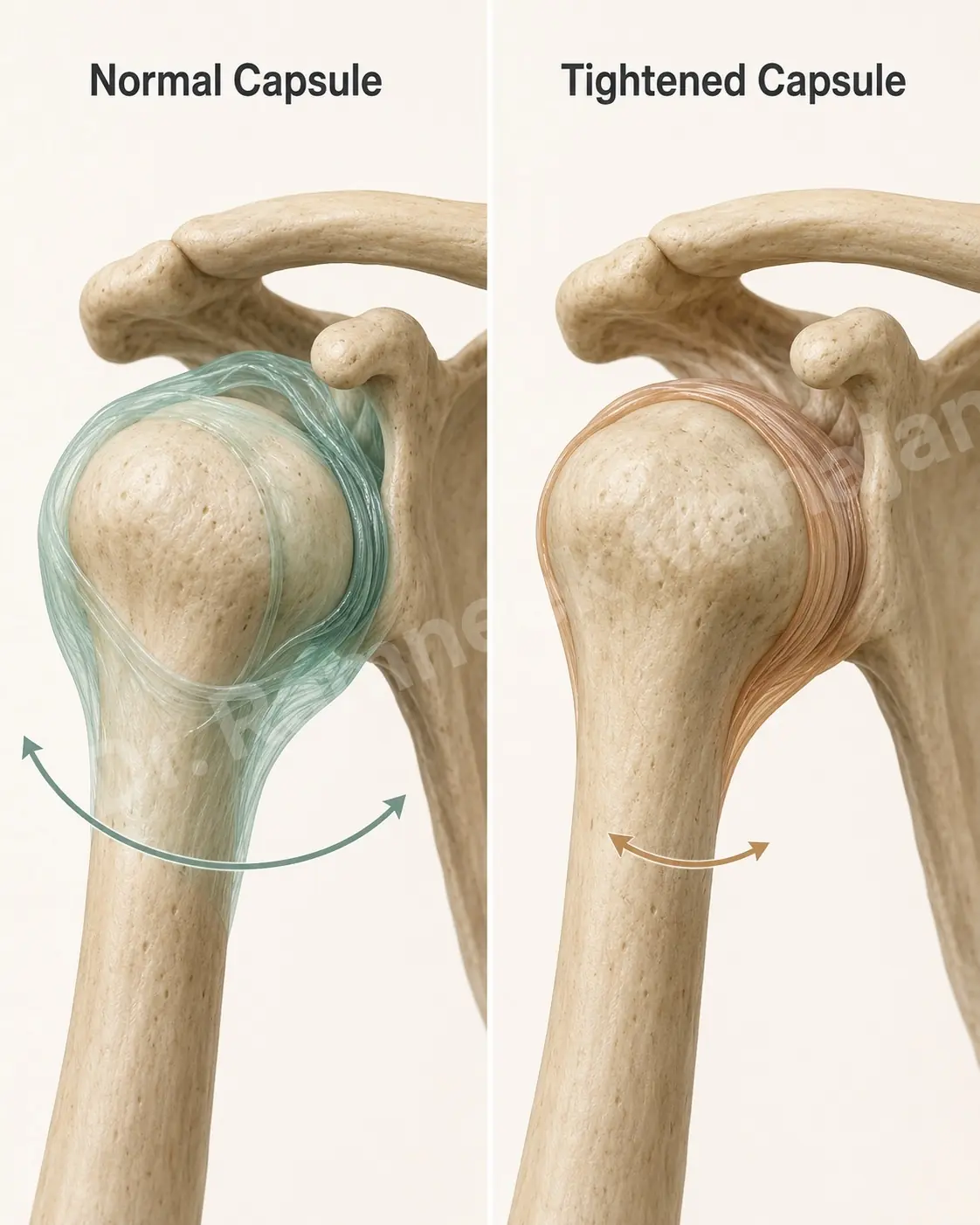
A frozen shoulder, also called adhesive capsulitis, is a shoulder that has slowly become painful and stiff because the capsule - the soft-tissue envelope around the joint - has become inflamed, then thickened and tight, leaving less and less room for the joint to move. There is usually no single injury behind it. The capsule gradually scars down, and the shoulder loses its range of movement in every direction.
The three phases a frozen shoulder moves through
Freezing, the painful phase: pain builds gradually over weeks to months, is often worse at night, and the shoulder slowly starts to stiffen.
Frozen, the stiff phase: the pain often eases a little, but stiffness takes over - reaching overhead or behind your back becomes hard. This phase commonly lasts 4 to 12 months.
Thawing, the recovery phase: movement returns gradually over weeks to months, and the pain settles.
Who tends to get a frozen shoulder?
It affects around 2 percent of people, most often between the ages of 40 and 70 years.
About 70 percent of those affected are women.
Diabetes is the strongest link - it raises the risk around fivefold, and tends to make recovery slower.
A thyroid condition, a spell of keeping the arm still after another injury or surgery, and some heart conditions are also associated.
In 20 to 30 percent of people, the other shoulder is affected too, though it rarely returns in the same shoulder once recovered.
Primary or secondary - two ways it starts
Doctors group frozen shoulders into two kinds, which can change what else needs attention:
Primary (idiopathic): it comes on for no clear reason, with nothing abnormal on examination other than the stiffness, and a normal X-ray.
Secondary: it follows something identifiable - diabetes, a spell of keeping the arm still after an injury or surgery, or a thyroid problem - and that underlying cause is treated alongside the shoulder.
How is a frozen shoulder diagnosed?
It is mainly a clinical diagnosis - the history and the examination. The giveaway is that movement is lost in every direction even when the doctor gently moves your arm for you, not just when you move it yourself, and external rotation - turning the forearm outward with the elbow tucked in - is especially restricted. That passive stiffness is what separates a frozen shoulder from a rotator cuff problem, where someone else can still move the arm. An X-ray is usually normal but is done to rule out arthritis, and a scan is reserved for when the picture is unclear.
When should you get it checked rather than wait?
A frozen shoulder is not dangerous, but a few things are worth a prompt assessment because they can point to something else:
Stiffness that started right after a significant fall or injury - an X-ray is needed to rule out a fracture or a shoulder that is out of place
Constant, unremitting pain with weight loss, fever, or a lump - to exclude other causes
Real weakness or numbness, not just stiffness from pain - which points away from a simple frozen shoulder
Once you know it is a frozen shoulder and not something else, the question most people ask is whether it needs surgery.
02 Do you need surgery for a frozen shoulder?
For the large majority of frozen shoulders, the honest answer is no. A frozen shoulder is one of the few shoulder problems that usually settles on its own - it is self-limiting. The job of treatment is to control the pain and keep the shoulder moving while the capsule calms down, not to operate.
Path | What it is | When it works | What it asks of you |
|---|---|---|---|
Time and a home exercise programme (the foundation) | Gentle, regular stretching and range-of-motion work, done daily | Almost everyone - this is the backbone of recovery | Consistency over months |
Pain control | Anti-inflammatory or simple pain medication, and ice | The painful freezing phase | Short-term use, alongside movement |
A steroid injection into the joint | Corticosteroid placed in or around the joint | When pain is limiting and progress has stalled, especially early | A clinic visit; relief is faster but not permanent |
A procedure (manipulation or keyhole release) | Freeing the tight capsule under anaesthetic | Only the small number of shoulders that stay stuck after months of the right treatment | Day-care or short-stay surgery, then rehabilitation |
Do you actually need surgery? Who does, and who does well without it?
This is the question most pages skip. The honest answer from the published evidence: most people recover without surgery. In a long-term follow-up study of frozen shoulder, about 94 percent regained normal levels of function and movement without any surgery at all.
A smaller group does come to a procedure - typically those whose shoulder stays stiff and painful despite several months of the right non-surgical treatment. Diabetes makes that stubborn, slower course more likely.
Can I just wait it out?
Often, yes - but waiting it out is not the same as ignoring it. Left completely alone, movement returns gradually in most people, though it may never measure exactly as it did before. Active treatment - keeping the shoulder moving, settling the pain - is linked to a quicker recovery, and people who seek care earlier tend to recover faster. So the plan is active management with a clear review point, not neglect.
If the conversation does point towards a procedure, here is what that actually involves.
03 What happens if you do need a procedure?
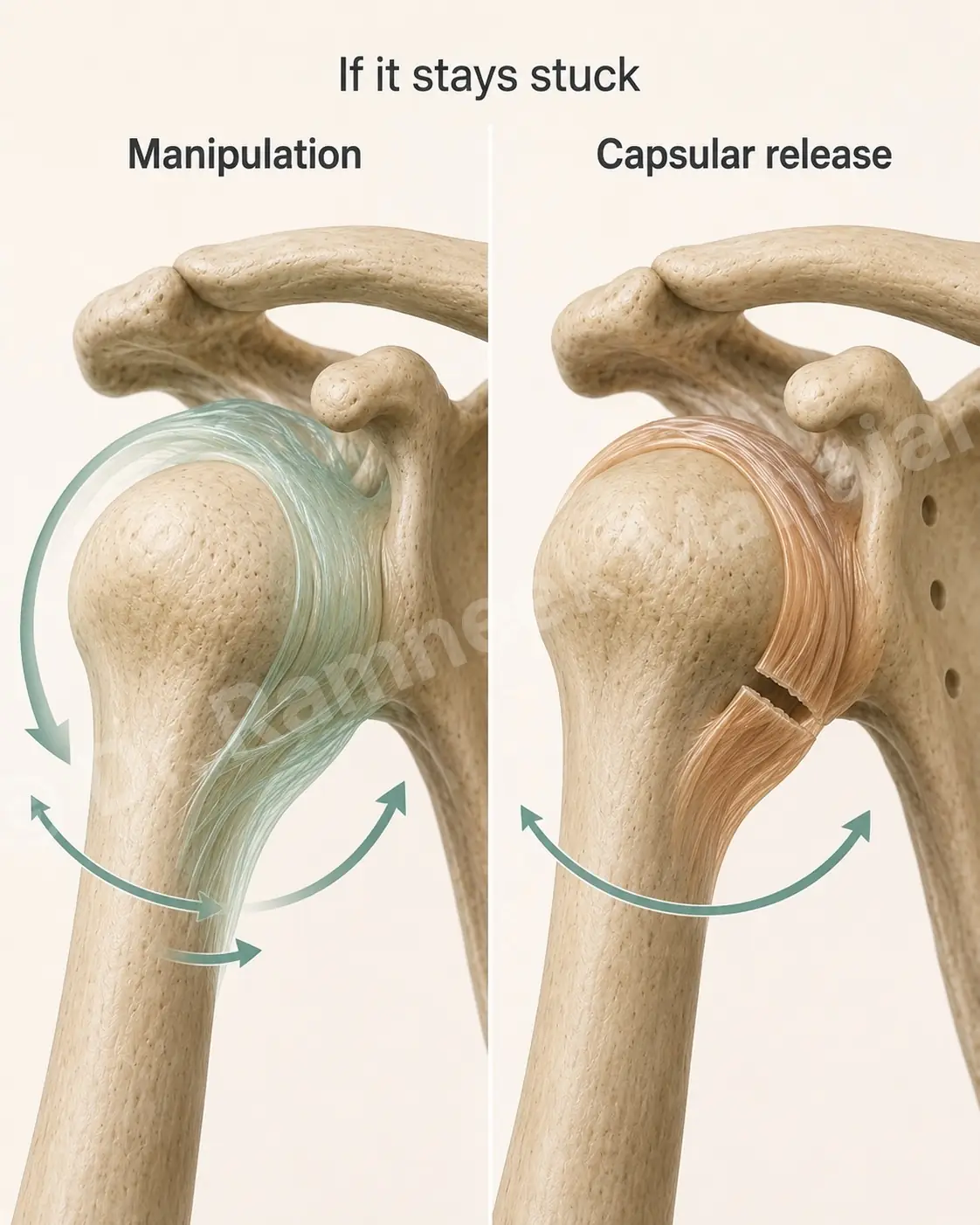
For the small number of frozen shoulders that stay stuck after months of the right treatment, two procedures can help. Both aim to free the tightened capsule so movement can return, and neither involves replacing the joint.
Manipulation under anaesthesia
Under a short general anaesthetic, the shoulder is gently moved through its range to release the tight capsule. It is reserved for shoulders that have not responded to conservative treatment, and it is avoided where the bone is thin (osteoporosis) or recently healed, because the force involved carries a small risk of a fracture or a dislocation.
Arthroscopic capsular release
This is keyhole surgery. Through small incisions, a fine telescope (an arthroscope) and instruments are used to release the thickened capsule directly. It is an option when manipulation is not suitable or has not worked, or for a shoulder that has been stuck for a long time. In the published evidence, 80 to 90 percent of patients improve after an arthroscopic release, and one long-term study found the movement gained was maintained or better at 7 years.
Will I be admitted?
Both are short procedures, usually day-care or a single overnight stay, and the real work begins straight afterwards: the physiotherapy that holds on to the freed-up movement matters as much as the procedure itself. The exact plan for your case will be discussed during your consultation.
Whether or not a procedure is ever involved, recovery runs on the same clock - so how long does it take?
04 How long does a frozen shoulder take to recover?
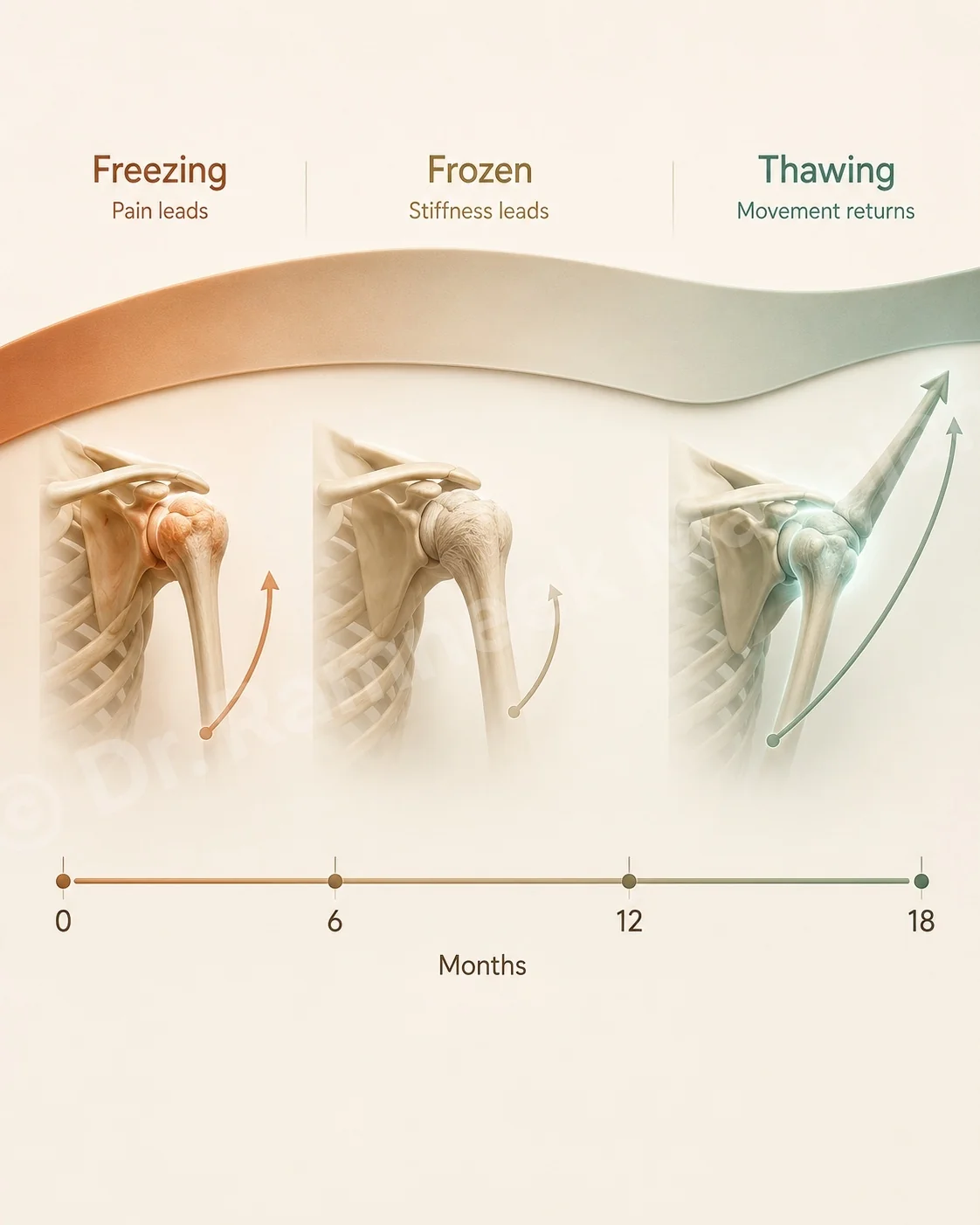
A frozen shoulder is slow. It is traditionally described as self-limiting over 12 to 18 months, moving through the freezing, frozen, and thawing phases - though many people are troubled for less time than that with active treatment, and a minority for longer.
The recovery arc, in plain terms
Freezing (roughly the first few months): pain leads. The priority is settling the pain and keeping as much gentle movement as the shoulder allows.
Frozen (often 4 to 12 months): stiffness dominates and the pain eases. This is where steady, daily range-of-motion work does the heavy lifting.
Thawing (weeks to months): movement returns gradually and the shoulder feels progressively more normal.
What actually speeds it up?
A daily home exercise programme. In comparison studies, a structured home stretching programme produced results equal to surgery for many people - the exercises are most of the treatment, not an add-on.
A steroid injection at the right time. Used in the painful early phase, an injection into the joint gives faster pain relief and better function than tablets alone, which makes the movement that drives recovery easier to do.
Starting early. People who seek care sooner tend to recover more quickly; long delays are linked to a slower course.
Managing diabetes. If you have diabetes, recovery tends to be slower and stiffer, so consistent therapy and good blood-sugar control matter more, not less.
The honest version of the timeline
There is no switch that turns a frozen shoulder off. What the right treatment buys you is less pain along the way and, often, a shorter road - not an instant fix.
The next question many people have: which doctor should look at this?
05 How do you choose a doctor for a frozen shoulder?
Choosing a doctor for a frozen shoulder comes down to four checks. The four below are what actually matter.
An assessment that confirms the diagnosis. Stiffness has more than one cause. The first job is to confirm it is a frozen shoulder and not a rotator cuff problem, arthritis, or pain referred from the neck - usually on clinical examination, with an X-ray or scan only to rule out other causes.
Honest counsel on whether you need anything beyond time and exercise. The right doctor will tell you plainly that most frozen shoulders settle without surgery, and will not push a procedure you are unlikely to need.
A clear, staged plan. Pain control, the right exercises, an injection if and when it helps, and a defined point to review progress - rather than open-ended waiting.
Access to a procedure if it is genuinely needed. In the small number of stubborn cases, the doctor should be able to offer manipulation or a keyhole release, or refer you on appropriately.
For context
Dr Ramneek is a senior orthopaedic surgeon at Max SMART Saket. A frozen shoulder is, in the large majority of cases, managed without surgery - the value of a good assessment is to confirm it is a frozen shoulder and not something else, and to guide the staged plan that restores movement. In the small number of cases that stay stuck despite months of the right treatment, the procedures that help - manipulation under anaesthesia, or a keyhole capsular release - are handled within the practice. The point of this page is not to push a procedure you almost certainly will not need.
Every patient is personally assessed by Dr Ramneek, even when seen by the team - this may add to OPD waiting times, but ensures the doctor's direct evaluation in your case.
A question that sits behind the decision for many people: what does this cost?
06 How much does frozen shoulder treatment cost?
The cost of treating a frozen shoulder depends on the path it takes. For most people the path is non-surgical - a course of physiotherapy over months, sometimes with a steroid injection - which is the lower-cost route and, for a frozen shoulder, usually the clinically right one too.
For the small number of shoulders that need a procedure, the cost depends on whether it is a manipulation or a keyhole release, the type of hospital, and the specific situation. There is no single figure that would be honest across these variables.
For a specific figure - what insurance covers, and the options for your situation - the team works through it at or after the first consultation. That is the right setting for those numbers, not a webpage.
Before deciding anything, an honest look at how well treatment works - and what can go wrong.
07 Does treatment work, and what can go wrong?
For most people, frozen shoulder treatment works - but it works slowly, and an honest page says so. Here is what the published evidence shows, in ranges, not promises.
What the evidence shows
Most recover. In long-term follow-up, about 94 percent of people regained normal function and movement - the great majority without surgery.
Pain can linger. Being completely pain-free was less universal: in the same evidence, roughly half of people were totally pain-free, with broadly similar figures across the untreated and non-surgical groups. For many, movement returns before the last of the discomfort does.
Injections help the painful phase. With the right timing and patient, a steroid injection brings significant improvement for around 70 percent of people - faster relief, not a cure.
Surgery helps the stubborn cases. When a frozen shoulder stays stuck, an arthroscopic capsular release improves 80 to 90 percent of patients, with gains that hold up in long-term follow-up.
Most frozen shoulders get better. Here is the honest version of the risks.
Diabetes changes the odds. Recovery tends to be slower and less complete - in one comparison, full range of motion returned in 71 percent of people with diabetes versus 90 percent of those without.
Manipulation carries a small risk. Because it applies force under anaesthetic, there is a small risk of a fracture or a dislocation, which is why it is avoided in thin or recently healed bone.
It can take longer than you want. Even with everything done right, a frozen shoulder can run 12 to 18 months or more. Treatment shortens and eases the road; it does not switch the condition off.
Results vary by person. Someone in their 50s without diabetes who keeps up the exercises will usually track differently from someone with long-standing diabetes whose shoulder has been stiff for a year. Both can do well; their recovery curves will not look identical. The numbers above are population averages, not individual forecasts.
One last, fair question: who is telling you all this?
Frequently Asked Questions (FAQs)
This guide was written and clinically reviewed by Dr Ramneek Mahajan - an orthopaedic surgeon at Max Smart Super Speciality Hospital, Saket, New Delhi. Alongside a high-volume knee and hip joint-replacement practice, he assesses and treats a broad range of orthopaedic conditions, including shoulder problems such as a frozen shoulder, and holds international fellowship training.
For the full credentials record - fellowships, society roles, publications - see the credentials page.
For press coverage and media features, see In the news.
Meet Your Surgeon
Can I safely wait?
The questions worth asking before you decide - and when waiting is the right call, and when it is not.
Before we meet
→
What should I expect, step by step?
The whole path, stage by stage - getting ready, the day itself, recovery, physio, life after.
Patient journey
→
Where did he train?
Fellowships, years in practice, and international experience
Credentials and experience
→






Powered by RAiZEN · Built in India, for the world · © 2026 RAiZEN
Go to RAiZEN website