Shoulder arthritis: what helps, and when to consider surgery
Last Reviewed:
11 August, 2026
~13 min read
Reviewed by:
Dr. Ramneek Mahajan
Dr. Mahajan is Chairman Orthopaedics, Joint Replacement & Chief Robotic Joint Replacement at Max Smart Super Speciality Hospital, Saket.
This guide is for someone with a shoulder that aches deep in the joint, grinds or catches, and has slowly lost movement - and who has been told it is arthritis, or suspects it. If you are weighing what eases it and whether surgery is worth considering, this guide frames that decision. It is written for the person living with it, not only the doctor treating it.
This guide is not for sudden shoulder pain after an injury, for weakness that points to a rotator cuff tear, or for a mainly stiff shoulder (a frozen shoulder) - each has its own guide on this site. It also does not replace an in-person assessment of your shoulder.
01 What is shoulder arthritis?
Shoulder arthritis is the wearing away of the smooth cartilage that lines the shoulder's ball-and-socket joint. As the cartilage thins, the bones move less smoothly against each other, which causes pain, grinding, and a gradual loss of movement. It is usually a slow, wear-related process, though it can also follow rheumatoid arthritis or an old injury.
How do you know it might be shoulder arthritis?
A deep ache inside the shoulder, worse with use and often worse at night
Grinding, clicking, or catching as the shoulder moves
A gradual loss of reach - behind the back, overhead, or out to the side
Stiffness that builds over months and years, not after a single injury
What kind of arthritis is it?
The common form is osteoarthritis - simple wear-and-tear of the cartilage over time. Rheumatoid arthritis (an inflammatory condition) and arthritis after an old fracture or dislocation can affect the shoulder too. An examination and an X-ray confirm the diagnosis and show how far the wear has gone, which is what shapes the plan.
What makes shoulder arthritis more likely?
Increasing age - the common wear-related form builds up over years.
An old fracture or dislocation, a shoulder that has dislocated repeatedly, or - less often - earlier surgery to stabilise it, any of which can leave the joint worn years later.
A long-standing, large rotator cuff tear, which over time can wear the joint (sometimes called cuff-tear arthropathy).
Loss of blood supply to the ball of the joint - avascular necrosis - linked to heavy or prolonged steroid use, heavy alcohol use, and sickle cell disease.
When to get a shoulder checked sooner rather than later
Most shoulder arthritis builds slowly and is not an emergency, but a few things are worth a prompt assessment because they point to something other than simple wear:
A shoulder that turns hot, swollen, and very painful over a day or two, especially with a fever or feeling unwell - a joint infection needs urgent care, not a wait.
Pain that is constant and worsening, disturbs sleep, and comes with unexplained weight loss or feeling generally unwell - worth a prompt check to rule out other causes.
A fairly sudden loss of active movement or real arm weakness, rather than the slow stiffness of wear - this points more to a rotator cuff problem than to arthritis itself.
There is usually no rush to operate. But a very worn shoulder left painful and unused for a long time can slowly lose bone from the socket and strength in the rotator cuff, which can make a later replacement more complex - one reason an occasional review is worth keeping up, even in the years when surgery is not needed.
Once you know it is arthritis, the question most people ask is whether it needs surgery.

02 Do you need surgery for shoulder arthritis?
For a long time, no. Shoulder arthritis is usually managed without surgery for years - the aim early on is to control pain and keep the shoulder moving, not to operate. Surgery becomes a real conversation only when the wear is advanced and the pain is limiting daily life despite proper non-surgical care.
Path | What it is | When it works | What it asks of you |
|---|---|---|---|
Activity change and pain control | Adjusting how you load the shoulder, plus anti-inflammatory or simple pain medication and ice | Early to moderate arthritis with intermittent pain | Patience and gradual adjustments |
Physiotherapy | Exercises to keep range of movement, balance the muscles, and reduce pain | Most patients benefit at every stage | Consistent home and supervised work |
Injections | A corticosteroid injection for flare-ups; hyaluronic acid for longer-lasting lubrication in selected cases | When pain is significant but not constant; relief lasts weeks to months | Periodic clinic visits; relief is temporary |
Surgery | An arthroscopic clean-up, or a shoulder replacement for advanced wear | When the options above have stopped giving meaningful relief and the pain limits daily life | A recovery measured in months |
So when does surgery become the right step?
When the non-surgical measures have genuinely run out - when the pain disturbs sleep most nights, when reaching for everyday tasks has become hard, and when an X-ray confirms advanced wear. Surgery is the answer that comes after the others, not the one that comes first. A good assessment tells you which stage you are at, and what the realistic next step is - which, for a long time, is usually not surgery.
If the wear is advanced enough that surgery is on the table, here are the actual options.
03 What are the surgical options for shoulder arthritis?

There are two broad surgical routes for shoulder arthritis, and which one fits depends on how far the wear has gone and the state of the rotator cuff.
An arthroscopic clean-up (joint-preserving)
For selected shoulders - usually earlier arthritis, or a recent flare in a joint not yet ready for replacement - keyhole surgery can be used to clean out the joint, remove loose fragments, and tidy worn tissue. It is not a permanent fix and it does not reverse the arthritis, but it can ease pain for a period. In the published evidence, around 80 percent report good early results, and about 76 percent still have pain relief at roughly 34 months.
A shoulder replacement (for advanced wear)
When the joint is worn out, the damaged surfaces can be replaced with implants - a shoulder replacement. There are a few types: a total shoulder replacement is the usual choice when the rotator cuff is intact (the common situation in osteoarthritis); a reverse total shoulder replacement is used when the rotator cuff is not working; and a partial replacement is used in selected cases. A shoulder replacement is a distinct area of surgery, so part of the value of an assessment is making sure that, if you need one, you are guided to the right surgical care for it.
Whichever route is taken, recovery runs over months - so what does it look like?
04 What does recovery from shoulder arthritis treatment look like?
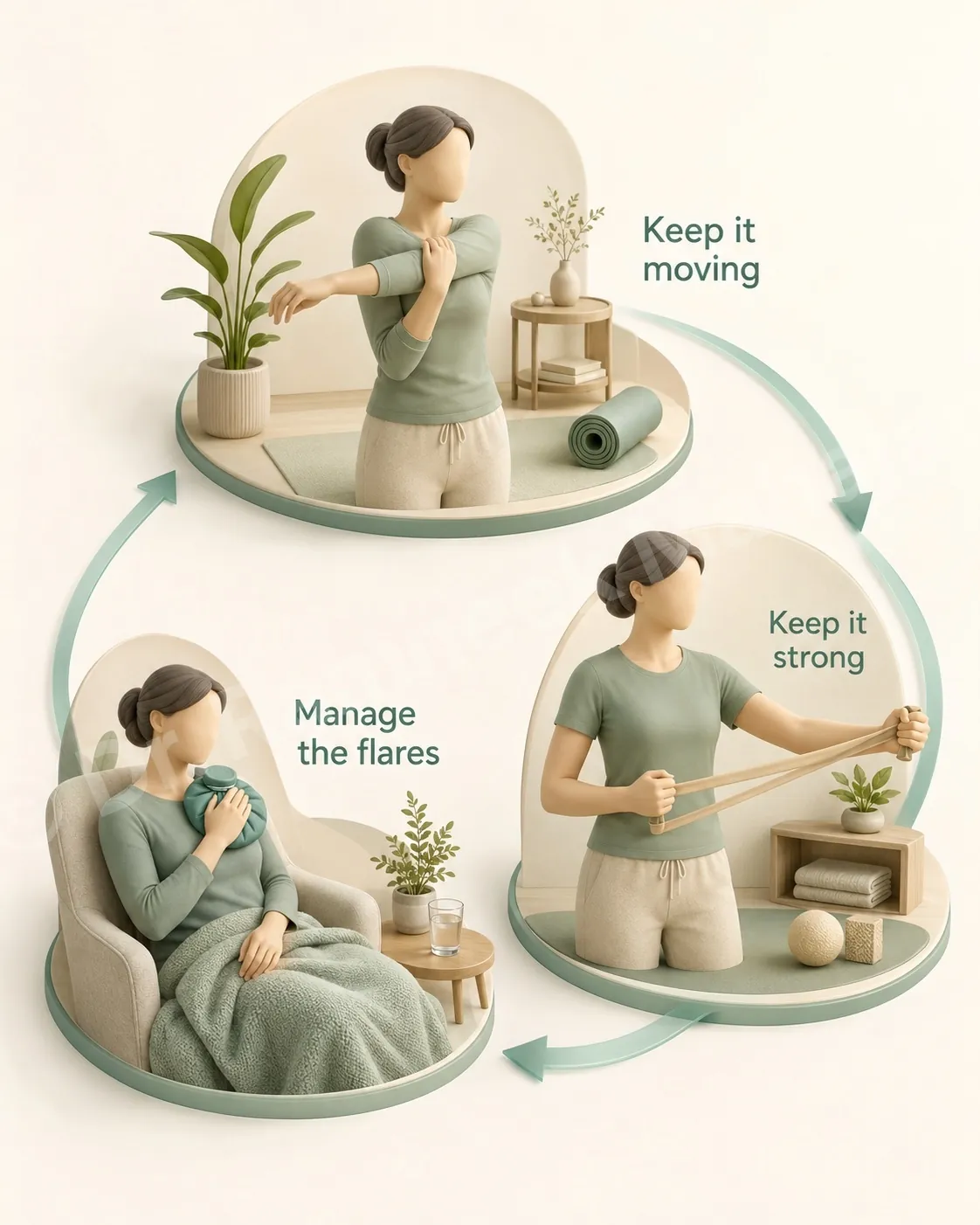
For most people, "recovery" from shoulder arthritis is really long-term management rather than a single event - the cartilage does not grow back, so the work is keeping the shoulder comfortable and moving for as long as possible.
Recovering on the non-surgical path
Physiotherapy is ongoing rather than a fixed course - the gains hold while the work continues.
Injections give relief for weeks to months and can be repeated within sensible limits.
Pacing daily activity protects the joint and reduces flare-ups.
Recovering after surgery
After an arthroscopic clean-up, recovery is faster, with physiotherapy over weeks - but the relief is a window, not a cure.
After a shoulder replacement, recovery is measured in months, with a structured physiotherapy programme to rebuild movement and strength. The detail is set by the surgeon doing the replacement.
The honest version: non-surgical care manages the condition, an arthroscopic clean-up buys a period of relief, and a replacement is the durable answer for an end-stage joint. Each step is matched to how worn the joint actually is.
The next question many people have: which doctor should look at this?
05 How do you choose a doctor for shoulder arthritis?
Choosing a doctor for shoulder arthritis comes down to four checks. The four below are what actually matter.
An assessment that grades the wear honestly. The first job is to confirm it is arthritis, see how advanced it is on an X-ray, and check the rotator cuff - because that shapes every later choice.
Honest counsel on what to try first. The right doctor will be clear that shoulder arthritis is managed without surgery for a long time, and will not move to an operation before the simpler measures have had a fair run.
A clear, staged plan. Activity change, physiotherapy, injections when they help, and a defined point to review - rather than open-ended waiting or a rushed operation.
The right onward path if surgery is needed. If the joint is worn enough to need a replacement, the assessment should make sure you are guided to the right surgical care for it.
For context
Dr Ramneek is a senior orthopaedic surgeon at Max SMART Saket. Shoulder arthritis is, for a long time, managed without surgery, and the value of an assessment is to confirm the diagnosis, grade the wear, and set the right plan. Where a joint-preserving option such as an arthroscopic clean-up fits, that is handled within the practice. If the arthritis is advanced enough to need a shoulder replacement, the assessment makes sure you are guided to the right surgical care for it. The point of this page is not to push an operation - it is to help you understand the condition and the choices.
Every patient is personally assessed by Dr Ramneek, even when seen by the team - this may add to OPD waiting times, but ensures the doctor's direct evaluation in your case.
After the path is clear, a question every patient has: what does this cost?
06 How much does shoulder arthritis treatment cost?
The cost of treating shoulder arthritis depends entirely on the path. Non-surgical care - physiotherapy and the occasional injection - is the lower-cost route and, for years, usually the clinically right one. An arthroscopic clean-up and a shoulder replacement are very different procedures with very different costs, which also depend on the implant and the type of hospital.
There is no single figure that would be honest across these variables. For a specific figure - what insurance covers, and the options for your situation - the team works through it at or after the first consultation. That is the right setting for those numbers, not a webpage.
Before deciding anything, an honest look at how well treatment works - and what can go wrong.
07 Does treatment work, and what can go wrong?
Treatment for shoulder arthritis works, but what "works" means changes with the stage - and an honest page is clear about that. Here is what the published evidence shows, in ranges, not promises.
What the evidence shows
Non-surgical care manages, it does not reverse. Physiotherapy, activity change, and injections control symptoms and can do so for years, but they do not regrow cartilage.
An arthroscopic clean-up buys time. Around 80 percent report good early results and about 76 percent still have relief at roughly 34 months - useful, but a window rather than a cure.
A shoulder replacement is reliable for an end-stage joint. For osteoarthritis, around 89 percent of people get complete or near-complete pain relief, and the implant is durable - about 85 percent are still in place at 20 years, with revision rates under 10 percent. Good results are reported in 65 to 95 percent of patients.
Treatment helps most. Here is the honest version of the risks.
A replacement is major surgery. As with any large joint operation, there are real risks; the overall risk to life around the operation is small, at about 1 percent, but it is not zero, and careful medical preparation matters.
The type of replacement matters. A partial (hemi) replacement alone tends to do less well over the long term for arthritis - in one long-term report only about 25 percent were satisfied at 17 years - which is why a full replacement is usually preferred when the shoulder is suitable.
Age is not an automatic barrier. Even in carefully selected patients over 80, around 80 percent have an excellent or satisfactory result at about 5.5 years.
Results vary by person and by how worn the joint is. Someone with early arthritis managed with physiotherapy is on a very different path from someone with an end-stage joint considering a replacement. The numbers above are population averages, not individual forecasts.
One last, fair question: who is telling you all this?
Frequently Asked Questions (FAQs)
This guide was written and clinically reviewed by Dr Ramneek Mahajan - an orthopaedic surgeon at Max Smart Super Speciality Hospital, Saket, New Delhi. Alongside a high-volume knee and hip joint-replacement practice, he assesses and treats a broad range of orthopaedic conditions, including shoulder arthritis, and holds international fellowship training.
For the full credentials record - fellowships, society roles, publications - see the credentials page.
For press coverage and media features, see In the news.
Meet Your Surgeon
Can I safely wait?
The questions worth asking before you decide - and when waiting is the right call, and when it is not.
Before we meet
→
What should I expect, step by step?
The whole path, stage by stage - getting ready, the day itself, recovery, physio, life after.
Patient journey
→
Where did he train?
Fellowships, years in practice, and international experience
Credentials and experience
→






Powered by RAiZEN · Built in India, for the world · © 2026 RAiZEN
Go to RAiZEN website