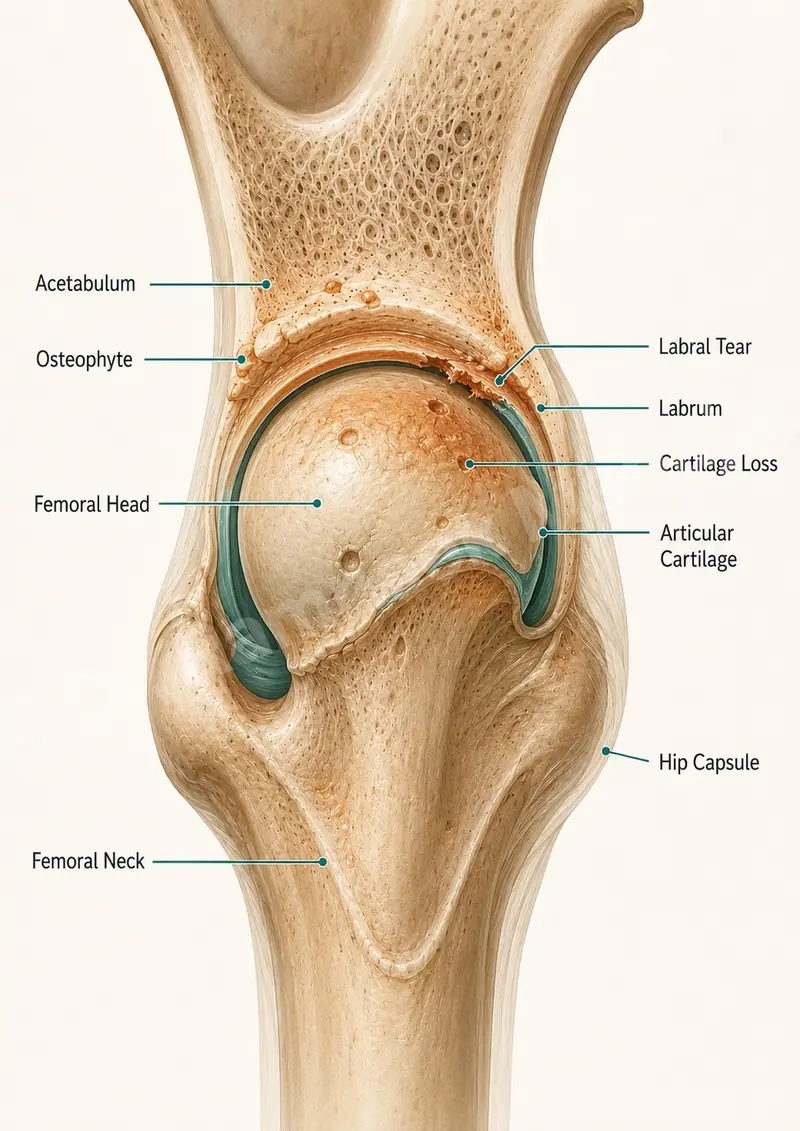
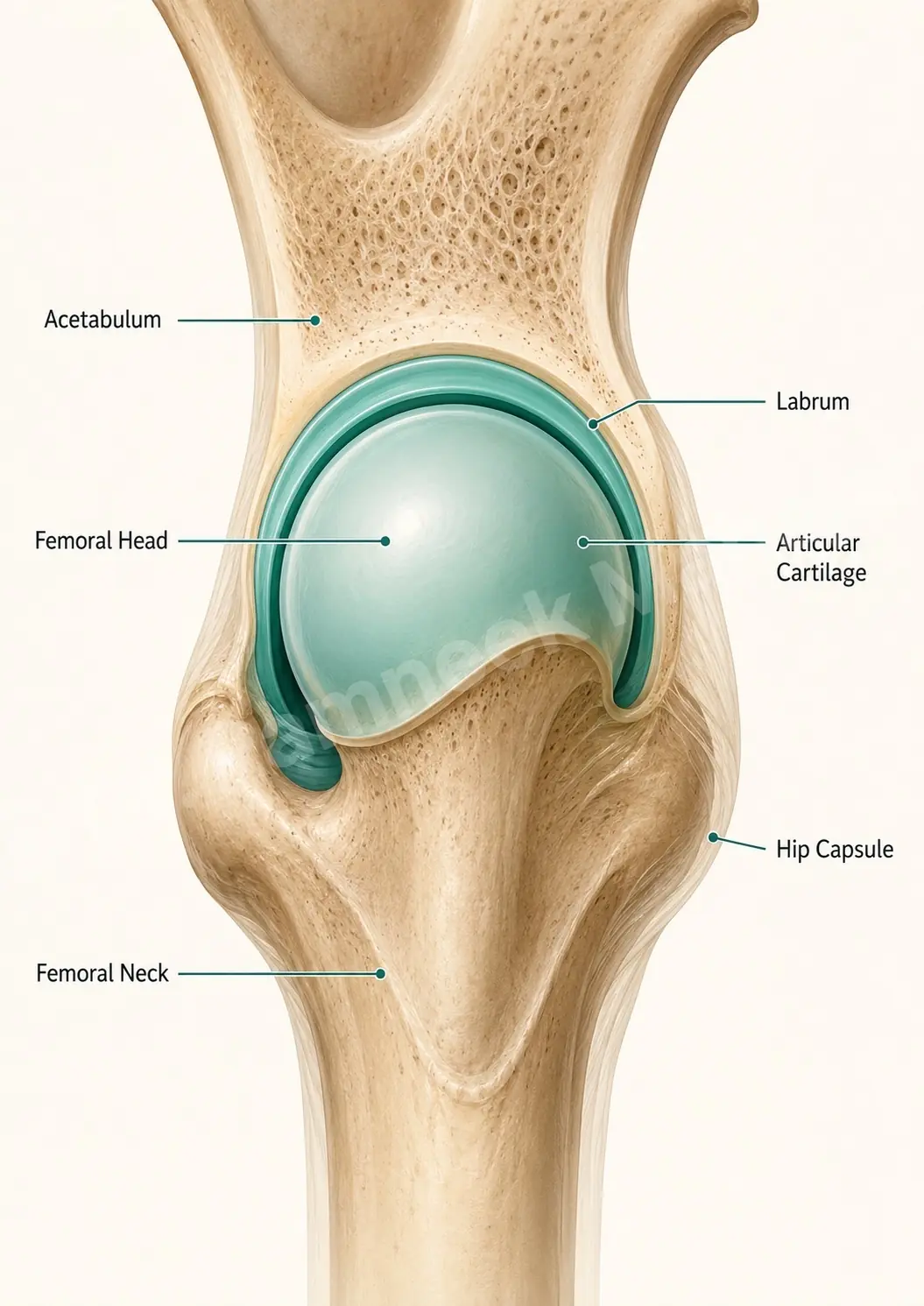


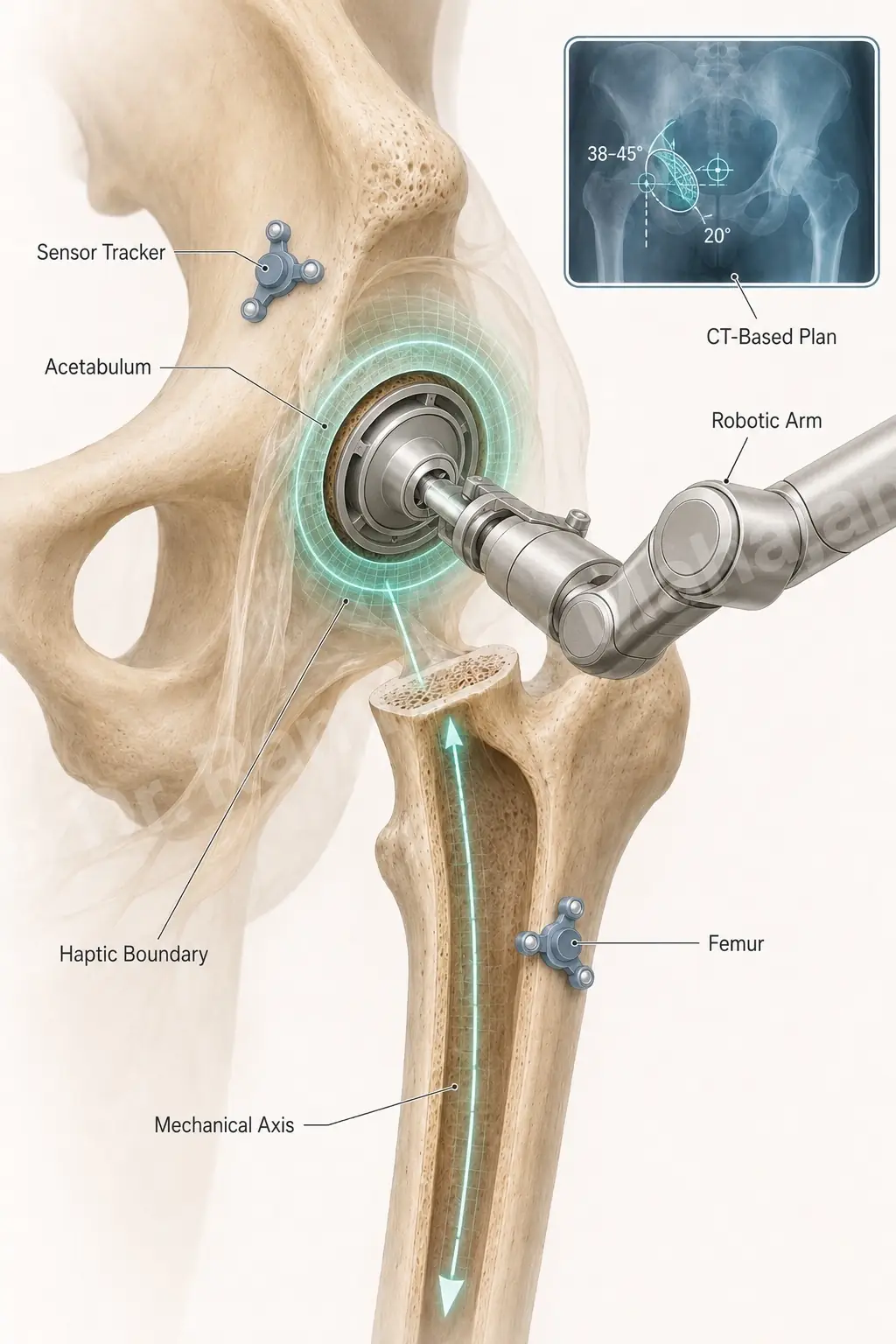

Yes, robotic hip replacement is often the right choice for avascular necrosis, particularly in younger patients where implant longevity matters most. AVN destroys the ball of the hip joint and the surrounding bone can be irregular, which makes precise component placement harder with conventional instrumentation. The CT-based 3D plan accounts for the irregular anatomy before surgery, and the robotic arm holds the cup within a few degrees of the plan. Many of Dr Ramneek AVN patients are in their thirties and forties; precision placement gives the implants the best chance of lasting decades. We discuss the approach choice - posterior, anterolateral, or direct anterior - based on your specific anatomy.
Robotic Hip Replacement
A CT-based 3D plan and the Mako robotic arm place your new hip within a few degrees of the plan - and let us choose the approach for your hip.
Max SMART Saket
Mahajan's GK-1
Robotic Hip Replacement, also called Mako-assisted Total Hip Replacement or Robo-assisted THA, is one of the most advanced technologies available for replacing a worn-out, damaged, or deformed hip joint with significantly high accuracy and placing a new artificial joint - a surgeon-assistance and predictable tool to give the best outcome similar to conventional hip replacement. What changes is the planning, the already-decided framework, and the precision of placement: a CT scan of your hip is built into a 3D model before surgery, and a robotic arm assists the surgeon to position the cup and stem within the exact degrees of the plan chalked out for your hip joint according to your hip anatomy.
Dr Ramneek's Joint team has expertise in it, and we offer this to you when medicines, physiotherapy, weight management, and walking aids are no longer working for treating your hip disease. In Robotic-assisted THR, precision (accuracy) on cup position, hip centre of rotation, absolute leg length, and offset is worth the additional planning step. Most of our patients walk within a few hours to 1 day of surgery, go home by Day 1 or 2, and are back to routine activity within one month - the timeline is highly tailored by Dr Ramneek's team for your hip anatomy, your age, and your overall health status. The patient-specific protocol of recovery is discussed personally with every patient individually by Dr Ramneek himself.
Same hip. See why precision changes the outcome.
Who Robotic Hip Replacement is for
Robotic Hip Replacement is for adults whose hip pain stops them from doing what they want to do - walking comfortably, climbing stairs, sleeping through the night, rising from a chair, putting on shoes and socks, and sitting cross-legged.
The decision to replace the hip rests on three things together:
How much pain is limiting your daily life,
How much function has been lost, and
Whether enough conservative treatment - medicines, physiotherapy, weight loss - has been tried and stopped helping.
If all three line up, surgery becomes the right tool to consider. Within surgery, four situations make robotic-assistance especially worthwhile:
Complex hip anatomy - hip dysplasia, post-fracture deformity, prior hip surgery, or a high hip center, where a millimetre matters,
Patients for whom leg length matters most - athletes, drivers, those with a visible pre-existing discrepancy,
Younger patients where implant longevity is the priority, since precision placement reduces wear,
Patients on the precision-priority side of the decision, who want the additional pre-operative planning step.
Bring your X-rays or MRI, a list of medicines you have tried, and a sense of which daily activities you have stopped doing - we discuss your specific case in consultation before any recommendation.
Real outcomes from real patients
These videos are published on Max Healthcare's official YouTube channel. Each patient's experience is unique - outcomes depend on individual health, disease characteristics, and clinical factors. These accounts are not a guarantee of results.
Meet Your Surgeon
How long is the hospital stay?
Most hip replacement patients stay 1 or 2 nights at our centre. Many are home within 24-48 hours of surgery through our Enhanced Recovery Pathway. The robotic-assistance step does not change the hospital stay.
Day 0 (surgery day)
You arrive in the morning, the CT-based plan and registration happen in the operating room, surgery follows, and you spend the rest of the day in post-operative observation - pain monitoring, vital signs, IV fluids, and gentle limb positioning. Mobilisation begins after 2 hours of recovery if anaesthesia and vitals allow - bedside sitting, chair sitting, commode use, posture changes. Sips of water and small portions of food typically restart by evening.
Day 1 (next morning)
Walking with a frame, a structured physiotherapy briefing covering the home exercises and the Rule of 20 protocol, and discharge if vitals and mobilisation are stable. Patients having a single hip replaced typically go home this day. Patients having both hips done in the same admission typically go home the day after.
Going home
Discharge readiness comes down to three checks - pain controlled on oral medication, vitals stable, and confident walking with a frame for short indoor distances. Every patient goes home with 7 to 8 contact numbers - covering doctors, physiotherapist, dieticians, emergency services, and administrative staff - so nobody feels alone in the recovery.
What does recovery actually look like
Every patient goes home with 7 to 8 contact numbers - covering doctors, physiotherapist, dieticians, emergency services, and administrative staff. Nobody feels alone in the recovery.
Recovery has milestones at Day 1, Week 1, and Month 1. Many patients tell us the precision of the robotic plan translates into less early pain and more confident first steps.
Day 1: most patients are mobilised with a walking aid within 2 hours of surgery, with bedside sitting, commode use, and posture changes the same day.
Week 1: most begin walking with a single cane at home. Short walks outside are encouraged. Daily-living chores resume - making your own tea, dining with family at the table, sitting on the balcony, watching TV, reading. Some patients comfortable enough briefly return to office for a few hours.
Month 1: routine social activities - cycling, walks in the park, public gatherings. Target is approximately 4,000 steps a day, individualised by patient comfort.
The Rule of 20
20 minutes of activity, 20 minutes of icing, 20 minutes of rest is our team's protocol, followed through waking hours, in hospital and at home. Diet matters too: small frequent meals, protein-rich, adequate hydration, individualised with our dieticians.
Hip cautions in the first 6 weeks. Avoid crossing your legs, do not bend the new hip past 90 degrees with certain approaches, and use the elevated toilet seat we provide. These precautions reduce the rare risk of dislocation while the joint capsule heals.
How you know it's the right time
The signal is functional, not just radiological. You may be a candidate for hip replacement - robotic or conventional - when the pain has changed what you do.
Specific things we listen for:
Pain in the groin or front of the thigh that worsens with weight-bearing or with putting on socks (the classic hip-joint pattern, distinct from back pain that radiates down the leg),
Stiffness on getting out of bed in the morning that takes longer to ease each year,
Daily activities you have quietly stopped doing - long walks, stairs, sitting cross-legged, putting on shoes,
Sleep interrupted by hip pain three or more nights a week.
Then we look at how much conservative treatment has been tried - medicines, physiotherapy, weight loss, injections. If all of these have been tried in good faith and stopped helping, surgery moves from "maybe later" to "the right tool now". The choice between robotic and conventional comes after that decision, not before.
Your options for hip replacement
Once your hip pain has crossed the line where conservative measures stop helping, there are usually four paths in front of you:
Continue conservative care - medicines, physiotherapy, weight loss, walking aids, sometimes injections - if your pain is still partly controlled and you are not ready for surgery,
Joint-preserving surgery for select younger patients with very early or mechanical hip problems - osteotomy or hip arthroscopy - where the anatomy and the cause of pain allow it,
Conventional Total Hip Replacement, performed without a robotic arm, which in skilled hands produces excellent long-term results and is the route most patients in India still take,
Robotic-assisted Hip Replacement, where the surgeon uses a CT-based 3D plan and a robotic arm to place the cup and stem within a few degrees of the plan.
Within robotic-assistance there is a second choice - which approach. With Mako robotics we can reach the hip from the front (direct anterior), from the side (anterolateral), or from the back (posterior). Direct anterior and anterolateral are our default approaches; posterior is reserved for hips where prior hardware or a defect must be reached from the back. The approach is chosen for the patient, not for the surgeon - based on your anatomy, your past surgeries, the implants planned, and your recovery profile. Some patients heal faster with one approach than another, and the plan reflects that. Which approach suits you is decided after evaluation - the recommendation comes after examining you, not before.
Conventional and robotic both reliably relieve pain and restore function for most patients. Robotic-assistance adds precision in cup position, leg length, and offset, at the cost of an additional CT scan and pre-operative planning step. We discuss which one fits your hip, your goals, and your timeline before any recommendation is locked in.
Inside the procedure
Same hip. See why precision changes the outcome.
Robotic hip replacement happens in five steps. Most of the personalisation comes from the CT scan you have before surgery.
Pre-operative planning: a CT scan of your hip is uploaded to a software lab where a 3D model of your pelvis and femur is built. On that model we virtually place the cup and the stem, fine-tune the size, the orientation, and the planned leg length, until the reconstruction matches your anatomy and your contralateral hip. This plan is reviewed and signed off before the day of surgery.
Step 1 - The approach. Under anaesthesia, the surgeon makes the incision through one of three approaches - posterior, anterolateral, or direct anterior - chosen for your hip.
Step 2 - Exposure and registration. The hip joint is exposed and the worn femoral head is removed. The surgeon touches 20 anatomical points - 16 on the inner walls of the acetabulum and 4 around the cotyloid notch - which the software uses to align your real anatomy with the 3D plan.
Step 3 - Robotic-arm-controlled reaming and cup placement (the differentiator). The robotic arm now constrains the reamer and the cup impactor to the planned position. If reaming exceeds the planned depth, the arm stops. The cup is impacted within a haptic tunnel that holds it to within a few degrees of the planned inclination and anteversion. The surgeon's hand stays in control throughout - the arm is a guide, not a substitute.
Step 4 - Femoral preparation. The femur is broached to the planned size; trial neck cuts are checked against the plan.
Step 5 - Reduction check and final implants. A trial of the new joint is performed, leg length and offset are verified against your other side, the final implants are placed, and the wound is closed with care for the posterior capsule if a posterior approach was used.
Technology and implants
The technology is the Mako Robotic-Arm Assisted Surgery System. It is the only robotic system currently approved internationally for hip, total knee, and partial knee replacement. The system has been in clinical use since 2005 and has been refined across hundreds of thousands of cases worldwide.
The plan is patient-specific. Before surgery, a CT scan of your hip becomes a 3D model. On that model we virtually place the cup and the stem, size each component, and check the reconstruction against your other hip for leg length and offset. The plan is signed off before you reach the operating room, so what happens during surgery is the execution of a decision already made.
The arm is a guide, not a substitute. The robotic arm holds the reamer and the cup impactor within a haptic tunnel defined by the plan. The surgeon's hand drives the cut; the arm prevents it from straying outside the plan. If the surgeon tries to go beyond the planned depth or angle, the arm stops. No part of the operation is automated - the precision comes from constraint, not from removal of the surgeon.
The 360-degree advantage. Mako lets us approach the hip from the back (posterior), from the side (anterolateral), or from the front (direct anterior). The approach is chosen for the patient, not for the surgeon. Dr Ramneek is one of the few Indian surgeons collaborating internationally on the direct anterior approach with Mako robotics.
The implants - the ball-and-socket trio. A hip replacement has three parts that together recreate a natural-feeling joint:
The femoral stem - a titanium implant that fits into the upper thigh bone, available in multiple sizes,
The femoral head - a metal or ceramic ball that sits on top of the stem, available in several sizes so leg length can be fine-tuned during surgery,
The acetabular cup - a titanium shell fixed into the socket of the pelvis, lined with polyethylene or ceramic so the ball can move smoothly inside it.
Modern hip implants last 20-25 years or more for most patients. Our team has performed over 2,000 robotic procedures across hip, knee, and partial knee combined.
Risks we discuss
Every surgery carries risk. Hip replacement is one of the most reliable orthopaedic operations - studies show very high satisfaction and very long-lasting implants - but we discuss every meaningful risk with you before surgery, with the numbers that apply to your hip, so the decision is made with eyes open. Robotic-assistance reduces some of these risks; it cannot eliminate any of them.
Risks that apply to any major surgery
Bleeding. Typical blood loss is small with robotic placement and a careful approach; transfusion is rarely needed. We check your haemoglobin before and after surgery and have blood available if it becomes necessary,
Infection. We screen extensively before surgery for dental, urinary, and skin sources, use antibiotics around the operation, and follow strict operating-room protocols. Deep infection rates after hip replacement are typically under 1% in our team's practice. Most superficial infections clear with a short course of antibiotics,
Blood clots in the leg or lungs. Deep vein thrombosis and pulmonary embolism are uncommon but can be serious. We use preventive medication, mechanical compression devices, and early mobilisation to keep this risk low,
Anaesthesia-related risks. The anaesthesia team reviews these with you separately and selects the technique - usually a spinal anaesthetic - that suits your overall health.
Risks specific to hip replacement
Dislocation - the artificial ball slipping out of the socket, most often in the first 6 weeks while the soft-tissue capsule is healing. The risk is typically under 1% when the cup is placed accurately and the posterior capsule is repaired. The first 6 weeks of hip precautions exist for this reason. Precision component placement and the choice of approach both reduce this risk further,
Leg-length discrepancy - your new leg feeling longer or shorter than the other. The robotic plan and intraoperative measurement reduce this; small differences sometimes remain and most people stop noticing them within a few months. We work with you on a small shoe lift if it persists,
Nerve irritation or injury - most often a tingling or numbness on the front of the thigh from a small nerve called the lateral femoral cutaneous nerve, especially with the direct anterior approach. It is usually temporary and resolves over weeks to months. More serious sciatic and femoral nerve injuries are rare, tracked carefully, and discussed individually before surgery if your anatomy or surgical history makes them more likely,
Periprosthetic fracture - a small crack in the thigh bone during stem placement, more common in older or osteoporotic bone. We assess your bone quality before surgery, plan stem sizing accordingly, and manage this intraoperatively when it happens,
Wear over time. The liner slowly wears with daily use. Modern bearings last 20-25 years or more for most patients; younger or very active patients may eventually need a revision procedure to exchange the worn parts.
We walk you through each of these in your pre-operative consultation - in plain language, with time for your questions before any decision is locked in.
Frequently Asked Questions (FAQs)
Can I safely wait?
The questions worth asking before you decide - and when waiting is the right call, and when it is not.
Before we meet
→
What should I expect, step by step?
The whole path, stage by stage - getting ready, the day itself, recovery, physio, life after.
Patient journey
→
Where did he train?
Fellowships, years in practice, and international experience
Credentials and experience
→






Powered by RAiZEN · Built in India, for the world · © 2026 RAiZEN
Go to RAiZEN website