

Yes. A partial knee replacement can be revised to a total knee replacement if the other compartments later develop arthritis or the implant wears. The revision is more straightforward than a failed total knee revision because the bone has been preserved during the partial procedure. We follow you long-term so wear is caught early and the conversion, if needed, is planned rather than urgent.
Revision Total Knee Replacement
Revision knee replacement for loose, infected, or unstable implants at Max SMART Saket. 12,000+ knees done across primary and revision. 23+ years' experience.
Max SMART Saket
Mahajan's GK-1
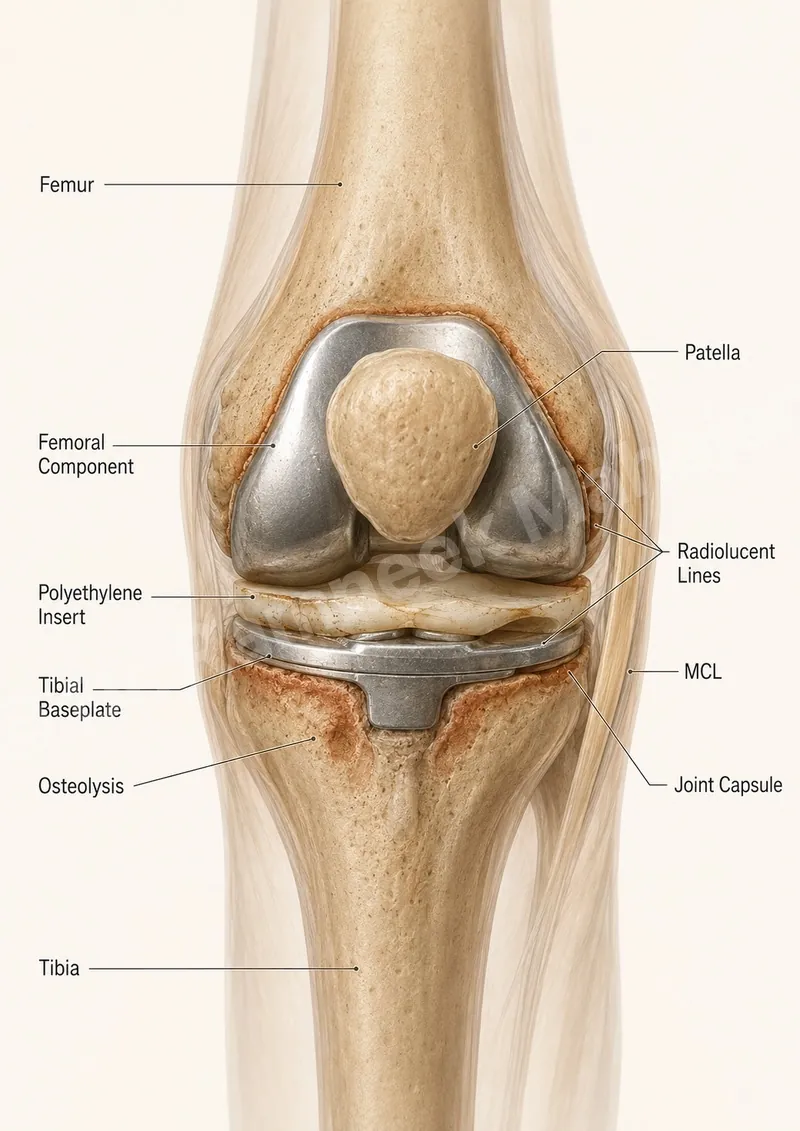
Revision total knee replacement is performed for patients who already have an artificial knee in place and need further surgery because the existing implant is no longer functioning as it should.
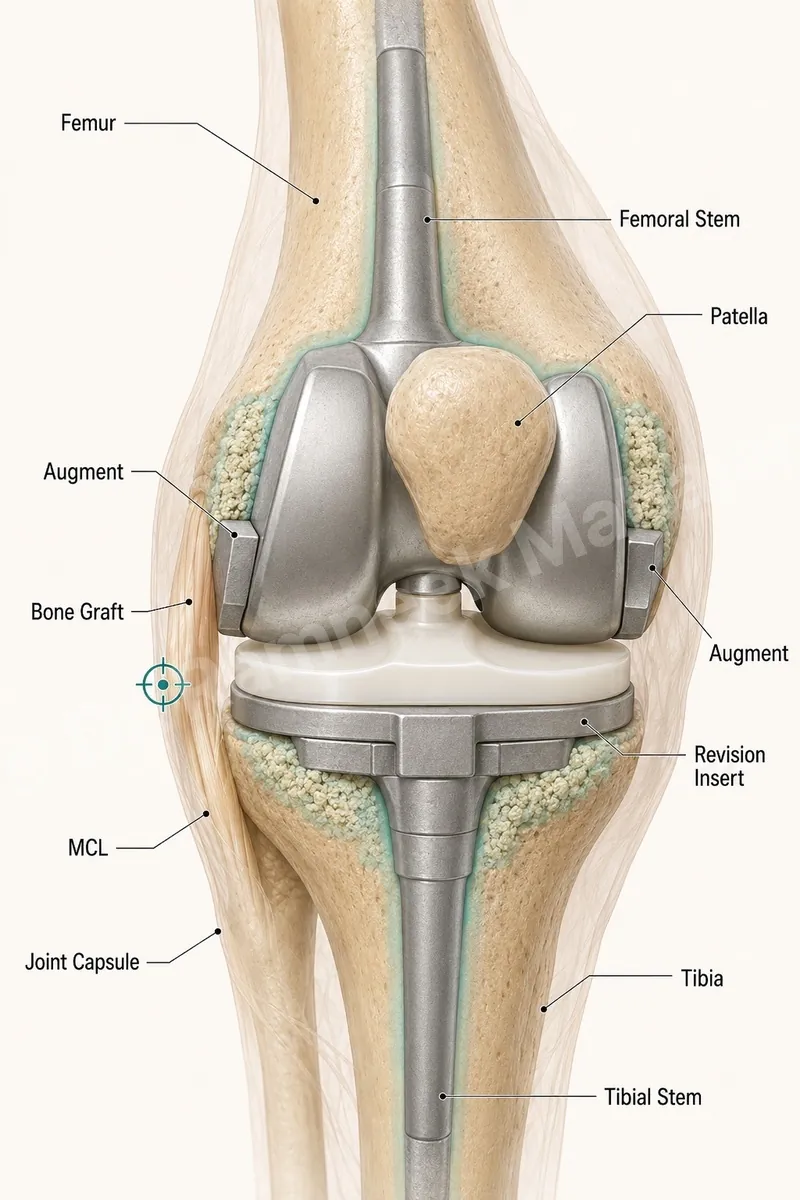
This may be due to loosening, wear, instability, infection, fracture around the implant, stiffness, or ongoing pain with loss of function. The existing components are carefully removed, the knee is reassessed, and reconstruction is performed using the most appropriate revision implants - sometimes requiring specialised implants with improved levels of stability, longer stems, and techniques to manage bone loss using cones, sleeves, or augments.
Most revisions are for non-infective (aseptic) problems and can be completed in a single planned operation. If infection is present, treatment is more complex and often requires a staged approach with implant removal, infection clearance, temporary antibiotic spacer placement, and later definitive reconstruction.
Revision knee replacement is a more complex procedure than a primary surgery, requiring detailed planning with blood tests, radiological scans, and tailored rehabilitation.
Same knee. See what revision rebuilds.
Who Revision Knee Replacement is for
Revision Total Knee Replacement is for adults whose previous knee replacement is no longer functioning as it should.
If any of these signs have developed after your first knee surgery, this page is for you:
Pain in the operated knee returning after a previously pain-free period.
Warmth, swelling, or redness around the knee, especially if associated with fever.
Instability when walking or climbing stairs.
The knee giving way or a feeling that it cannot be trusted.
A clunk, click, or grinding sensation during normal movement.
Reduced range of motion compared to the early recovery period after your original surgery.
The decision rarely rests on a single test. We look at three things together:
How much pain or function has been lost since your first replacement.
What imaging and laboratory tests show about the implant or surrounding bone.
Whether infection has been confirmed or ruled out.
If those three align:
New symptoms
Objective evidence on imaging or tests
Failure of appropriate conservative measures
Then the revision surgery becomes the right option to consider. If any part remains unclear, we investigate that further first. Bring your earlier operative notes, previous and current X-rays, and any laboratory reports - we discuss your specific case in consultation before making any recommendation.
Real outcomes from real patients
These videos are published on Max Healthcare's official YouTube channel. Each patient's experience is unique - outcomes depend on individual health, disease characteristics, and clinical factors. These accounts are not a guarantee of results.
Meet Your Surgeon
How long is the hospital stay?
Hospital stay for a revision total knee replacement is usually 3 to 5 nights for a straightforward aseptic revision, longer than the 24 to 48 hours typical for a first-time knee replacement. The extra time reflects the larger operation, more careful pain management in the first 48 hours, and the time we take to confirm safe walking before you go home.
Surgery itself usually takes 2 to 3 hours because we need time to remove the existing implants carefully, address any bone loss, and place the new components precisely. We use spinal anaesthesia where possible, supplemented with local nerve blocks so you stay comfortable through and after the operation.
Most patients stand and take their first supervised steps with a walker the evening of surgery or the next morning. Physiotherapy starts on Day 1 and continues twice daily during the stay. By the time you go home you can walk with a walker or sticks, manage stairs with one rail, and handle basic self-care.
The Rule of 20
20 minutes of activity, 20 minutes of icing, 20 minutes of rest - continues through your waking hours into the early weeks at home.
If your revision is being done in two stages for infection, the first stay is typically a week or longer while we remove the infected implant and place the temporary spacer and start antibiotic treatment; you go home with treatment continuing for several weeks; the second stay is again 3 to 5 nights when we put in the new knee.

What does recovery actually look like?
Every patient goes home with 7 to 8 contact numbers - covering doctors, physiotherapist, dieticians, emergency services, and administrative staff. Nobody feels alone in the recovery.

Recovery from revision knee replacement takes longer than recovery from a first-time knee replacement, often 2 to 3 times longer to reach the same milestones. We tell you this upfront so the timeline does not feel like something has gone wrong.
In Week 1, you walk inside the house with a walker, manage basic self-care, and do the gentle exercises the physiotherapist prescribes.
By Week 2, stitches are out, swelling is settling, and most patients are using a single stick around the house.
Between Weeks 6 and 8 you transition off walking aids if balance and strength allow. Driving usually returns at 8 to 10 weeks once you can brake safely.
Office work, light household activity, and longer walks come back in Months 2 and 3.
Stamina and confidence on stairs continue to improve through Months 4 to 6.
Return to fuller activity like brisk walking, gym work tailored to your knee, and travel happens through the second half of the first year. If your revision was done in two stages for infection, the whole recovery is longer because of the gap between operations.
We see you back at six weeks, three months, six months, and one year, and adjust your physiotherapy plan as you progress. Recovery is steady but not linear; some days feel better than others, which is normal.
Signs your knee replacement may need a closer look

There are six signals that tell us your previous knee replacement may need a closer look.
The first is pain that has come back months or years after a knee that was comfortable, especially pain that hurts on weight-bearing and eases when you sit down.
The second is instability or a knee that gives way during ordinary movements like getting out of a low chair, walking on uneven ground, or turning.
The third is warmth, redness, drainage from the old scar, or unexplained fevers, which raise the question of infection in the implant.
The fourth is a new clunk, click, or grinding inside the knee during walking or stair-climbing.
The fifth is loss of range - the knee no longer bending or straightening as well as it did.
The sixth is X-ray evidence picked up on follow-up or for another reason - a component that has shifted position, bone thinning around the implant suggestive of loosening or wear-particle damage, or a fracture line near the implant after a fall.
Any one of these is reason to come in. We confirm with X-rays, sometimes a CT scan, blood tests, and a joint-fluid sample where infection is on the table, before we discuss revision.
What are the surgical options for revision knee replacement?
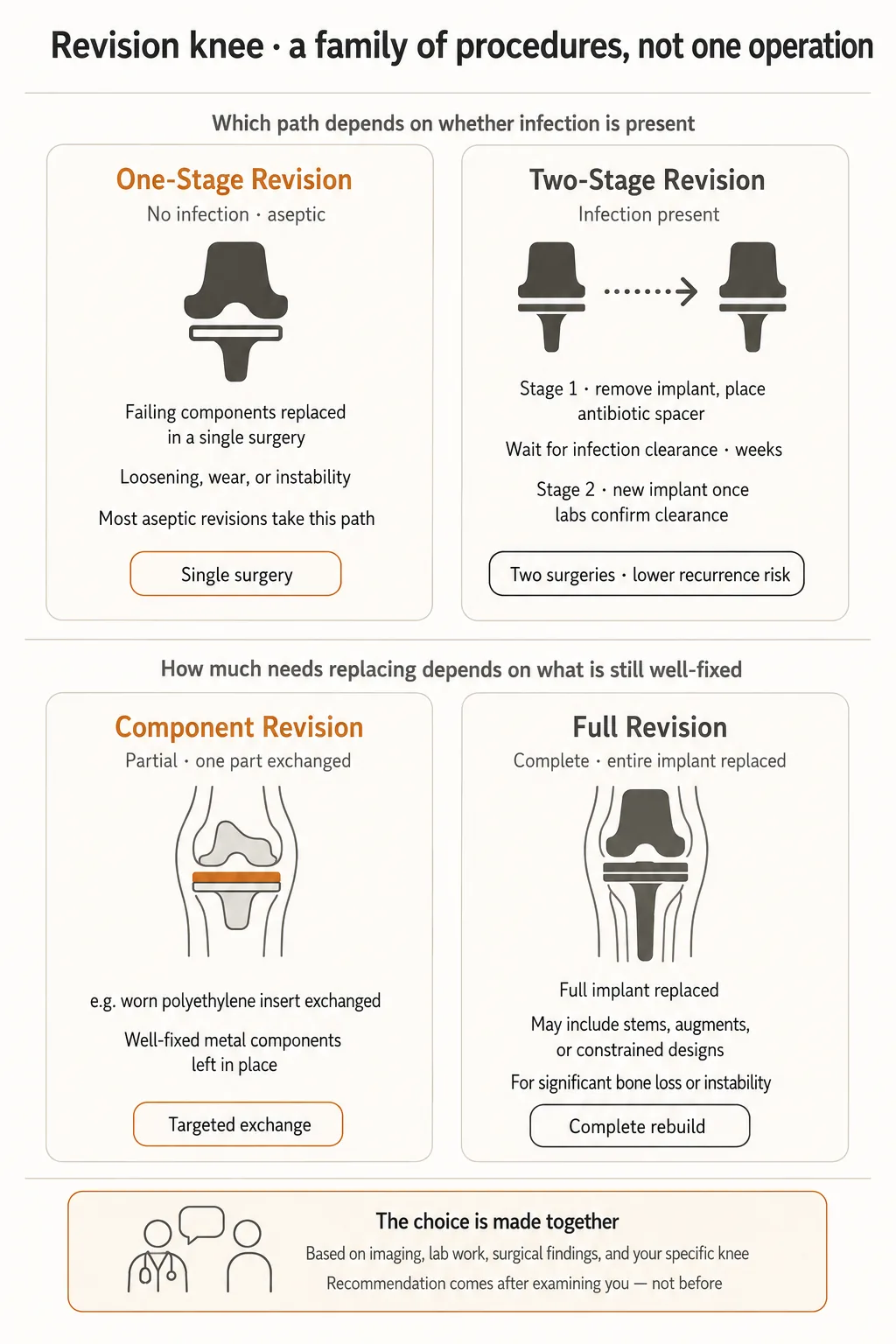
Four broad revision pathways are possible, and the right one for you depends on what has failed in your knee.
The first option is a bearing (polyethylene insert) exchange. If the femoral and tibial components remain well-fixed to the bone and only the polyethylene insert has worn, damaged, or become unstable, we may replace just the insert. This is the least extensive revision, and recovery is often closer to a first-time knee replacement than a full revision. It is suitable only in a carefully selected minority of cases, where the implant system is compatible and the rest of the knee remains well-aligned, stable, and free from infection.
The second option is a single-component revision - either the femoral or tibial component is replaced while the other is retained if it remains well-fixed and well-positioned. This is uncommon and appropriate only when failure is clearly isolated to one side, with careful intra-operative confirmation that the retained component is sound.
The third option is a full revision - both the femoral and tibial components are removed and replaced. The choice of implants depends on bone loss and ligament integrity: a posterior-stabilized or semi-constrained design is suitable in many cases, a condylar-constrained implant is used when the side ligaments are compromised, and a rotating-hinge design is reserved for severe bone loss or complete ligament insufficiency.
The fourth pathway applies when the knee replacement is infected. In these cases, treatment commonly involves a staged approach. The first surgery removes the infected implants and places a temporary antibiotic-loaded cement spacer, followed by a course of targeted antibiotics. Once infection control is confirmed clinically, through blood tests, and where required joint aspiration, the second stage involves implantation of the definitive new knee replacement.
We discuss the most appropriate treatment option in detail once we have reviewed your X-rays, scans, and infection workup.
What happens during the surgery itself?
Same knee. See what revision rebuilds.
Planning starts before you reach the operating theatre. We study your X-rays and, where bone loss is suspected, a CT scan, so we know how much bone we have to work with on the femoral side and on the tibial side.
We template the new components - the level of constraint, stem length, the need for cones or augments to fill bone gaps - so the right inventory of stems, sleeves, cones, augments, and constrained or hinged inserts is opened in the operating room before we start.
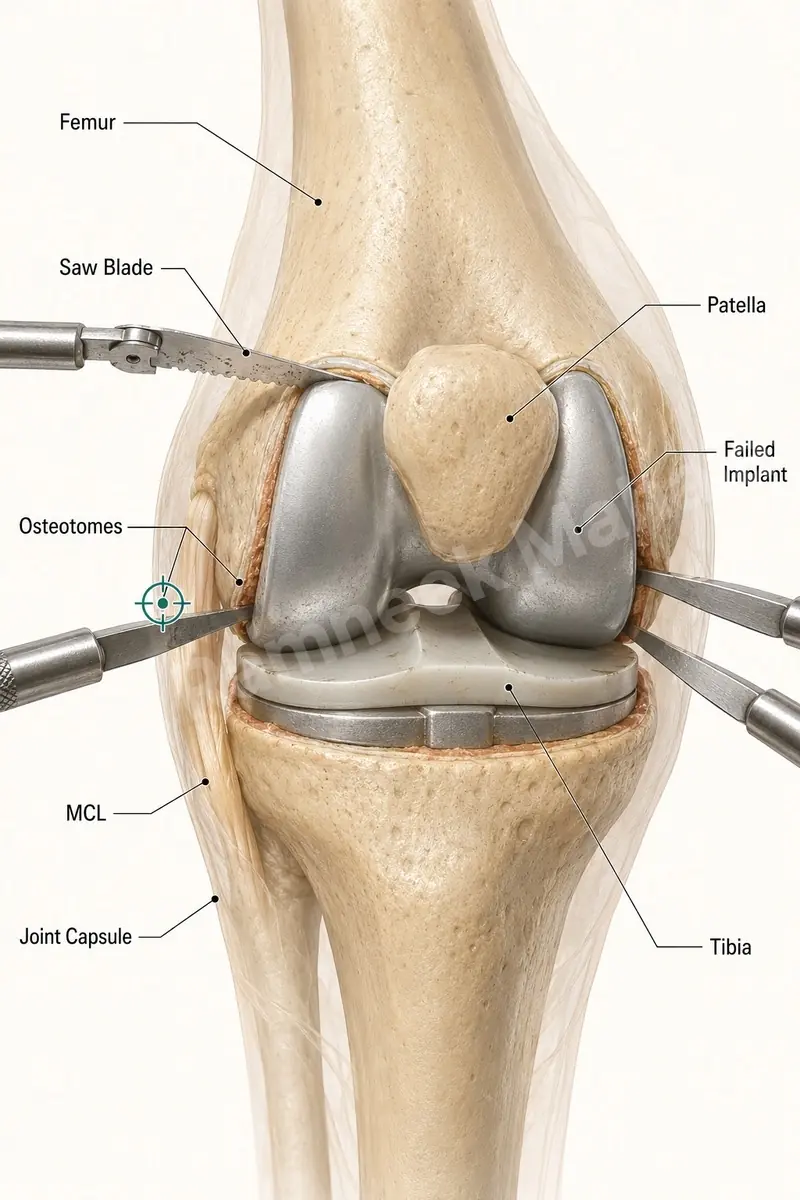
On the day of surgery, after spinal anaesthesia and a local nerve block, we position you and plan an incision that often follows your old scar to keep new tissue undisturbed. The surgical exposure has to be larger than a first-time knee replacement because we need to see the bone around the existing implants and the soft tissues are scarred.
In selected cases where the kneecap will not flip safely or where exposure is otherwise tight, we use a tibial tubercle osteotomy to open the knee safely and repair the bone window at closure. We then remove the existing implants carefully, preserving as much of your own bone as possible.
Once the old components are out, we assess what we find: bone defects in the femur and tibia are addressed with bone graft, porous metal cones or sleeves, or longer stems that bypass the weakened bone and grip the strong bone below.
Soft-tissue balance and flexion-extension gap symmetry are checked with trial components, and the level of constraint of the new implant is chosen based on what the ligaments can do. Only when every trial check is correct are the definitive components implanted.
For an infected knee the first stage is removal plus spacer placement; the second stage repeats this planning and reconstructs the knee after the infection has cleared.

What technology and implants do we use for revision?
Revision knee replacement uses a different implant family from a first-time knee replacement because the goals are different - we are reconstructing around what is left of your bone and the ligaments around the knee, not starting from a healthy joint.
Dr Ramneek Mahajan uses the Stryker Triathlon Revision Knee System TS family as the default platform at Max Smart Saket.
The system gives a graded range of constraint - the surgeon dials up only the constraint that the knee needs - which lets us preserve as much normal kinematics as possible and avoid over-constraining the joint, since higher constraint transfers more force to the stem-bone interface and over time can lead to radiographic loosening.
In the majority of revisions, a semi-constrained posterior-stabilized design is sufficient when the collateral ligaments are intact and bone loss is manageable. When the side ligaments are mildly compromised or the flexion-extension gap balance is borderline, a condylar-constrained design adds stability through the post-cam mechanism.
When there is complete loss of a collateral ligament or massive bone defects with flexion-extension gap mismatch, a rotating-hinge design is used; rotating-hinge implants are reserved for severe cases, and account for roughly 10 to 30% of revisions in published series.
Stemmed components extend into the femur or tibia past the weakened bone and grip the strong bone below; the stems can be cemented for immediate fixation in poor-quality bone, or press-fit in patients with good cortical bone and the option of fluted designs to resist rotation.
Where bone loss is moderate, porous metal cones or trabecular metal sleeves fill the defect and support the new component while bone grows into the porous surface. Where bone loss is severe and the joint line has been lost, structural bone graft or distal femoral replacement is considered. Highly cross-linked polyethylene bearings are standard.
For infected knees, the temporary spacer used in the first stage is made from antibiotic-loaded bone cement that delivers high local doses of antibiotic into the joint while preserving spacing for the definitive implants at the second stage. The implant combination is chosen based on the X-rays, the CT scan where bone loss is significant, and the findings at surgery once we have removed the old implant and assessed what bone and ligament integrity we have to work with.
Risks we discuss before any revision surgery
Revision knee replacement is a bigger operation than a first-time knee replacement, and complication rates after revision are higher than after a first-time knee replacement. We discuss this openly with you so the consent is informed, not just signed.
Infection. Even with strict sterile technique, antibiotic prophylaxis, and screening for skin, dental, and urinary sources beforehand, a small proportion of revisions become infected after surgery, and infection is the most common cause of failure of a revision knee replacement reported in the literature. If your revision is being done for an existing infection, the risk of the infection returning is real and we monitor you carefully with blood tests and clinical review.
Periprosthetic fracture - the bone around the stem can crack when an old implant is being removed or when the new stem is being seated. Fractures around a long-stem revision knee behave differently from fractures around a primary knee, often requiring a longer revision stem, plating, or both, and we plan around this with bone windows and protective wires where the bone is thin.
Instability or recurrent stiffness. The soft-tissue balance is harder to achieve than in a primary knee because the ligaments may already be stretched or scarred. We address this with the right level of constraint at surgery and focused physiotherapy afterwards.
Extensor mechanism problems - the muscle and tendon system that straightens the knee can be weakened in revision, more so in patients with previous surgeries or chronic stiffness, and a patellar fracture or tendon disruption is uncommon but serious when it happens.
Wound healing problems. The skin and soft tissues over a revision knee have already been through one surgery and are more fragile; smokers, patients on long-term steroids, and those with significant comorbidities are at higher risk.
Blood clots in the leg veins or lungs, which we lower with blood-thinner medication, mechanical compression, and the early walking that starts within 2 hours of surgery.
Bleeding requiring transfusion - more common in revision than in a first-time knee replacement because the operation is longer and the exposure is larger.
Nerve injury, most commonly the common peroneal nerve, which can cause weakness or numbness in the foot; this is uncommon but real and is mentioned before surgery.
Medical complications related to the longer surgery, more relevant in older patients with heart, lung, or kidney conditions, which is why pre-operative health checks are detailed.
The possibility of further surgery at some point in the future, since some failure modes of a revision knee can recur, and the survivorship of a revision implant is generally less than that of a first-time knee replacement over the long term. We explain each of these in our consultation, what we do to lower the chance of each one, and what the plan is if any of them occurs. The aim of this conversation is not to alarm you; it is to ensure you walk in with eyes open about both the typical course and the small chance of every complication, and to confirm we have a plan for each before the operation begins.
Frequently Asked Questions (FAQs)
Can I safely wait?
The questions worth asking before you decide - and when waiting is the right call, and when it is not.
Before we meet
→
What should I expect, step by step?
The whole path, stage by stage - getting ready, the day itself, recovery, physio, life after.
Patient journey
→
Where did he train?
Fellowships, years in practice, and international experience
Credentials and experience
→






Powered by RAiZEN · Built in India, for the world · © 2026 RAiZEN
Go to RAiZEN website