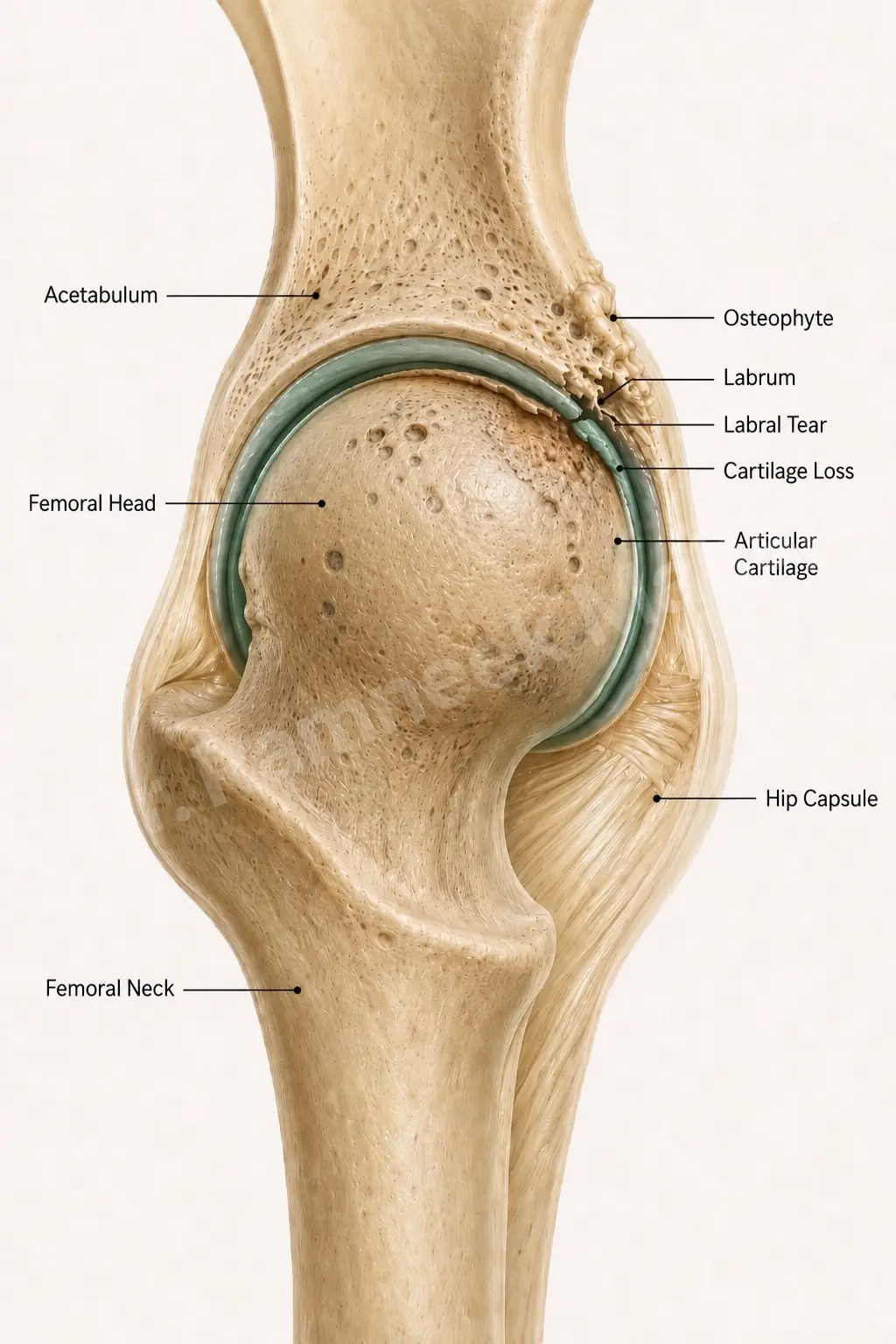
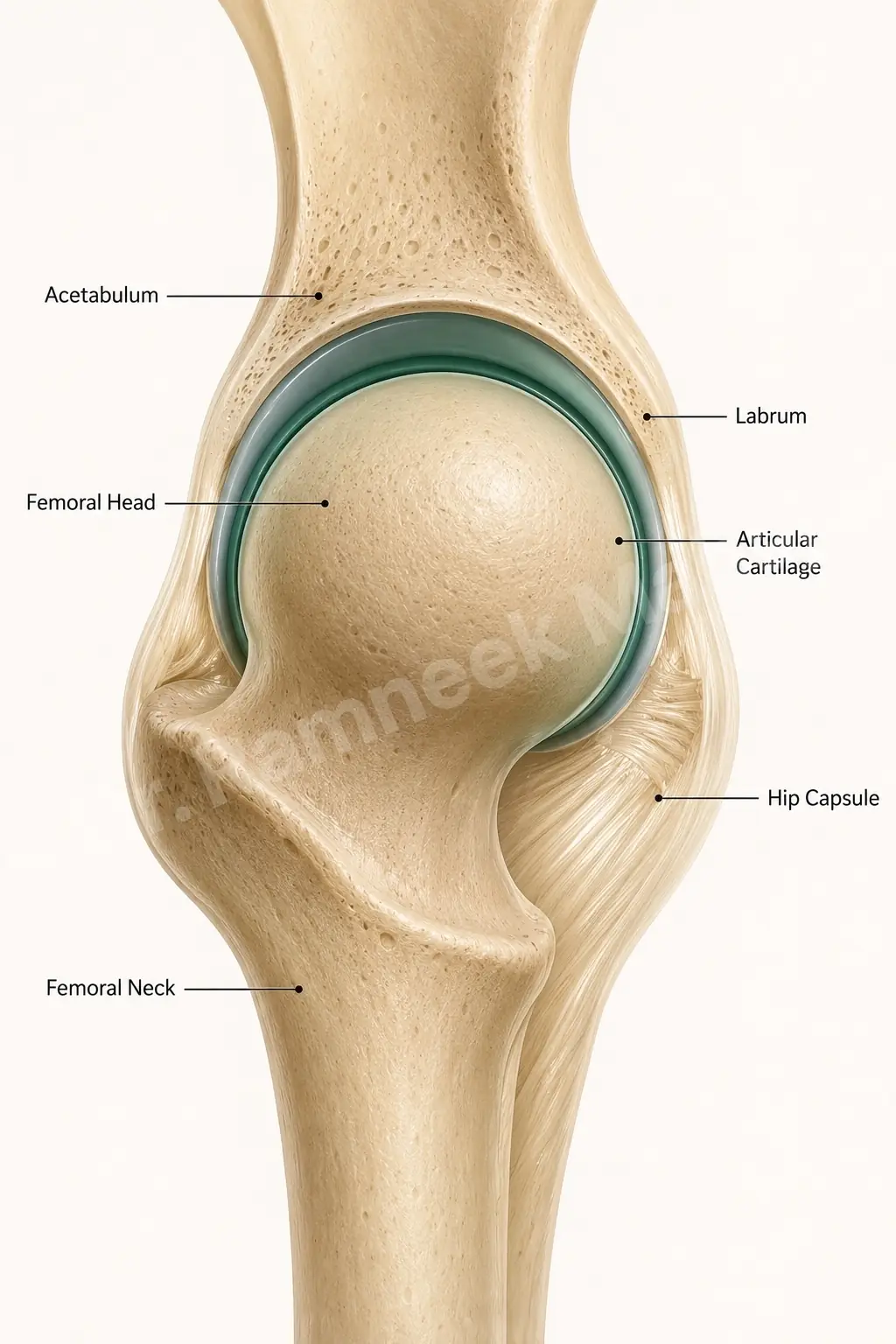


Hip osteoarthritis is wear of the cartilage in the hip joint - where the ball of the femur meets the socket of the pelvis. Pain typically starts in the groin, sometimes referring to the front of the thigh or the knee. Stiffness in the mornings, difficulty putting on socks or shoes, and a limp on walking are early signs. Like knee arthritis, it progresses slowly in most patients and is managed at each stage.
Total Hip Replacement (THR)
Direct Anterior, posterior, and MAKO robotic hip replacement at Max SMART Saket. 23+ years' experience.
Max SMART Saket
Mahajan's GK-1
Total Hip Replacement (THR), also called Total Hip Arthroplasty (THA), replaces a worn-out, damaged, or deformed hip joint (femur ball or femoral head) with a new artificial joint. The metal ball replaces the worn femoral head; a cup lined with highly durable polyethylene or ceramic sits in the socket of the hip, called the acetabulum. The components recreate a natural-feeling ball-and-socket joint with a pain-free, fully mobile hip joint.
We are experts in hip joint replacements when medications, physiotherapy, weight management, and walking aids no longer give pain relief, or when hip function loss is already present. Most patients walk with a walking frame within hours of surgery, go home by Day 1 or 2, and are back to routine activity within 4 to 6 weeks - a predicted and planned timeline individualised for your hip, your age, and your overall health.
Dr Ramneek's Joint team believes in and implements his exclusive ERAS (Early Recovery After Surgery) protocols for every hip replacement, to give you pain-free, full mobility at the earliest.
Same hip. See what arthritis takes away.
Who Hip Replacement is for
Total Hip Replacement is for adults whose hip pain stops them from doing what they want to do - walking comfortably, climbing stairs, sleeping through the night, rising from a chair, putting on shoes and socks, and sitting cross-legged.
The decision is rarely about a single test. We weigh three things together:
How much pain is limiting your daily life
How much function has been lost, and
Whether enough conservative treatment - medicines, physiotherapy, weight loss - has been tried and stopped helping.
If all three line up, surgery becomes the right tool to consider. If any of them is still a "no", we work on that piece first.
One specific check we do for hip pain: distinguishing hip-joint pain from back pain. Hip-joint pain typically presents as groin or front-of-thigh pain that worsens with weight-bearing or with putting on socks; back pain typically extends down the leg with movement of the spine. Imaging and a careful examination sort this out.
Bring your X-rays or MRI, a list of medicines you have tried, and a sense of which daily activities you have stopped doing - we discuss your specific case in consultation before any recommendation.
Real outcomes from real patients
These videos are published on Max Healthcare's official YouTube channel. Each patient's experience is unique - outcomes depend on individual health, disease characteristics, and clinical factors. These accounts are not a guarantee of results.
Meet Your Surgeon
How long is the hospital stay?
Most hip replacement patients stay 1 or 2 nights at our centre. Many are home within 24-48 hours of surgery through our Enhanced Recovery Pathway.
Day 0 (surgery day)
You arrive in the morning, surgery happens, and you spend the rest of the day in post-operative observation - pain monitoring, vital signs, IV fluids, and gentle limb positioning. Mobilisation begins after 2 hours of recovery if anaesthesia and vitals allow - bedside sitting, chair sitting, commode use, posture changes. Light food and water typically restart by evening.
Day 1 (next morning)
Walking with a frame, a structured physiotherapy briefing covering the home exercises and the Rule of 20 protocol, and discharge if vitals and mobilisation are stable. Patients having a single hip replaced typically go home this day. Patients having both hips done in the same admission typically go home the day after.
Going home
Discharge readiness comes down to three checks - pain controlled on oral medication, vitals stable, and confident walking with a frame for short indoor distances. Every patient goes home with 7 to 8 contact numbers - covering doctors, physiotherapist, dieticians, emergency services, and administrative staff - so nobody feels alone in the recovery.
What does recovery actually look like
Every patient goes home with 7 to 8 contact numbers - covering doctors, physiotherapist, dieticians, emergency services, and administrative staff. Nobody feels alone in the recovery.
Recovery has milestones at Day 1, Week 1, and Month 1.
Day 1: most patients are mobilised with a walking aid within 2 hours of surgery, with bedside sitting, chair sitting, commode use, and posture changes the same day.
Week 1: most begin walking with a single cane or stick at home. Short walks outside the home are encouraged. Daily-living chores resume - making your own tea, dining with family at the table, sitting on the balcony, watching TV, reading. Some patients comfortable enough briefly return to office or shop for a few hours, just to break the monotony of recovery.
Month 1: routine social activities - cycling, walks in the park, public gatherings. Target is approximately 4,000 steps a day, presented as a goal to strive toward, individualised by patient comfort.
The Rule of 20
20 minutes of activity, 20 minutes of icing, 20 minutes of rest - is our unit's protocol, followed through waking hours, in hospital and at home. Diet matters too: small frequent meals, protein-rich, adequate hydration, individualised with our dieticians.
A few specific hip cautions in the first 6 weeks. Avoid crossing your legs, do not bend the new hip past 90 degrees with certain approaches, and use the elevated toilet seat we provide. These precautions reduce the rare risk of dislocation while the joint capsule heals.
Signs that suggest Hip Replacement may be right
A few things together usually point toward hip replacement being the right tool - and any one of them being a "no" usually means we work on that piece first.
Signs that suggest Hip Replacement may be the right path:
• Daily hip or groin pain that does not improve with rest, weight loss, ice, or a long-enough course of physiotherapy.
• Stiffness, a limp, or shortening of the leg that you or others have noticed.
• Trouble putting on socks and shoes, sitting cross-legged, or getting in and out of a car - these activities tell us joint range of motion is significantly limited.
• X-ray or MRI showing advanced osteoarthritis, avascular necrosis, or another structural cause of joint damage.
• Conservative treatments ineffective - medicines, injections, physiotherapy - no longer providing meaningful relief.
If most of these apply to you, the next step is talking to a hip specialist. Earlier evaluation is better than later - surgery is often less complex when arthritis is moderate rather than end-stage. We discuss your specific case in consultation before any recommendation.
What are the surgical options for hip replacement, and how do I choose?
With hip replacement, two choices shape your operation - the surgical approach (how we reach the joint) and the technology (manual or robotic-assisted). We use the right combination for your hip.
Surgical approaches. We offer three at our centre - from the front, the side, and the back:
Direct Anterior Approach (DAA) - our default. The hip is reached from the front, working between muscles rather than cutting through them. DAA is associated with less muscle damage, faster recovery, lower dislocation rates, and better implant positioning. Dr Ramneek Mahajan is the only Indian collaborator on the DAA surgical technique, and DAA is our default approach for most primary hip replacements.
Direct lateral (anterolateral) approach. Reaches the hip from the side. The right choice for some patients with specific anatomical considerations.
Posterior approach. Reaches the hip from behind, with decades of long-term outcome data behind it. We reserve it for hips that need access from the back - significant pelvic deformity, prior hardware, or specific anatomy.
Which approach suits you is decided after evaluation. The recommendation comes after examining you, not before.
Technology. Each approach above can be done with conventional instruments or with MAKO robotic-assistance. The robot adds a CT-scan-based 3D plan and arm-guided precision to the cuts and implant placement. We use MAKO when hip anatomy is unusual, when there has been prior hip surgery, or when significant deformity demands tight tolerance.
The choice is made together - we discuss all the combinations in consultation, based on your imaging, your hip anatomy, your activity profile, and what you do day-to-day.
That is what Hip 360 means at our centre - we can reach the hip from the front, the side, or the back, and the approach is customised to your hip, not the other way around.
What happens during the surgery itself
Hip replacement typically takes 60-90 minutes per hip. Here is the broad sequence - without the graphic detail.
Step 1 • Pre-op setup.
You arrive in pre-op. Anaesthesia (usually spinal with sedation) is set up; the hip is positioned and prepped. For the Direct Anterior Approach, you lie flat on your back on a specialised radiolucent table.
Step 2 • Incision and access.
For the DAA, a 4-5 inch incision is made on the front of the hip. The surgeon reaches the joint through an intermuscular, internervous plane - very few muscles are cut. For posterior or lateral approaches, the incision is on the back or side and muscle dissection is more involved.
Step 3 • Removing the worn ball.
The femoral head (the ball of the hip) is removed at the neck of the femur. The damaged cartilage in the socket (acetabulum) is also cleared.
Step 4 • Implant fitting.
The new acetabular cup (with its polyethylene or ceramic liner) is fixed into the socket. The femoral stem is placed into the upper thigh bone, and the new metal or ceramic ball is fitted to the top of the stem.
Step 5 • Balance, closure, and recovery.
The new ball-and-socket joint is tested through full range of motion - we confirm the joint is stable and the leg lengths are matched. The layers are closed, often with absorbable sutures and surgical glue. You move to recovery.
Specifics - which approach, which implant, whether the MAKO robot is used - are decided in consultation based on your imaging and exam.
The implant we put in • how precisely it gets placed
Two things shape the outcome of a hip replacement - the implant we put in, and how precisely it gets placed.
The implant: cup, stem, and bearing.
The acetabular cup - a metal shell that fits into the socket of the pelvis. Modern cups are usually uncemented, with a porous outer surface that lets your own bone grow into the implant for permanent fixation.
The femoral stem - a metal stem that fits into the upper thigh bone. Modern stems are also usually uncemented; in older patients with softer bone, cemented fixation is sometimes the better choice.
The bearing surface - the ball on top of the stem articulates against a liner inside the cup. Options at our centre include ceramic-on-polyethylene (most common; balance of wear resistance and proven track record), ceramic-on-ceramic (excellent wear properties; we use selectively in younger patients), and metal-on-polyethylene (well-established option in older patients).
We select the bearing based on your age, activity level, and bone quality - decades of long-term data inform the choice.
Precision - MAKO robotic assistance. Before surgery, a CT scan of your hip becomes a 3D plan. During surgery, a robotic arm guides each cut and the placement of each component to match that plan exactly - the surgeon stays in full control; the arm just prevents the cut from straying. Studies show this approach improves cup positioning accuracy and may reduce the rare risk of dislocation.
When we use it: when hip anatomy is unusual, when there has been prior hip surgery, when there is significant deformity, and for younger patients where small precision differences add up over decades of wear.
When robotic-assist is not the right fit. For most straightforward hip replacements with standard anatomy, conventional surgery without the robot works just as well. Cost, surgery duration, or your own preference can point either way - we discuss this with you upfront.
Risks we discuss with you
Every surgery carries risk. Hip replacement is no exception. We talk through these openly in consultation - honest discussion is part of how informed consent works.
Infection.
Reported in roughly 1% of hip replacements in modern operating theatres. Risk is higher with poorly-controlled diabetes, obesity, smoking, or pre-existing skin conditions. We screen and optimise these before surgery; a sterile OR setup, prophylactic antibiotics, and meticulous wound closure further reduce risk.
Blood clots - DVT and pulmonary embolism.
A DVT (Deep Vein Thrombosis) is a clot that can form in a leg vein after major surgery, when movement is limited. Rarely, that clot breaks loose and travels to the lung - a pulmonary embolism, which is the dangerous version of the same problem. We mitigate both through early mobilisation (most patients walk with a frame within 2 hours of surgery), blood thinners during admission, and compression devices.
Dislocation.
The new ball can come out of the socket if the joint is taken through certain extreme positions in the first 6 weeks while soft tissues are healing. We provide specific position cautions and physiotherapy briefings to minimise this. Modern implant positioning, careful soft-tissue handling during the operation, and the Direct Anterior Approach all reduce dislocation rates. Reported rates in expert series are under 1%.
Leg-length difference.
The new hip occasionally feels longer or shorter than the other leg in the first few months. Most differences are small and either even out as the soft tissues settle or are managed with a small shoe insert. Significant differences are rare with modern implant positioning and intra-operative checks.
Nerve injury.
Stretch or pressure on nerves around the hip can occur during surgery. The most common is a numb patch on the front of the thigh after a Direct Anterior Approach. This is usually temporary and rarely affects function.
Periprosthetic fracture.
A fracture of the thigh bone around the new stem is uncommon but more likely in older patients with softer bone. We manage this with internal fixation or, rarely, a revision implant.
Stiffness or restricted range of motion.
Some patients heal with less range of motion than they hoped. Pre-op physio + structured post-op rehab + our Rule of 20 protocol minimise this.
Wound healing problems.
Higher in smokers, patients on long-term steroids, and those with significant comorbidities. Smoking cessation 4-6 weeks before surgery materially reduces risk.
Implant longevity and revision.
Modern hip implants have around 90% survivorship at 25 years in most patient profiles. Revision surgery - replacing a worn or loose implant - is a recognised care pathway, not a failure. We follow you long-term so any wear or progression gets caught early.
Your personal risk profile depends on age, comorbidities, lifestyle, bone quality, and your specific anatomy. We discuss your specific picture in consultation before any recommendation.
Frequently Asked Questions (FAQs)
Can I safely wait?
The questions worth asking before you decide - and when waiting is the right call, and when it is not.
Before we meet
→
What should I expect, step by step?
The whole path, stage by stage - getting ready, the day itself, recovery, physio, life after.
Patient journey
→
Where did he train?
Fellowships, years in practice, and international experience
Credentials and experience
→






Powered by RAiZEN · Built in India, for the world · © 2026 RAiZEN
Go to RAiZEN website