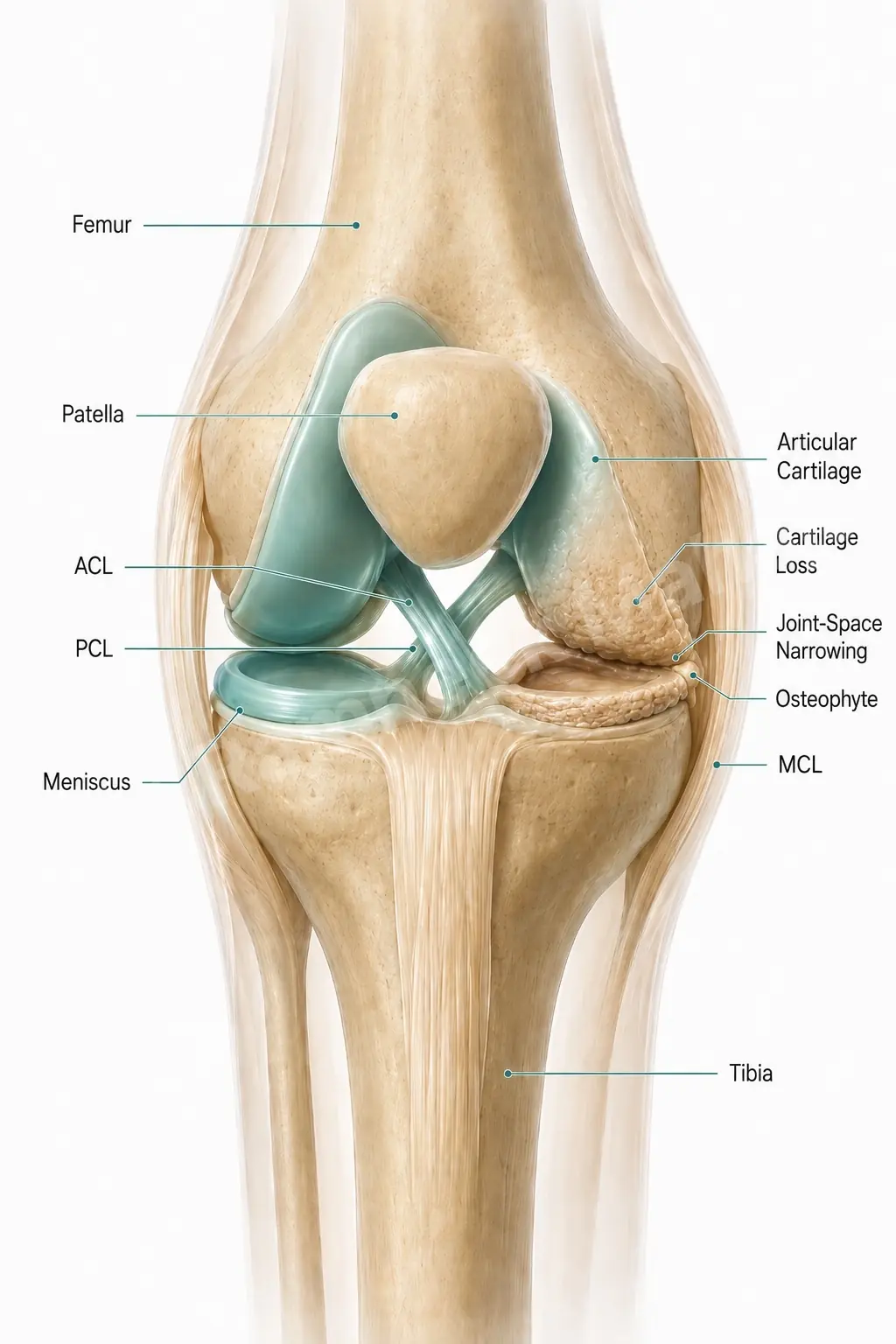


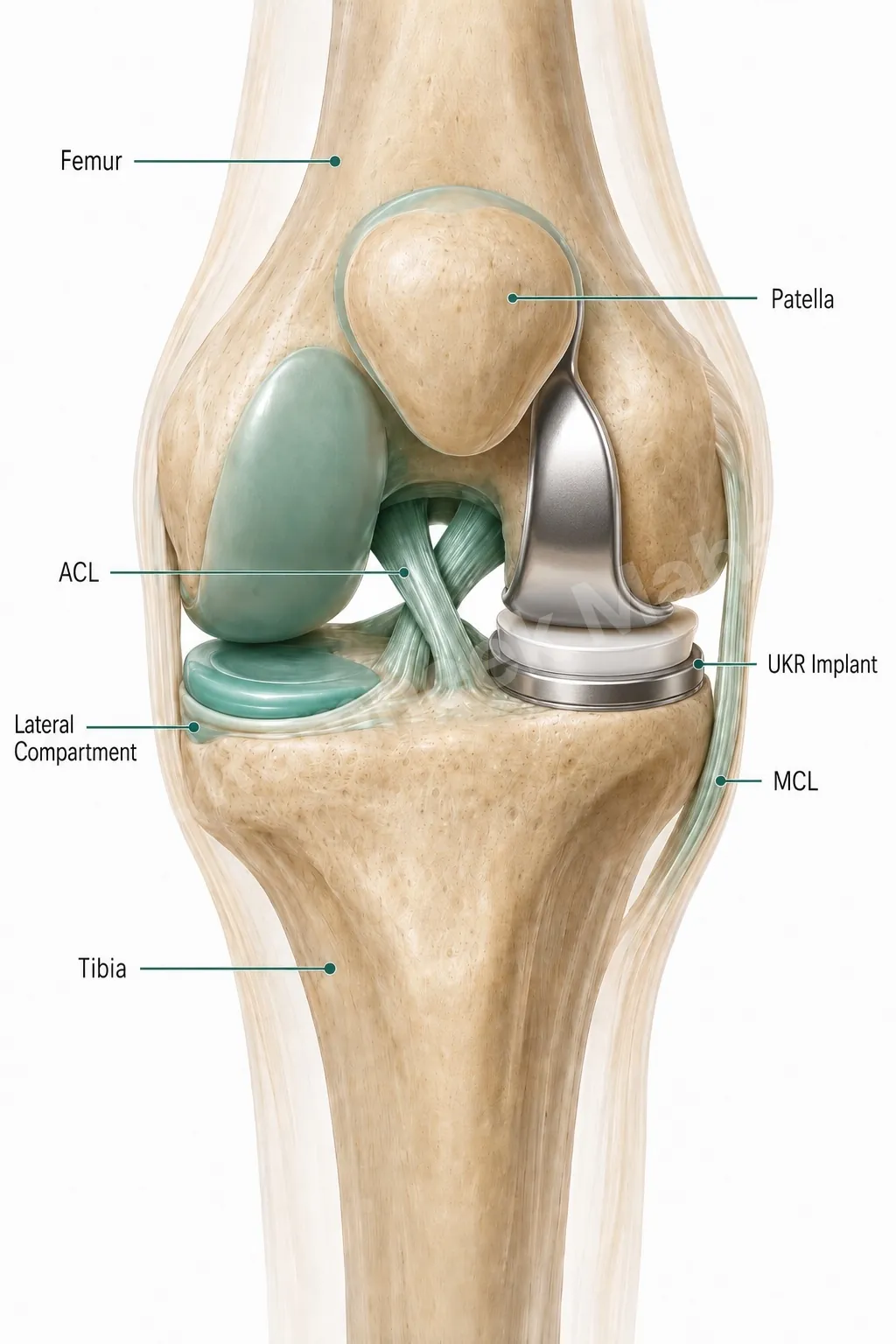
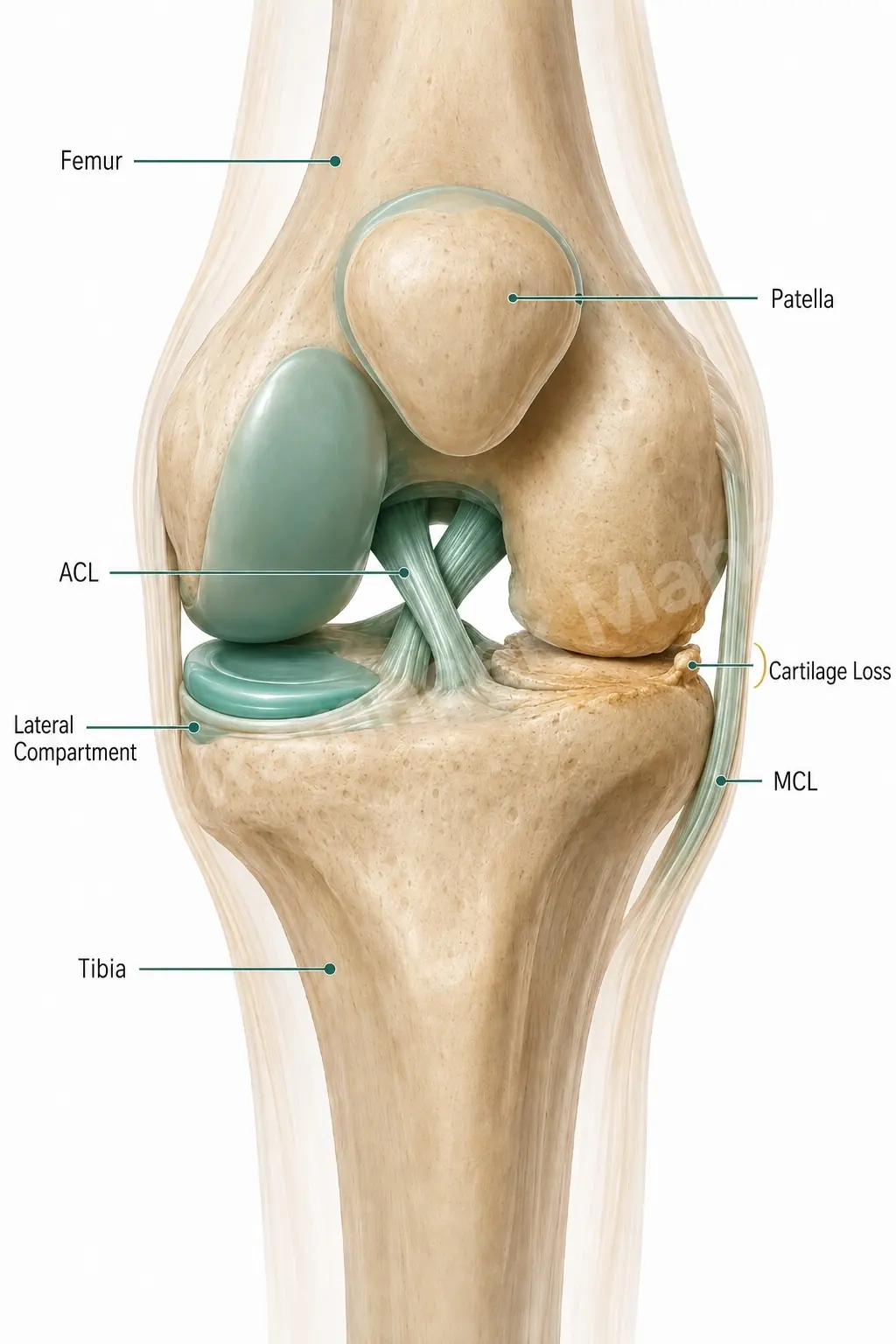
A total knee replacement resurfaces all three compartments of your knee. A partial knee, also called unicompartmental or UKR, replaces only the worn compartment and keeps the rest of your natural knee intact. Recovery tends to be quicker and the knee often feels more natural because the ligaments are preserved. Not every knee is suitable; the arthritis must be limited to one compartment with the other ligaments and cartilage healthy.
Partial Knee Replacement
Single-compartment knee replacement at Max SMART Saket. 23+ years' experience. MAKO robotic-assist available when indicated.
Max SMART Saket
Mahajan's GK-1
Partial Knee Replacement, also called Unicompartmental Knee Arthroplasty (UKA), is based on replacing exclusively the limited worn-out part of the knee joint - usually the inner (medial) compartment - without touching the rest of the knee. The cruciate ligaments and the unworn, normal joint areas remain in your knee to function and feel normally. The implant is smaller than in a total knee replacement, the incision is shorter, and most of your own original and natural knee joint stays in place.
It is the right answer for knees when arthritis is confirmed on imaging to be limited to one compartment, when the ligaments are intact, and when the deformity can be corrected. Recovery is typically quick, early, and faster than total knee replacement - most of Dr Ramneek Mahajan's Joint team's UKR patients walk confidently without support within 24 hours of surgery. When arthritis involves more than one compartment, total knee replacement is the cleaner choice as per indications and clinical evaluation, which is done 1:1 and exclusively decided by Dr Ramneek Mahajan himself with the patients.
Same knee. See why partial replacement is enough.
Who Partial Knee Replacement is for
Partial Knee Replacement is for adults whose knee pain stops them from doing what they want to do - but whose imaging and exam show arthritis in only one compartment of the knee, not the whole joint. The implant is smaller than in total knee replacement and more of the native joint is preserved.
The criteria are strict. Five things have to line up:
Arthritis limited to one compartment - confirmed on standing X-ray. Most commonly the inner (medial) compartment.
Intact cruciate ligaments - particularly the ACL. The knee's front-back stability depends on them.
Correctable deformity - mild bow-leg or knock-knee is fine. Severe deformity that does not straighten passively is a flag.
Reasonable body weight - obesity increases load on the small implant. Not a hard cutoff; we discuss your BMI in consultation.
A knee that bends well - flexion greater than about 100°. A stiff knee suggests joint damage beyond what partial can address.
Partial knee replacement is not always the right answer. When arthritis involves more than one compartment, the cruciate ligament is torn, or the deformity is severe, total knee replacement is the cleaner choice.
Bring your X-rays or MRI, a list of medicines you have tried, and a sense of which daily activities you have stopped doing - we discuss your specific case in consultation before any recommendation.
Real outcomes from real patients
These videos are published on Max Healthcare's official YouTube channel. Each patient's experience is unique - outcomes depend on individual health, disease characteristics, and clinical factors. These accounts are not a guarantee of results.
Meet Your Surgeon
How long is the hospital stay?
Most partial knee replacement patients stay 0 or 1 night - same-day discharge in many cases, the next morning at the latest. Stays are shorter than after total knee replacement, and readmissions in the first 30 days are less common.
Day 0 (surgery day)
Surgery typically takes 45-60 minutes per knee. After surgery you spend a few hours in post-operative observation - pain monitoring, vital signs, IV fluids, gentle limb positioning. Mobilisation begins within 2 hours of recovery if anaesthesia and vitals allow, and often sooner because the incision is smaller. We have had patients standing within 6 hours of surgery. Eligible patients are discharged the same evening.
Day 1 (next morning, if needed)
If Day-0 discharge is not appropriate - lingering anaesthesia, long travel home, limited support at home - Day-1 morning is the standard alternative. You walk with a frame, get a physiotherapy briefing covering the home exercises and the Rule of 20 protocol, and go home once the three discharge checks pass.
Going home
Discharge readiness comes down to three checks - pain controlled on oral medication, vitals stable, and confident walking with a frame for short indoor distances. Every patient goes home with 7 to 8 contact numbers - covering doctors, physiotherapist, dieticians, emergency services, and administrative staff - so nobody feels alone in the recovery.
What does recovery actually look like
Every patient goes home with 7 to 8 contact numbers - covering doctors, physiotherapist, dieticians, emergency services, and administrative staff. Nobody feels alone in the recovery.
Recovery has milestones at Day 1, Week 1, and Month 1, and the cadence is faster than after total knee replacement because the cruciate ligaments and unworn compartments are kept in place.
Day 1: most patients are mobilised with a walking aid within 2 hours of surgery - bedside sitting, chair sitting, commode use, posture changes the same day. We have had partial knee patients walking unaided within 24 hours, which is exceptional but does happen.
Week 1: most are walking with a single cane or stick at home; some without any aid. Daily-living chores resume - making your own tea, dining with family at the table, sitting on the balcony, watching TV, reading. Knee bending typically returns faster than after total knee replacement because the joint capsule was not disrupted.
Month 1: routine social activities - cycling, walks in the park, public gatherings. Target is approximately 4,000 steps a day, individualised by patient comfort. Patients often tell us the joint feels normal - they "forget" they have had a knee replacement.
The Rule of 20
20 minutes of activity, 20 minutes of icing, 20 minutes of rest - is our unit's protocol, followed through waking hours, in hospital and at home. Diet matters too: small frequent meals, protein-rich, adequate hydration, individualised with our dieticians.
Signs that suggest Partial Knee Replacement may be right
A few signs together usually point toward partial knee replacement being the right tool. The pattern that suggests partial (rather than total) knee replacement:
• Pain localised to one side of the knee, most commonly the inner (medial) side - patients often point to it precisely.
• Pain worse on stairs, standing up from a low chair, squatting, pivoting, kneeling, or walking on uneven ground.
• Daily knee pain that does not improve with rest, weight loss, ice, or physiotherapy.
• Imaging shows advanced osteoarthritis (Grade 3 or 4) limited to one compartment, with intact cruciate ligaments.
• The knee still bends well (more than about 100°) and any deformity (bow-leg or knock-knee) corrects passively.
If most of these apply, the next step is talking to a knee specialist. Earlier evaluation is better than later - the candidacy window for partial closes as arthritis progresses into a second compartment, after which total becomes the cleaner choice. We discuss your specific case in consultation before any recommendation.
What are the surgical options for this procedure, and how do I choose between them?
We perform three forms of knee replacement, and the right one depends on your knee - not on the procedure being smaller or more advanced.
1. Partial Knee Replacement (UKA). This page.
Only the worn-out compartment of the knee is replaced - the rest, including the cruciate ligaments, is preserved.
Suitable for patients with arthritis limited to one compartment, intact ligaments, correctable deformity, reasonable BMI, and a knee that bends well (flexion arc >100°).
10-year survivorship of well-selected modern designs is around 94%.
Available with conventional instrumentation or MAKO robotic-assist.
Typically shorter hospital stay (0-1 night) and faster recovery than total knee replacement.
Benefits of a partial over a total knee replacement (in a suitable knee):
Smaller incision
Less blood loss
Less pain after surgery
Faster recovery
Better range of movement
A more natural-feeling knee, because the ligaments are kept
Lower risk of infection and complications
If a total is ever needed later, converting from a partial is generally more straightforward than revising a total
2. Conventional Total Knee Replacement.
The full knee joint is replaced using manual jigs and instruments.
This is the most studied approach, with decades of long-term outcome data.
Suitable for most patients with end-stage osteoarthritis affecting all three compartments of the knee.
3. Robotic-assisted Total Knee Replacement.
A CT scan made before surgery is used to plan implant size and positioning.
During surgery, a robotic arm guides bone cuts within a pre-planned safe boundary controlled by the surgeon.
Studies report fewer alignment outliers compared to manual instrumentation.
Suitable for the same patients as conventional TKR - and often the right call when bone-anatomy variation makes manual alignment harder.
When partial is not enough. If imaging shows arthritis in more than one compartment, if the cruciate ligament is torn, or if deformity is severe - total knee replacement is the cleaner choice. Converting from a partial to a total later is possible (and simpler than revising a failed TKR), but starting with the right operation the first time matters.
The choice is made together - based on your imaging, your knee anatomy, the compartments involved, and what you do with your knees day-to-day. We discuss all three options in consultation; the recommendation comes after examining you, not before.
What happens during the surgery itself
Same knee. See why partial replacement is enough.
Partial knee replacement typically takes 45-60 minutes per knee - shorter than total knee replacement because only one compartment is resurfaced. Here is the broad sequence - without the graphic detail.
Step 1 • Pre-op setup.
You arrive in pre-op. Anaesthesia (usually spinal with sedation) is set up; the knee is positioned and prepped.
Step 2 • Incision and access.
A 3-4 inch incision is made on the side of the affected compartment - usually the inner (medial) side. This is smaller than the 6-8 inch incision for total knee replacement. The surgeon reaches the joint without dislocating the kneecap, and the capsule is opened only on one side.
Step 3 • Intraoperative re-confirmation of candidacy.
Before any bone is cut, the surgeon directly inspects the other compartments and the cruciate ligaments. If unexpected damage is found - cartilage loss in a second compartment, or a torn ACL - the operation converts to a total knee replacement. This consent is taken before surgery, so nothing changes for you mid-operation. It is a deliberate safety beat, not a complication.
Step 4 • Bone preparation (single compartment).
The worn cartilage and a thin layer of damaged bone are precisely removed from the affected femoral condyle and the adjacent tibial plateau. The other compartments and the ligaments are left untouched. With MAKO robotic-assist (when used), a CT scan made before surgery becomes a 3D plan; the robotic arm guides each cut to match the plan, and the arm holds a haptic safety boundary - the surgeon stays in full control; the arm just prevents the cut from straying.
Step 5 • Implant fit, balance check, and closure.
The new implant goes in three parts - a metal femoral component, a metal tibial component, and a polyethylene bearing between them that acts as the new cartilage for that compartment. Balance + tracking are verified through full range of motion. Once stable, the layers are closed. You move to recovery.
Specifics - implant choice, fixed-bearing vs mobile-bearing design, whether the MAKO arm is used - are decided in consultation based on your imaging and exam.
The implant we put in • how precisely it gets placed
Two things shape the outcome of a partial knee replacement - the implant we put in, and how precisely it gets placed.
Implant - fixed-bearing or mobile-bearing UKA system. The metal components (femoral condyle resurfacing + tibial baseplate) are cobalt-chromium, the same alloy that has been the standard in knee replacements for decades. Between them sits the polyethylene bearing that acts as the new cartilage. There are two main bearing-family choices:
Fixed-bearing UKA - the polyethylene insert is locked to the tibial baseplate. Simpler design, decades of long-term outcome data, more forgiving in patients with mild ligament laxity.
Mobile-bearing UKA (Oxford-style designs) - the polyethylene insert can rotate slightly within the tibial tray, mimicking native joint motion. More physiologic feel; requires intact ligaments to track properly.
When we use which: the bearing-family choice depends on your knee anatomy, your ligament integrity, and the surgical setup we have in your operation. We discuss this with you in consultation.
Precision - MAKO robotic-assist (when indicated). Before surgery, a CT scan of your knee becomes a 3D plan. During surgery, the robotic arm guides each bone cut to match that plan exactly - the surgeon stays in full control; the arm just prevents the cut from straying. Studies show robotic-assisted UKA reduces alignment errors compared to manual instrumentation, which matters more in a partial than a total because the implant is smaller and even small malalignments load it harder.
When we use it: when knee anatomy is unusual, when there has been prior knee surgery, or when smaller deformity demands tight tolerance - and for younger patients where small precision differences add up over decades of wear.
When robotic-assist is not the right fit. For most straightforward partial knee replacements with standard anatomy, conventional UKA without the robot works just as well. Cost, surgery duration, or your own preference can point either way - we discuss this with you upfront.
The right choice is one that fits your knee, your situation, and your preferences. We talk through all of it with you in consultation.
Every surgery carries risk - we discuss yours
Every surgery carries risk. Partial knee replacement is no exception. We talk through these openly in consultation - honest discussion is part of how informed consent works.
The universal risks of any knee replacement (with UKA-specific modulation).
Infection. Reported in roughly 1% of partial knee replacements in modern operating theatres - generally lower than the 1-2% with total knee replacement because the surgery is shorter, the wound is smaller, and less native tissue is exposed. Risk is higher with poorly-controlled diabetes, obesity, smoking, or pre-existing skin conditions. We screen and optimise these before surgery.
Blood clots - DVT and pulmonary embolism. A DVT is a clot in a leg vein after major surgery; rarely it travels to the lung as a pulmonary embolism. Partial knee replacement's shorter surgery + faster mobilisation compresses the window of risk; readmission rates in the first 30 days are also lower than after total knee replacement. We mitigate with blood thinners, compression devices, and early walking.
Stiffness or restricted range of motion. Less common after partial than after total - retention of the cruciate ligaments and limited surgical dissection typically allows greater range of motion. If stiffness develops, manipulation under anaesthesia can usually recover function.
Wound healing problems. Higher in smokers, patients on long-term steroids, and those with significant comorbidities. The smaller incision generally heals faster than a TKR wound.
Risks specific to partial knee replacement.
Polyethylene wear and bearing dislocation. The polyethylene bearing is smaller than in a total knee replacement and works harder per unit area. In mobile-bearing designs, the bearing can rarely dislocate. We discuss the bearing-family choice (fixed vs mobile) with you in consultation.
Progression of arthritis in the retained compartments. The other compartments and the cruciate ligaments are preserved but can degrade over time, particularly the patellofemoral (kneecap) joint - some patients develop anterior knee pain years later. Routine follow-up tracks this.
Conversion to total knee replacement. A partial knee is slightly more likely to need revision over its lifetime than a total knee, but when it does need revision, converting a UKA to a TKR is operationally simpler than revising a failed TKR. Reasons a partial converts include arthritis progressing into a second compartment, bearing wear, and component loosening. The trade-off is real and we surface it before surgery.
Surgeon and centre volume. Partial knee replacement depends more on surgical technique than total knee replacement does. Revision rates fall as centre and surgeon volume rises - choosing a high-volume joint replacement unit is a real risk-mitigation lever.
Implant longevity. Well-selected modern partial knee implants have around 94-96% 10-year survivorship in expert series. Revision surgery - converting to a total knee replacement if the partial fails, or replacing the worn bearing - is a recognised care pathway, not a failure. We follow you long-term.
Your personal risk profile depends on age, comorbidities, lifestyle, bone quality, ligament integrity, and how active you intend to stay. We discuss your specific picture in consultation before any recommendation.
Frequently Asked Questions (FAQs)
Can I safely wait?
The questions worth asking before you decide - and when waiting is the right call, and when it is not.
Before we meet
→
What should I expect, step by step?
The whole path, stage by stage - getting ready, the day itself, recovery, physio, life after.
Patient journey
→
Where did he train?
Fellowships, years in practice, and international experience
Credentials and experience
→






Powered by RAiZEN · Built in India, for the world · © 2026 RAiZEN
Go to RAiZEN website