Shoulder dislocation: will it happen again, and when surgery helps
Last Reviewed:
11 August, 2026
~13 min read
Reviewed by:
Dr. Ramneek Mahajan
Dr. Mahajan is Chairman Orthopaedics, Joint Replacement & Chief Robotic Joint Replacement at Max Smart Super Speciality Hospital, Saket.
This guide is for someone who has dislocated a shoulder - felt it come out of the joint - or whose shoulder keeps slipping or giving way, and who is weighing what to do next. If you are wondering whether it will happen again and whether you need surgery, this guide frames that decision. It is written for the person living with it, not only the doctor treating it.
This guide is not for a shoulder that is painful or stiff without ever having come out of joint - that points more to arthritis, a rotator cuff problem, or a frozen shoulder, each with its own guide on this site. It also does not replace an in-person assessment of your shoulder.
01 What is a shoulder dislocation?
A shoulder dislocation is when the ball of the upper arm bone comes fully out of its socket - almost always forwards. It usually follows a fall or a sports impact, and it is unmistakable: sudden severe pain, the arm held still, and a shoulder that looks and feels wrong until it is put back into place. The shoulder is the most commonly dislocated large joint in the body, making up nearly 50 percent of all dislocations, with about a 2 percent lifetime incidence in the general population.
What a first dislocation can damage
When the ball comes out, it often tears the rim of cartilage and ligament at the front of the socket (a Bankart lesion) and can dent the back of the ball where it catches on the socket edge (a Hill-Sachs lesion). In some shoulders it also chips bone off the socket. How much of this damage is present - especially how much bone is lost - is the single biggest thing that decides whether the shoulder stays stable afterwards.
First-time versus recurrent
A first-time (primary) dislocation is a one-off event that has just happened.
Recurrent instability is a shoulder that keeps coming out, or keeps feeling like it might give way on certain movements.
When a shoulder dislocation is an emergency
A dislocated shoulder needs to be put back into place promptly, and a few signs mean it should be seen straight away:
Numbness over the outer shoulder and upper arm, or weakness lifting the arm - a sign the axillary nerve, which is vulnerable in a dislocation, may be affected.
A cold, pale, or pulseless hand, or spreading numbness - this points to a blood-vessel or nerve problem and needs urgent care.
A shoulder that cannot be put back in, or one that came out during a seizure or an electric shock - the latter is often a backward (posterior) dislocation, which is less common and is easily missed unless the right X-ray views are taken.
How a shoulder dislocation is diagnosed
An X-ray taken before and after the shoulder is put back confirms it was out, shows which way it went, and checks for a fracture. If surgery is being weighed, a CT scan - often a three-dimensional one - measures how much bone has been lost from the socket, and an MRI shows the torn rim and ligaments (the Bankart lesion) and the state of the rotator cuff, which matters more in older patients.
The first question almost everyone asks after a dislocation is: will it happen again, and do I need surgery?
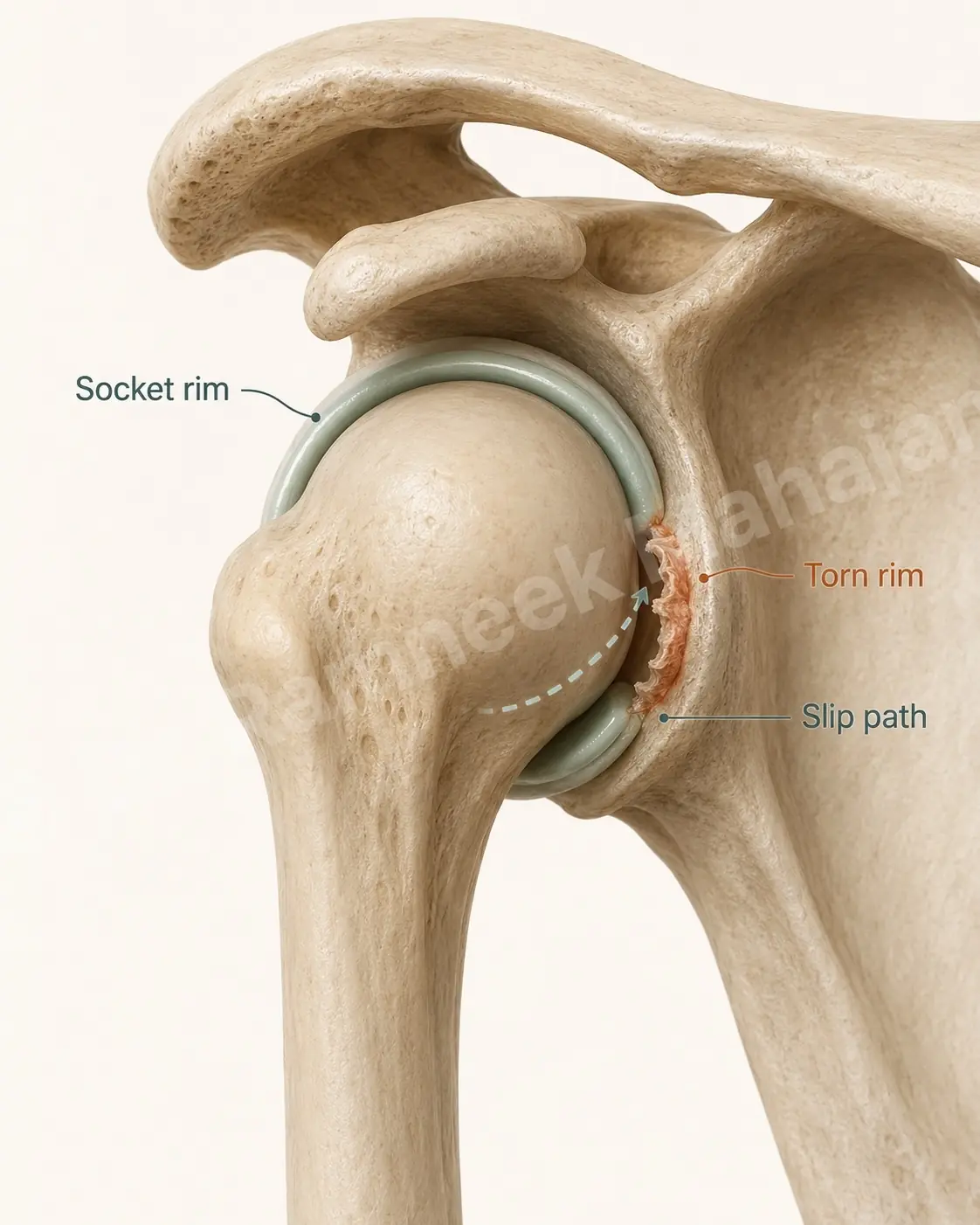
02 Do you need surgery after a shoulder dislocation?
Not always - and the honest answer turns mostly on your age and how active you are. After a first dislocation, the shoulder is put back in place, rested briefly, and rehabilitated. Whether you then need stabilisation surgery depends on how likely it is to happen again.
Path | What it is | When it tends to fit | What it asks of you |
|---|---|---|---|
Reduction, brief rest, and rehabilitation (non-surgical) | Putting the joint back, a short spell in a sling, then a guided strengthening programme | Many first-time dislocations, especially over 40, where recurrence is much less likely | Consistent rehabilitation; some activity adjustment |
Arthroscopic stabilisation (surgery) | Keyhole repair of the torn rim and ligament to stop the shoulder coming out again | Younger and active people; a shoulder that keeps dislocating; significant bone loss | Surgery plus a recovery measured in months |
Will it happen again? Age is the biggest factor
In one well-known series, the shoulder dislocated again in about 90 percent of people under 20, in about 60 percent of those aged 20 to 40, and in only about 10 percent of people over 40. Contact and collision sports push the recurrence rate towards 100 percent in young athletes. So a young person who plays contact sport is in a very different position from someone over 40 with a first, single dislocation.
A note for older first-time dislocations
Over 40, the shoulder is much less likely to dislocate again - but a different problem becomes more common, and it must not be missed. Rotator cuff tears are present in around 30 percent of these dislocations, rising to more than 80 percent in people over 60, and fractures of the bony bump on the arm bone are also more frequent. In this age group, finding and treating a cuff tear or fracture often matters more than the dislocation itself.
If the decision points towards surgery, here is what stabilisation actually involves.
03 What happens during shoulder stabilisation surgery?
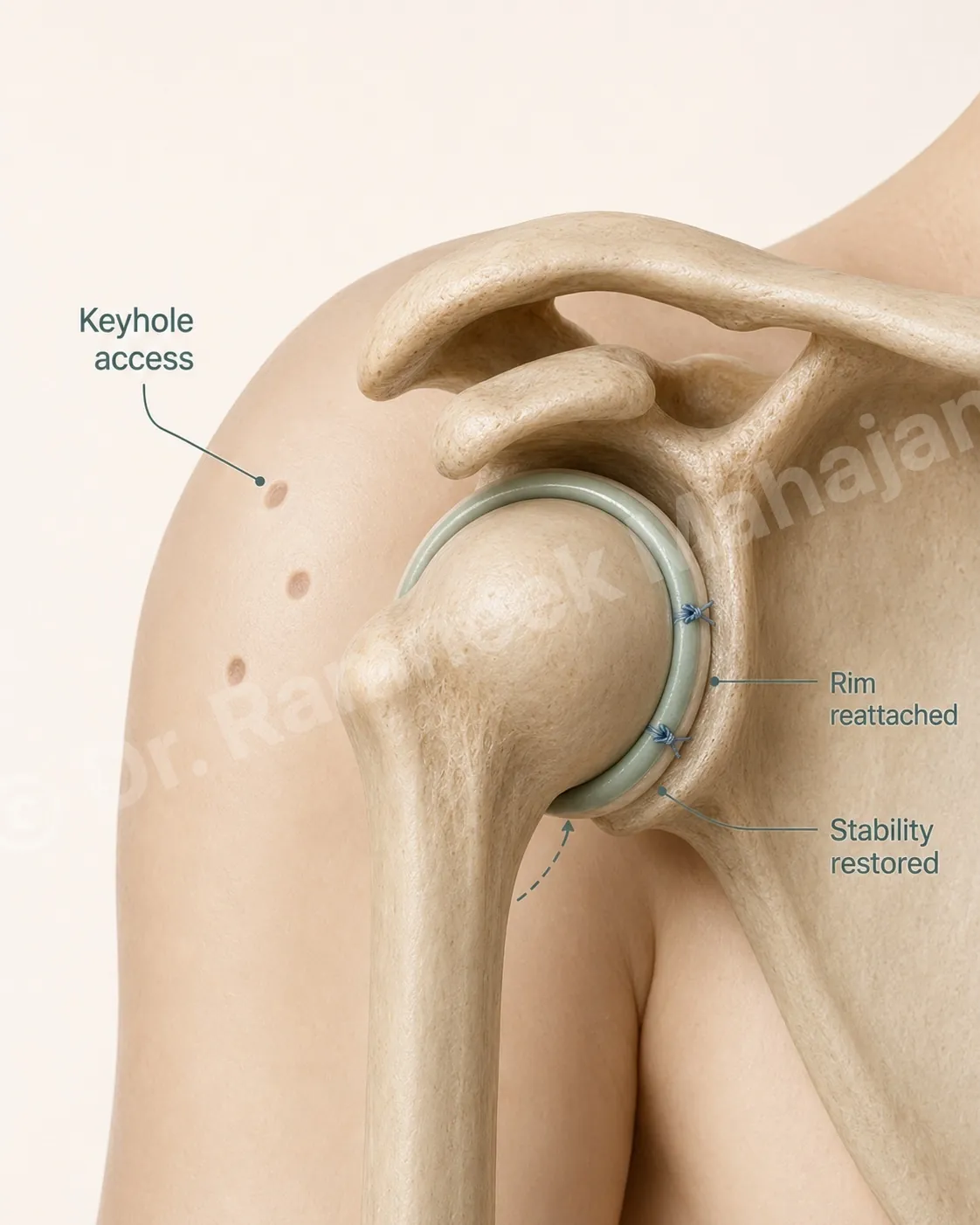
Most shoulder stabilisation is keyhole (arthroscopic) surgery. Through small incisions, the torn rim of cartilage and ligament at the front of the socket is reattached to the bone with small anchors, restoring the front wall that keeps the ball in place. This is often called an arthroscopic Bankart repair.
When more than a soft-tissue repair is needed
The exception is significant bone loss. When more than about 20 to 25 percent of the front of the socket has worn or chipped away, a soft-tissue repair alone is more likely to fail, and a procedure that rebuilds the bone (such as a Latarjet procedure, which transfers a small block of bone) is considered instead. This is a bigger, more specialised operation, and part of the value of a careful assessment - with the right scans - is working out which of these your shoulder actually needs, and planning it accordingly.
Will I be admitted?
Arthroscopic stabilisation is typically a day-care procedure or a single overnight stay, after which the shoulder is protected in a sling. The exact plan for your case will be discussed during your consultation.
The operation is the short part. Recovery is where stability is rebuilt.
04 How long does recovery take after a shoulder dislocation?
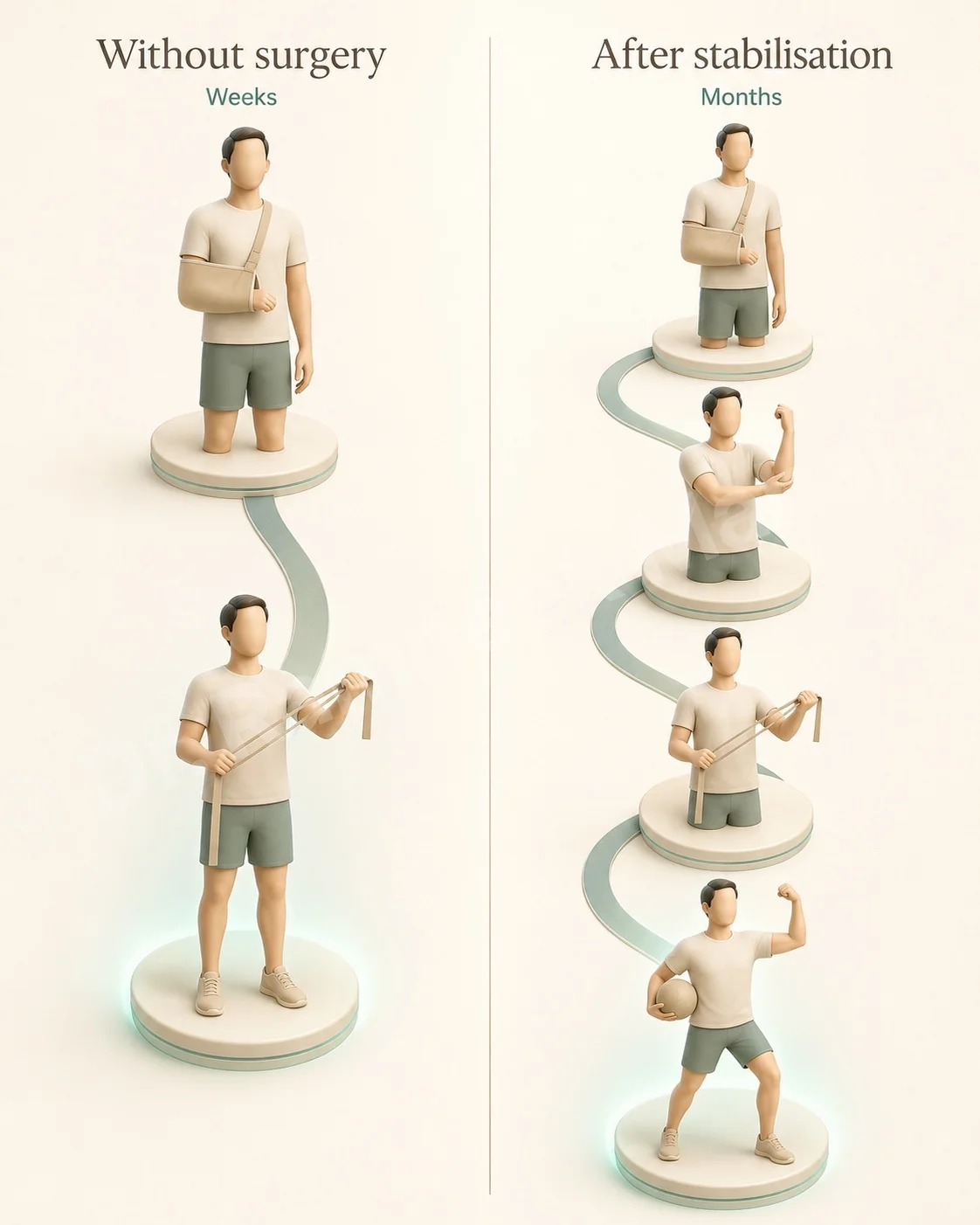
Recovery depends on whether you have surgery. After a first dislocation treated without surgery, the timeline is short; after stabilisation surgery, it runs over months because the repair has to heal before the shoulder is loaded.
After a first dislocation, without surgery
A sling is used only briefly - the evidence shows no benefit from conventional sling immobilisation beyond about 1 week for a first dislocation.
A guided strengthening programme then rebuilds the muscles that help hold the shoulder in place.
After arthroscopic stabilisation
Sling for around 4 to 6 weeks to protect the repair.
Guided movement begins early, from around 2 to 3 weeks, within safe limits.
Strengthening builds from around 8 to 12 weeks.
Return to heavy or manual work from about 3 months, with contact and overhead sport later still, once the shoulder has the strength and control for it.
The next question many people have: which surgeon should look at this?
05 How do you choose a surgeon for shoulder instability?
Choosing a surgeon for a dislocating shoulder comes down to four checks. The four below are what actually matter.
An assessment that measures bone loss. The single most important thing is working out how much bone has been lost from the socket, because that decides whether a keyhole repair will hold or whether a bone procedure is needed. That usually means the right scans, not just an X-ray.
Honest counsel on whether you even need surgery. The right surgeon will be clear that many first dislocations, especially over 40, are managed without an operation, and will not push surgery you may not need.
Arthroscopic shoulder experience. Stabilisation is keyhole surgery; you want a surgeon who does arthroscopic shoulder work regularly, and who will plan a bone procedure properly when one is required.
Rehabilitation and follow-up. The result depends on the months of rehabilitation as much as the repair. Ask what physiotherapy support the practice provides.
For context
Dr Ramneek performs arthroscopic shoulder surgery, including stabilisation for a dislocating shoulder, at Max SMART Saket, alongside a high-volume knee and hip joint-replacement practice. The point of this page is not to push surgery - it is to help you work out whether you need it, and to be clear that if you do, arthroscopic stabilisation is care the practice provides. Where significant bone loss means a larger bone procedure is the right answer, the assessment makes sure that is planned for your shoulder specifically.
Every patient is personally assessed by Dr Ramneek, even when seen by the team - this may add to OPD waiting times, but ensures the doctor's direct evaluation in your case.
A question that sits behind the decision for many people: what does this cost?
06 How much does shoulder dislocation treatment cost?
The cost depends on the path. A first dislocation managed without surgery is the cost of the reduction, a sling, and a course of physiotherapy. Arthroscopic stabilisation, and the larger bone procedures used for significant bone loss, are different operations with different costs, which also depend on the type of hospital and your specific situation.
There is no single figure that would be honest across these variables. For a specific figure - what insurance covers, and the options for your situation - the team works through it at or after the first consultation. That is the right setting for those numbers, not a webpage.
Before deciding, an honest look at what stabilisation can and cannot promise.
07 Does stabilisation surgery work, and what can go wrong?
Arthroscopic stabilisation is an effective operation for the right shoulder, but its success depends heavily on getting the bone-loss question right - and an honest page says so. Here is what the published evidence shows, in ranges, not promises.
What the evidence shows
In well-selected shoulders, keyhole repair holds. When bone loss is not significant, arthroscopic stabilisation gives recurrence rates comparable to open surgery, and arthroscopic soft-tissue repairs carry the lowest complication rate, at around 1 percent.
Bone loss is the deciding factor. In contact athletes, an unaddressed 25 percent glenoid bone defect pushed the re-dislocation rate from about 6.5 percent up to about 89 percent - which is exactly why measuring the bone loss matters so much.
Stabilisation works for the right shoulder. Here is the honest version.
Surgery reduces recurrence, it does not abolish it. No repair is a guarantee, especially if the shoulder goes back to high-risk contact sport.
Bone procedures carry more risk than soft-tissue repair. A Latarjet-type bone procedure has a higher complication rate - reported around 13 to 14 percent, with figures up to 25 percent in some series - and a return to the previous level of sport of about 50 percent. It is reserved for shoulders that genuinely need it.
Older first dislocations need a different check. Over 40, the bigger risk is a missed rotator cuff tear (present in around 30 percent) or fracture, rather than recurrence.
Results vary by person. A 19-year-old rugby player with bone loss is on a very different path from a 50-year-old with a single, first dislocation. The numbers above are population averages, not individual forecasts.
One last, fair question: who is telling you all this?
Frequently Asked Questions (FAQs)
This guide was written and clinically reviewed by Dr Ramneek Mahajan - an orthopaedic surgeon at Max Smart Super Speciality Hospital, Saket, New Delhi. He performs arthroscopic shoulder surgery, including stabilisation for a dislocating shoulder, alongside a high-volume knee and hip joint-replacement practice, and holds international fellowship training.
For the full credentials record - fellowships, society roles, publications - see the credentials page.
For press coverage and media features, see In the news.
Meet Your Surgeon
Can I safely wait?
The questions worth asking before you decide - and when waiting is the right call, and when it is not.
Before we meet
→
What should I expect, step by step?
The whole path, stage by stage - getting ready, the day itself, recovery, physio, life after.
Patient journey
→
Where did he train?
Fellowships, years in practice, and international experience
Credentials and experience
→






Powered by RAiZEN · Built in India, for the world · © 2026 RAiZEN
Go to RAiZEN website