Rotator cuff tear: when it needs surgery, and when it does not
Last Reviewed:
11 August, 2026
~14 min read
Reviewed by:
Dr. Ramneek Mahajan
Dr. Mahajan is Chairman Orthopaedics, Joint Replacement & Chief Robotic Joint Replacement at Max Smart Super Speciality Hospital, Saket.
This guide is for someone with shoulder pain and weakness - trouble lifting the arm overhead, reaching, or sleeping on that side - who has been told they have a rotator cuff tear, or suspects one. If you are weighing whether you need surgery or whether physiotherapy will do, this guide frames that decision. It is written for the person living with it, not only the doctor treating it.
This guide is not for a shoulder that is mainly stiff rather than weak (that points more to a frozen shoulder, which has its own guide on this site), nor for shoulder pain coming from arthritis. It also does not replace an in-person assessment of your shoulder.
01 What is a rotator cuff tear?
The rotator cuff is a group of four muscles and their tendons - the supraspinatus, infraspinatus, teres minor, and subscapularis - that hold the head of the arm bone in its shallow socket and let you lift and rotate the shoulder. A rotator cuff tear is a tear in one or more of those tendons. It can be partial - part-way through the tendon - or full-thickness, meaning all the way through. Some tears come from a sudden injury (a fall, a heavy lift), but most come on gradually with age as the tendon wears. In some shoulders, repeated rubbing of the tendons under the tip of the shoulder blade (the acromion) - known as impingement - adds to that wear over time.
How do you know it might be a rotator cuff tear?
Pain over the outer or front of the shoulder, often spreading down the upper arm
Weakness lifting the arm overhead, or lifting with the arm out in front of you
Pain at night, especially lying on that side, that disturbs sleep
A sudden loss of strength after a specific injury, in an acute tear
When should you see a doctor?
Most shoulder pain settles with time and simple measures. A few signs are worth getting assessed sooner rather than later:
Sudden weakness or difficulty lifting the arm after a fall or injury - a possible acute tear, where the timing of treatment can matter
Shoulder pain that keeps disturbing your sleep for more than a few weeks
Pain and weakness that are not improving despite rest and activity changes
A clear loss of shoulder strength or movement you did not have before
How common are they, and does the type matter?
Rotator cuff tears are very much part of ageing. Studies of shoulders find tears in 30 to 50 percent of people overall, and full-thickness tears affect about 25 percent of people over 60 and rise to 50 percent of people over 80. Many of these tears cause no symptoms at all. The type matters for treatment: a small partial tear is managed differently from a large full-thickness one. Tears do not always grow, but some do - partial tears enlarge in up to 50 percent of people over time. A few things make a tear more likely: increasing age and years of repetitive overhead use most of all, along with a previous shoulder injury, smoking, diabetes, and often a family tendency too.
Can you lower the risk of a rotator cuff tear?
Most tears that come with age cannot be fully prevented - the tendon wears over the years, and that is normal. What helps is reducing strain on the shoulder and keeping the tendon as healthy as possible:
Keep the shoulder and upper-back muscles strong, and warm up before overhead sport or heavy lifting
Use good technique and take breaks during repetitive overhead work
Not smoking, and keeping diabetes well controlled, both support tendon health
Have persistent shoulder pain looked at early, before a small problem is loaded into a larger one
How is a rotator cuff tear diagnosed?
Diagnosis starts with the shoulder itself, not a scan. The examination checks how the shoulder moves, tests its strength against resistance, and uses specific movements that point to which tendon is involved. Imaging then confirms the picture:
An X-ray does not show the tendon, but rules out other causes and shows the bone changes that go with a long-standing tear
An ultrasound is quick, low-cost, and accurate for confirming a tear
An MRI shows the most detail - the size of the tear and the condition of the muscle - and is the usual scan when surgery is being considered
A scan is not always needed. For a shoulder that is settling with time, the examination often tells enough; an MRI earns its place when the decision is leaning towards surgery.
Knowing you have a tear is the start. The bigger question for most people is whether it needs surgery.

02 Do you need surgery for a rotator cuff tear?
Not always - and that is the honest, evidence-based answer most pages skip. A rotator cuff tear has two real paths: a structured physiotherapy programme, or arthroscopic (keyhole) repair. Surgery is one path, not the automatic one.
Path | What it is | When it tends to work | What it asks of you |
|---|---|---|---|
Structured physiotherapy (non-surgical) | A guided programme that strengthens the surrounding shoulder muscles to take over the work, plus activity changes and pain relief - sometimes including a steroid injection to calm a painful shoulder | Older or lower-demand shoulders; many partial and some full-thickness tears; pain more than weakness | Consistent rehabilitation over weeks to months |
Arthroscopic repair (surgery) | Keyhole surgery that reattaches the torn tendon to the bone | A younger patient; an acute tear with sudden weakness; a shoulder that has not improved after a proper course of physiotherapy | A 4 to 6 month rehabilitation commitment after surgery (longer for large tears) |
Do you actually need surgery? Who does, and who does well without it?
Many people do well without an operation. Across the published evidence, non-surgical treatment succeeds in 33 to 90 percent of patients, and around 60 percent of full-thickness tears managed without surgery settle - especially in people over 60 with a gradual, wear-related tear. Strengthening the muscles around the cuff lets the shoulder work well even with a tear present.
The shoulders that lean towards surgery are younger ones, acute tears with sudden weakness after an injury, and shoulders that have genuinely failed a proper course of physiotherapy.
Can I try physiotherapy first and decide on surgery later?
Often, yes - and an 8 to 12 week trial of proper physiotherapy is a reasonable, evidence-backed plan for many tears. The honest caveat: a torn tendon will not knit back together, and some tears enlarge - roughly 50 percent of full-thickness tears progress over about 2 years - and a long-standing tear with muscle wasting becomes harder to repair. Symptoms lasting more than 6 months tend to respond less well. So the plan is active physiotherapy with a clear review point, and earlier repair when the signs point that way.
If the decision does point towards surgery, here is what it actually involves.
03 What happens during rotator cuff repair?

Rotator cuff repair is keyhole (arthroscopic) surgery. Through small incisions, a fine telescope and instruments are used to reattach the torn tendon to its footprint on the bone with small anchors. Most rotator cuff tears are now repaired this way rather than through a large open incision.
What the surgeon decides during the operation
For a partial tear involving less than half the tendon, the area is often cleaned up (debrided), sometimes with a smoothing of the overlying bone where there is impingement.
For a tear involving more than half the tendon, or a full-thickness tear, the tendon is repaired back to the bone.
Other problems found inside the joint can be treated at the same time.
Will I be admitted, and does timing matter?
Rotator cuff repair is typically a day-care procedure or requires a single overnight stay. You go home in a sling, and the longest part of treatment is the rehabilitation that follows. Timing can matter for acute traumatic tears: many surgeons recommend repair within the first few months after injury, as delays may allow the tendon to retract and the muscle to deteriorate, potentially making repair more difficult and affecting outcomes.
The operation is the short part. Recovery is the long part, and it is where the result is won.
04 How long does recovery take after rotator cuff surgery?
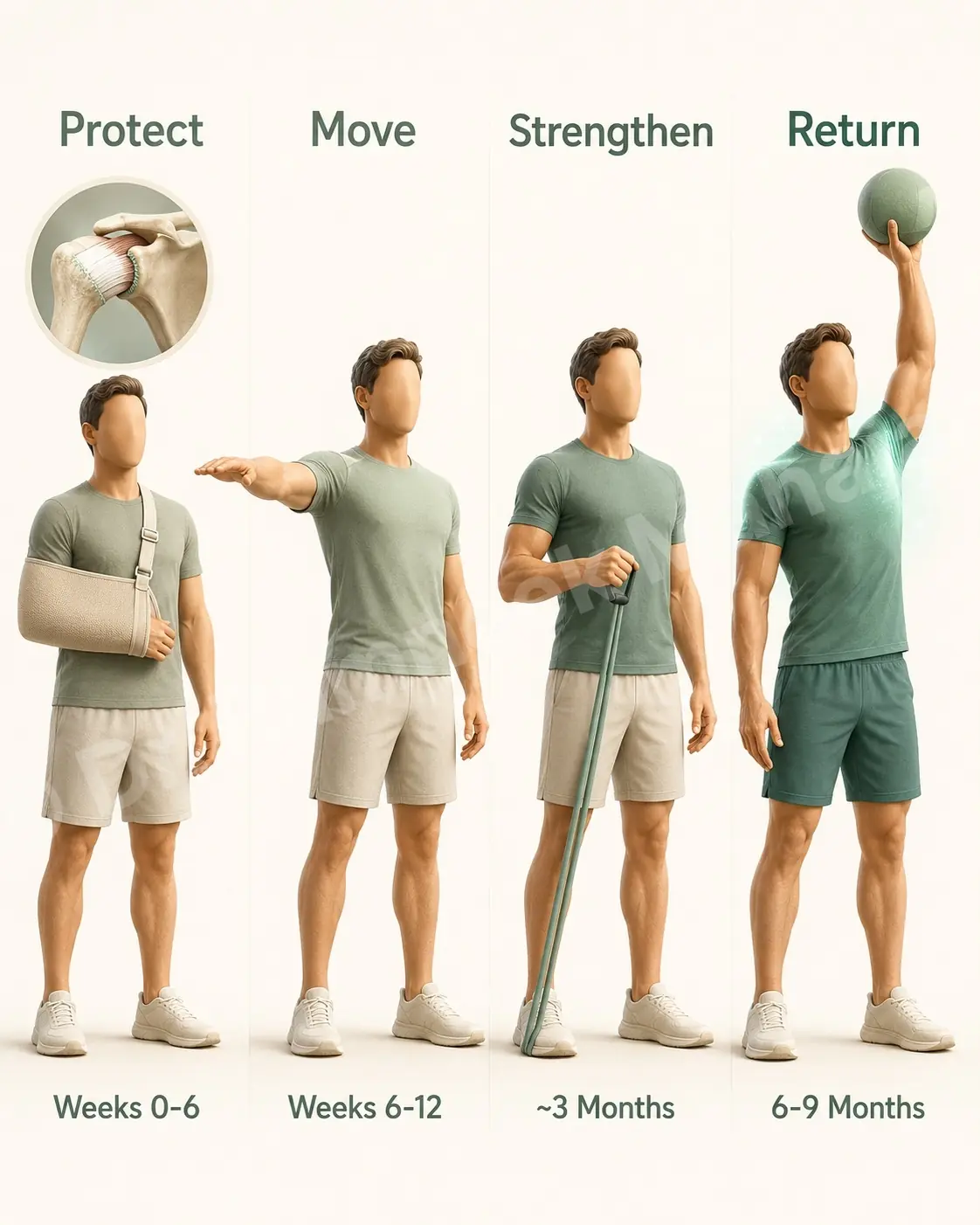
Recovery after rotator cuff repair is measured in months, not weeks, because the tendon has to heal back onto bone before it can be loaded. The arc runs from protection, to movement, to strength, with a return to full activity usually between 4 and 6 months, and up to 6 to 12 months for large tears.
The recovery phases, in plain terms
Protect (the first weeks): the arm is rested in a sling so the repair can start to heal. Gentle movement is guided by the team.
Move (the early months): passive and then active movement is built back up, and the everyday range returns.
Strengthen (from around 3 months): loading and strengthening begin once the repair is secure.
Return (4 to 6 months; longer for large tears): a graded return to heavier and overhead activity.
What makes a repair more likely to heal?
Being under 70, with a small tear (under 3 cm) and a healthy tendon
Following the full 4 to 6 month rehabilitation, including the weeks in a sling
Not smoking, and good control of diabetes
Carefully selected patients over 70 also do well, so age alone is not a barrier. And if you are not having surgery, the physiotherapy path is not "do nothing" - it is an active 8 to 12 week strengthening programme that is the treatment in its own right.
If you do choose surgery, the next question is who should do it.
05 How do you choose a surgeon for a rotator cuff tear?
Choosing a surgeon for a rotator cuff tear comes down to four checks. The four below are what actually matter to the result.
Arthroscopic shoulder experience. Rotator cuff repair is keyhole surgery; you want a surgeon who does arthroscopic shoulder work regularly.
Honest counsel on whether you even need surgery. The right surgeon will tell you plainly when physiotherapy is the better first step, and will not push a repair you may not need.
Physiotherapy support. The result depends as much on the 4 to 6 months of rehabilitation as on the hour of surgery. Ask what physiotherapy support the practice provides.
Follow-up. A surgeon who reviews you through the recovery, not just at discharge, is tracking the outcome that matters - your return to function.
For context
Dr Ramneek performs arthroscopic shoulder surgery, including rotator cuff repair, at Max SMART Saket, alongside a high-volume knee and hip joint-replacement practice. The point of this page is not to push surgery - it is to help you work out whether you need it, and to be clear that if you do, this is surgery the practice performs.
Every patient is personally assessed by Dr Ramneek, even when seen by the team - this may add to OPD waiting times, but ensures the doctor's direct evaluation in your case.
A question that sits behind the decision for many people: what does this cost?
06 How much does rotator cuff treatment cost?
The cost of treating a rotator cuff tear depends on the path. Structured physiotherapy is a course of sessions over weeks to months. Arthroscopic repair depends on the size of the tear, the type of hospital, and your specific situation. There is no single figure that would be honest across these variables.
One honest point is worth making: for many people - particularly an older shoulder with a gradual tear - physiotherapy is both a clinically reasonable first step and the lower-cost one. That is a real part of the conversation, not an afterthought.
For a specific figure - what insurance covers, and the options for your situation - the team works through it at or after the first consultation. That is the right setting for those numbers, not a webpage.
Before deciding, an honest look at what repair can and cannot promise.
07 Does rotator cuff surgery work, and what can go wrong?
Rotator cuff repair is a well-established operation that works for most people who need it, but it is not a guarantee, and an honest page says so plainly. Here is what the published evidence shows, in ranges, not promises.
What the evidence shows
Pain relief is reliable. The main goal of repair is relief of pain, and that is achieved predictably in around 80 percent of patients. Return of strength and function is also common but less predictable, and depends on the tear and the rehabilitation.
Non-surgical treatment helps many. Around 60 percent of full-thickness tears managed without surgery do well, which is why physiotherapy is a legitimate first choice for many shoulders.
Repair works for most. Here is the honest version of the risks.
Re-tear is the risk to respect. The repaired tendon can fail to heal or re-tear, reported across studies in 20 to 65 percent, with the higher figures for large tears and older patients. The reassuring part: even when the scan is not perfect, many people keep good pain relief and function at 10 years.
Some shoulders heal less well. Failure is more likely with large or massive tears (over 3 cm), significant muscle wasting, older age, diabetes, and smoking. This is why careful selection matters.
Waiting has a cost too. Left alone, about 50 percent of full-thickness tears enlarge over roughly 2 years, and a long-standing tear can become difficult or impossible to repair.
Results vary by person. A 55-year-old with a small acute tear who follows the rehabilitation will usually track differently from a 70-year-old with a large, long-standing tear. Both can do well; their recovery curves will not look identical. The numbers above are population averages, not individual forecasts.
One last, fair question: who is telling you all this?
Frequently Asked Questions (FAQs)
This guide was written and clinically reviewed by Dr Ramneek Mahajan - an orthopaedic surgeon at Max Smart Super Speciality Hospital, Saket, New Delhi. He performs arthroscopic shoulder surgery, including rotator cuff repair, alongside a high-volume knee and hip joint-replacement practice, and holds international fellowship training.
For the full credentials record - fellowships, society roles, publications - see the credentials page.
For press coverage and media features, see In the news.
Meet Your Surgeon
Can I safely wait?
The questions worth asking before you decide - and when waiting is the right call, and when it is not.
Before we meet
→
What should I expect, step by step?
The whole path, stage by stage - getting ready, the day itself, recovery, physio, life after.
Patient journey
→
Where did he train?
Fellowships, years in practice, and international experience
Credentials and experience
→






Powered by RAiZEN · Built in India, for the world · © 2026 RAiZEN
Go to RAiZEN website