The same way as with clinic sessions. In Dr Ramneek Mahajan's unit, the physiotherapist leads your day-to-day rehabilitation. Between reviews, a care coordinator is your point of contact after surgery. Are you or your physiotherapist worried? Perhaps the joint is not bending as far as expected, you are not walking well, or you are getting worse. Tell the care coordinator straight away. Do not wait for the next appointment. A warning sign is different. For any warning sign, such as new calf pain or swelling in the leg, sudden breathlessness or chest pain, a fever above 38°C (100.4°F), or a leg that will not take your weight, go to the nearest emergency department first. Then call the team. At your review appointments, starting with the six-week review, your surgeon checks your progress directly. This works the same way at home or at a clinic. It can break down if a physiotherapist outside the unit never reports a problem. So before you choose a physiotherapist, ask how they would contact your surgical team. They can use the physiotherapist number on your discharge ticket.
Knee & Hip
Home or clinic? Usually both, in order. How to choose.
 Reviewed by Dr. Ramneek Mahajan
This guide was written and clinically reviewed by Dr Ramneek Mahajan, Chairman of Orthopaedics, Joint Replacement and Chief Robotic Joint Replacement, Max SMART Saket, New Delhi. His unit arranges physiotherapy at home where it is appropriate, moves patients to clinic sessions as their recovery allows, and reads the trend at each review. The aim here is the same as it is in clinic, said plainly: what each place can and cannot do, and how to choose the person who supervises you.
~15 min read
· Last reviewed:
In short
After a joint replacement, physiotherapy starts in hospital for everyone. After you go home, it continues with home visits, clinic sessions, or both. Most people have home visits first and clinic sessions later. In Dr Ramneek Mahajan's unit, the team decides the move to clinic sessions with you. The decision depends on how well you move, your balance, the support you have at home, and what your rehabilitation needs. There is no fixed date.
This guide is for you if you are having a knee or hip replacement and need to decide where your physiotherapy will happen. Your surgery may be booked, or you may be about to go home from hospital. The guide is also for the family member who organises care in the first weeks. It is also for patients who come to Delhi for surgery and then go home to another city.
Who it is not for
This guide is not your exercise programme. After a knee replacement, your week-by-week exercises are in the guide "Physiotherapy after knee replacement, week by week". After a hip replacement, your physiotherapy team gives you your exercises. Your surgical team knows your case. If their advice is different from anything you read here, follow your surgical team.
01
What are your physiotherapy options after a joint replacement?
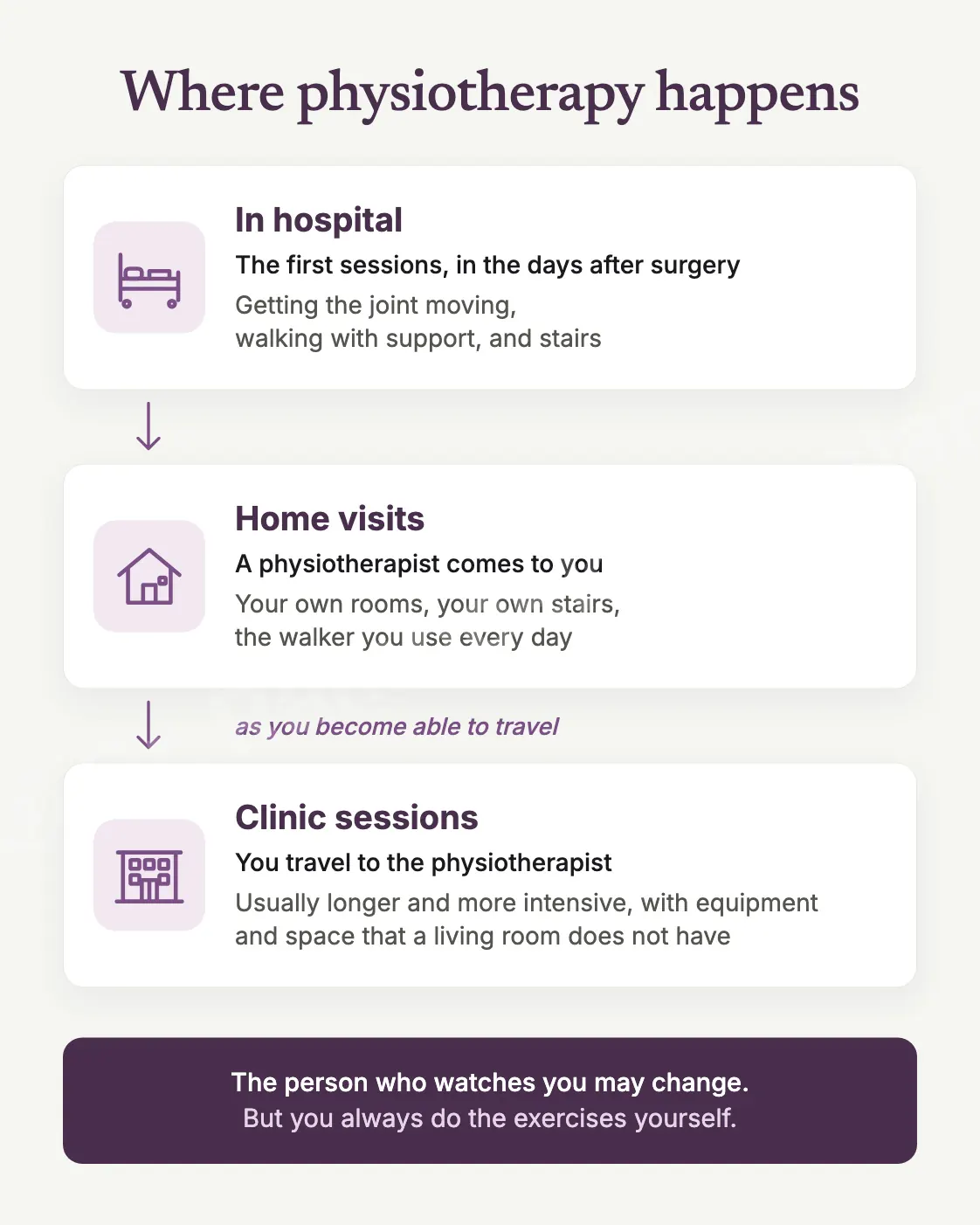
There are three places: the hospital, your home, and a clinic. Most people use all three, one after the other.
Physiotherapy after a knee or hip replacement starts in hospital, for everyone. After you go home, a physiotherapist can visit you at home, or you can go to a clinic. Most people have home visits first, and clinic sessions later, once they are able to travel.
In Dr Ramneek Mahajan's unit, physiotherapy at home can be arranged where it is appropriate, moving to clinic sessions as your recovery progresses.
What happens in each place?
In hospital.
The first sessions happen in the days after surgery. The team gets the joint moving and helps you walk with support and manage stairs. The team wants you to be safe on your own before you go home.
Home visits.
A physiotherapist comes to your home. You practise in your own rooms, on your own stairs, with the walker you use every day. The physiotherapist gives you exercises to do between visits, and makes them more challenging as you get stronger.
Clinic sessions.
You travel to the physiotherapist. Sessions are usually longer and more intensive. A clinic has equipment and space that a living room does not have, and the physiotherapist can guide you closely through more demanding exercises.
What stays the same, at home or at a clinic?
You still do your own exercises every day, at home or at a clinic. They are part of a planned programme. The programme rebuilds your strength, flexibility and balance. It helps you walk well again, and it helps the joint work well in the long term. The programme has three parts, and you do all three yourself:
exercises at home, every day
walking, several times a day
going to every physiotherapy session when it is scheduled
Surgery replaces the joint. Physiotherapy restores the movement. Most of your physiotherapy is the exercise you do yourself, between sessions. At home or at a clinic, a different person may watch you exercise. But you always do the exercises yourself.
02
Is this guide for you?
Yes, if you are deciding where your physiotherapy will happen after a knee or hip replacement.
For other questions, read these guides:
After a knee replacement, the week-by-week exercises are in physiotherapy after knee replacement, week by week.
After a hip replacement, you need different exercises from a knee. Your physiotherapy team gives you your hip exercises.
If you are still deciding whether to have surgery, read the total knee replacement or total hip replacement page.
03
How does physiotherapy start, before you choose anything?
Physiotherapy starts in hospital, before you choose anything about home or clinic. Most patients stand and take their first steps with support on the day of surgery or the next day.
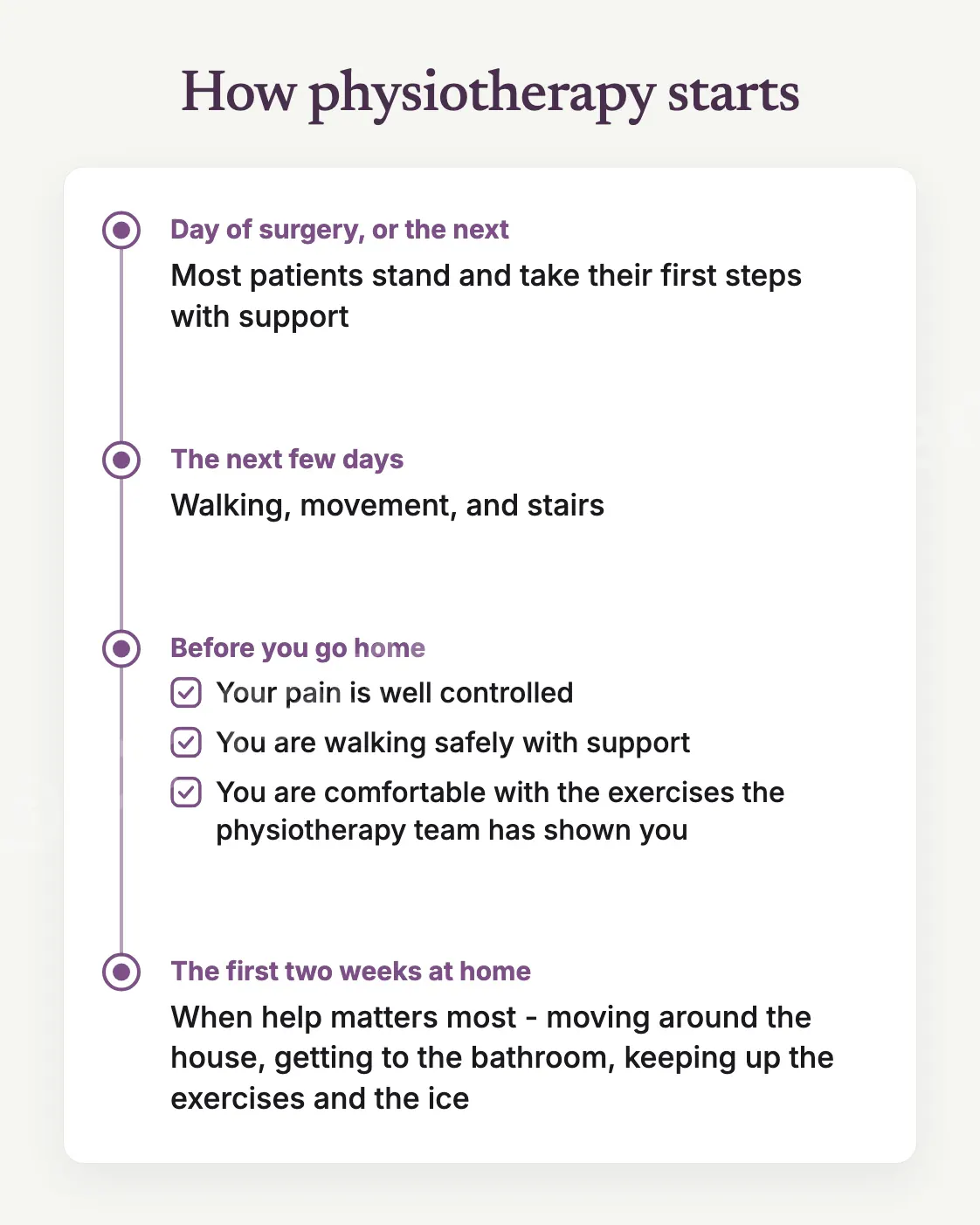
The first sessions use simple exercises. They get the joint moving, ease stiffness and build your confidence on your feet. Over the next few days, the team helps you with walking, moving and stairs. The aim is that you can move around safely before you go home.
What must be true before you leave hospital?
Three things:
Your pain is well controlled
You are walking safely with support
You are comfortable with the exercises the physiotherapy team has shown you
After you go home, your physiotherapist starts from the exercises you already know and adds to them.
You need the most help in your first two weeks at home. You may need help to:
move around the house
get to the bathroom
keep up your exercises and your icing
Needing help early is normal and temporary. Your team plans for it. It is also the main reason most early sessions happen at home.
04
When does physiotherapy at home make sense?
In the early weeks, home is usually the safer choice, because the trip to a clinic can be risky at that stage. Home visits continue until the team decides, with you, that you are ready for clinic sessions. Home is usually the better choice in these four situations:

The first days and weeks after you leave hospital.
When you use a walker, the trip is hard work. You have to get to the car, get in and out of it, and cross the clinic car park. A fall in these first weeks does more harm than a missed session. At this stage, the exercises are simple and you do them often. A physiotherapist needs to check that you do them correctly. You do not need equipment.
Walking is still limited, or both joints were replaced together.
You may not yet be able to walk far safely. Or two joints may be healing at the same time. Then a physiotherapist can come to you, so you do not miss sessions.
Other health problems, or being frail.
A heart or lung condition, poor balance, or weakness before surgery can make the trip itself risky. If this is you, start with home visits, and go to the clinic only when the trip is safe. Some people in this group are not yet ready to leave hospital at all. The team decides this using the three checks before you leave hospital, listed in section 03.
No one at home who can help you move safely.
You need someone who can hold you steady on the stairs and help you get to a car. Your husband or wife may be a great support, and still not be able to steady you on the stairs or help you into a car. If no one at home can help you move, you need extra help for the first weeks. Needing extra help is normal, and Dr Ramneek Mahajan's team plans for it. Tell the team before your surgery date if you live alone, or if the person at home cannot help you move. Published research names living alone as one of several things linked with a less satisfying recovery after a knee replacement.
Does physiotherapy at home actually work?
For hip replacement, two published trials help answer this:
No measurable difference between home and clinic.
One trial compared a home programme with a clinic programme after hip replacement. Both groups improved in stair climbing, walking distance, and getting up and moving. Neither group did measurably better than the other. In this trial, the place made no measurable difference to the result.
A better programme gave better results.
Another trial looked at people some months after a hip replacement. One group did a structured home programme that became more challenging step by step. The other group did basic exercises. The first group became stronger and steadier. They also said they could manage daily tasks better. Here, the quality of the programme made the difference.
Both trials were after hip replacement. For the knee, research shows that a physiotherapist guiding you makes a difference. Exercises guided by a physiotherapist help the knee bend further. Sometimes a stiff knee needs a manipulation, a short procedure in which the knee is bent for you, under anaesthesia, in a controlled way. Guided exercises lower the chance that you need one. So after a knee replacement, it matters even more to have supervised visits rather than a sheet of exercises.
One published study followed over 900 hip replacement patients who went home to manage their own exercises. About a third had to be prescribed sessions with a physiotherapist because their recovery was slow.
Home physiotherapy works most reliably with two parts. A physiotherapist visits you. And you do your own exercises every day. At each visit, the physiotherapist:
sets your exercises
checks how you do them
measures how far your joint bends, or how you walk, the same way each time
makes the exercises more challenging when the joint is ready, and keeps them the same or makes them easier when it is not
tells your surgical team if, over the weeks, your joint is not bending as far as expected or your walking is not improving
05
How do you choose - and what should you ask any physiotherapist?
Check five things before you agree to any physiotherapist, whether Dr Ramneek Mahajan's team arranges them or you find your own. If you find your own, make sure the team has their name. You may not want to ask a professional these questions yourself. That is fine. Give the physiotherapist's name to the team before your surgery date, and ask the team for advice.
A qualified physiotherapist.
The person should have a physiotherapy degree. An assistant or a trainer is not enough. Ask which degree they have. Some states have a physiotherapy council. If yours does, ask whether they are registered with it.
Experience with joint replacements.
Ask how much of their work is with people recovering from a knee or hip replacement, and how recently they have done this work.
A plan to make the exercises more challenging over time.
Ask what they measure. Ask how they decide when to make your exercises more challenging. A good physiotherapist will tell you what they measure, and will measure it the same way at every visit. For a knee, they measure how far it bends, how straight it goes, how you walk, and the swelling. For a hip, they measure how you walk, any limp, and the strength around the hip.
Contact with your surgeon.
Ask how they will tell the surgical team about your progress between reviews. Ask what they would do if you stopped improving. In Dr Ramneek Mahajan's unit, a care coordinator is your point of contact after surgery. If you or your physiotherapist are worried, tell the care coordinator straight away. Do not wait for the next appointment. A physiotherapist outside the unit can call the physiotherapist number on your discharge ticket. If a physiotherapist cannot tell you how they would report a problem, choose someone else.
Knowing the warning signs.
Ask what they would do about each warning sign listed below. The right answer is that every one of these signs means going to the nearest emergency department at once, and then calling the team.
Which warning signs need action now?
Know these signs yourself too, wherever you are recovering.
If you have any of these signs, go to the nearest emergency department straight away. Then call the team to let them know.
new calf pain, or tenderness or swelling in the leg, which can be a sign of a blood clot
sudden breathlessness, chest pain or a racing heart
a fever above 38°C (100.4°F), or chills
a wound that is leaking, or redness that is spreading
a sudden jump in pain after you had been improving
severe pain that never lets up
a leg that suddenly looks shorter, or turned the wrong way
difficulty taking weight on your leg, or not being able to take weight on it at all
The leg signs need checking quickly. After a hip replacement, a leg that suddenly looks shorter or turned the wrong way usually means the joint has come out of place. After a hip or a knee replacement, a leg that has changed shape or will not take weight can mean a break in the bone around the implant. This is more likely after a fall or a stumble.
This applies wherever you are recovering, including far from Delhi. To call the team, use the phone number they give you before you leave hospital.
When does the switch from home to clinic happen?
There is no fixed timeline. In Dr Ramneek Mahajan's unit, the team decides with you, and the decision depends on:
how well you move
your balance
the support you have at home
what your own rehabilitation needs
In Dr Ramneek Mahajan's unit, home physiotherapy is arranged through physiotherapists the unit regularly works with. Therapy shifts to the clinic once you are mobile enough to travel safely and can benefit from more intensive supervised rehabilitation.
At your review, Dr Ramneek Mahajan and the team make this decision with you. In the unit's own words:
Every patient is personally assessed by Dr. Ramneek, even when seen by the team - this may add to OPD waiting times, but ensures the doctor's direct evaluation in your case.
If you are not sure whether it is time to move to the clinic, say so at the review. Do not decide alone.
What if you are going home to another city?
Plan your physiotherapy before your surgery date, not after you leave hospital. Bring the name of a physiotherapist near your home to the consultation, and check them on the five things listed above.
Your local physiotherapist can call the physiotherapist number on your discharge ticket. The unit then coordinates your progress with them.
The unit prefers your six-week review to be in Delhi, so plan to come back for it.
Before you leave hospital, confirm:
that the team has your physiotherapist's name
when it is safe to travel home by road, train or air, and what to do on the way to lower the risk of a blood clot
At the consultation, also ask:
whether the unit's own physiotherapists can reach where you will be staying in the first weeks
what to do if the physiotherapist near your home is not right for you
06
What decides the cost, and what should you confirm before committing?
The cost depends on three things:
Where the sessions happen.
A home visit includes the physiotherapist's travel, so it is priced differently from a clinic session.
How often.
Sessions are most frequent in the early weeks.
How long.
A package is a set number of sessions that you pay for in advance. How long you need physiotherapy depends on your progress, not on the number of sessions in a package.
At the consultation, the team tells you what this means for your own case.
Before you agree to any physiotherapist, or to any package of sessions, get these answers in writing:
How many sessions are included, and over what period
Whether home visits are available, for how long, and how the move to clinic sessions works
Who will supervise the sessions, with their qualification and their experience with joint replacements
How your progress is measured, and by whom
What happens if a session is missed, by you or by the physiotherapist
Whether your insurance covers physiotherapy after surgery, at home, at a clinic, or both
07
Can you manage with just an exercise sheet and no physiotherapist?
Some people manage with just a sheet of exercises. Others do not. You cannot know in advance which group you will be in.
In one study, about a third of patients who managed their own exercises after a hip replacement later needed prescribed sessions because their progress was slow. After a joint replacement, a slow recovery is harder to put right if you find it out late.
This is even more important after a knee replacement. Sometimes a knee stops bending further before it bends far enough. If this happens, treatment works better when it starts early. If your knee does not bend well early on, it is far more difficult to make it bend later.
With only a sheet of exercises, no one sees your mistakes. You may hold your knee still to protect it, when it needs to move. Or you may do an exercise in a way that does not work the joint. A physiotherapist can spot these mistakes at each visit. (If your knee has stopped bending before it bends far enough, read stiff knee after replacement.)
Wherever your sessions happen, Dr Ramneek Mahajan's unit asks you to do three things:
do your home exercises every day
walk several times a day
come to your physiotherapy sessions when they are scheduled
Follow this simple routine every day. It is called the Rule of 20:
Rule of 20: move, ice, rest, repeat.
Twenty minutes of activity. Twenty minutes of icing. Twenty minutes of rest. Through the waking hours, during recovery at the hospital and at home. The Rule of 20 is followed in Dr Ramneek Mahajan's unit. Follow it every day, whether or not a physiotherapist is with you. Your sessions are part of this routine. They do not replace it. Follow the Rule of 20 until your physiotherapist tells you to stop.
Clinic timings for both of Dr Ramneek Mahajan's clinics, and how to book an appointment, are on one page.
By appointment only.
Questions people ask
Who is telling you this?
This guide was written and clinically reviewed by Dr Ramneek Mahajan, Chairman of Orthopaedics, Joint Replacement and Chief Robotic Joint Replacement, Max SMART Saket, New Delhi. His unit arranges physiotherapy at home where it is appropriate, moves patients to clinic sessions as their recovery allows, and reads the trend at each review. The aim here is the same as it is in clinic, said plainly: what each place can and cannot do, and how to choose the person who supervises you.
Keep reading
Related clinical case studies
Complication handled
Total knee replacement
Can a knee replacement go ahead when the tests before surgery find blood pressure out of control?
Clinically reviewed ·
Complication handled
Robotic hip replacement
Can both hips be replaced on the same day when one leg has become shorter and the pelvis is tilted?
Clinically reviewed ·
Day by day
Robotic knee replacement
What should decide a knee replacement when rheumatoid arthritis no longer responds to painkillers?
Clinically reviewed ·