Physiotherapy after knee replacement: what each week actually looks like
Last Reviewed:
5 September, 2026
~12 min read
Reviewed by:
Dr. Ramneek Mahajan
Dr. Mahajan is Chairman Orthopaedics, Joint Replacement & Chief Robotic Joint Replacement at Max Smart Super Speciality Hospital, Saket.
This guide is for anyone who has just had a knee replacement - or has a date set - and wants to know what the physiotherapy actually involves, week by week. It is equally for the family member helping at home: the first two weeks are when your help matters most, and the plan below names your part in it.
This guide is not for someone still deciding whether to have a knee replacement - the total knee replacement page covers that decision. And it does not replace your own physiotherapist's instructions: where they differ, your team's plan wins, because it is built on your knee.
01 What does physiotherapy after knee replacement actually do?
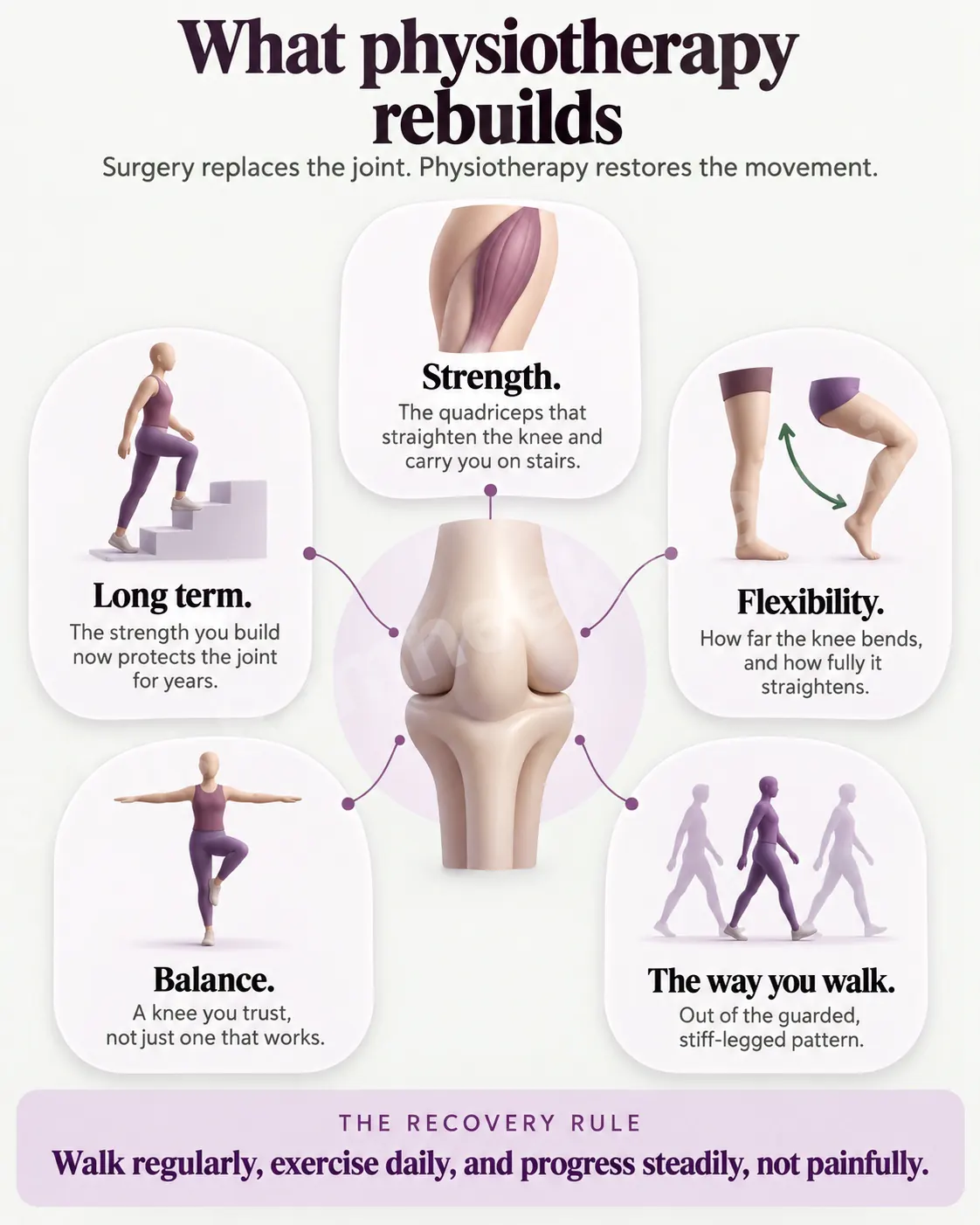
The operation gives you a new knee joint. What it cannot give you is the strength, the bend, and the confidence to use it - those are built in the weeks after surgery, and physiotherapy is how they are built. Surgery replaces the joint. Physiotherapy restores the movement.
What does the programme actually rebuild?
Strength - especially the quadriceps, the muscles on the front of the thigh that straighten the knee and control you on stairs
Flexibility - how far the knee bends, and how fully it straightens
The way you walk - out of the guarded, stiff-legged pattern the painful knee taught you
Balance - so the new knee is one you trust, not just one that works
How well the joint works long term - the strength you build now protects the implant for years
Rest is part of the work, not a break from it. A structured programme alternates effort with icing and rest, because the knee recovers between the sessions, not only during them. That is why the recovery rule in Dr Ramneek Mahajan's unit reads: walk regularly, exercise daily, and progress steadily, not painfully.
What that looks like, day by day and week by week, is the rest of this guide.
02 Is this guide for you?
This guide is for you if your knee replacement is already done - you are in the first days or weeks and want to know whether you are on track - or if your surgery date is set and you want to see the road before you walk it. It is written just as much for the person helping at home: a spouse, a son or daughter, an attendant. The first two weeks are when that help matters most, and it gets lighter every week after.
If you are still deciding whether to have a knee replacement at all, start with the total knee replacement page instead - that decision has its own questions, and this guide assumes it is behind you.
One honest line before we start: your own physiotherapist's instructions outrank this page. This guide describes the pattern most recoveries follow in Dr Ramneek Mahajan's unit; your programme is shaped around your knee.
03 What happens in the first days, while you are still in hospital?
Physiotherapy does not wait for you to feel ready. Most people stand and take their first steps, with support and a walker for balance, on the day of surgery or the next. Starting early is deliberate: it keeps the circulation moving, wakes the thigh muscle, and teaches you - on day one - that the new knee can be used.
Which exercises come first?
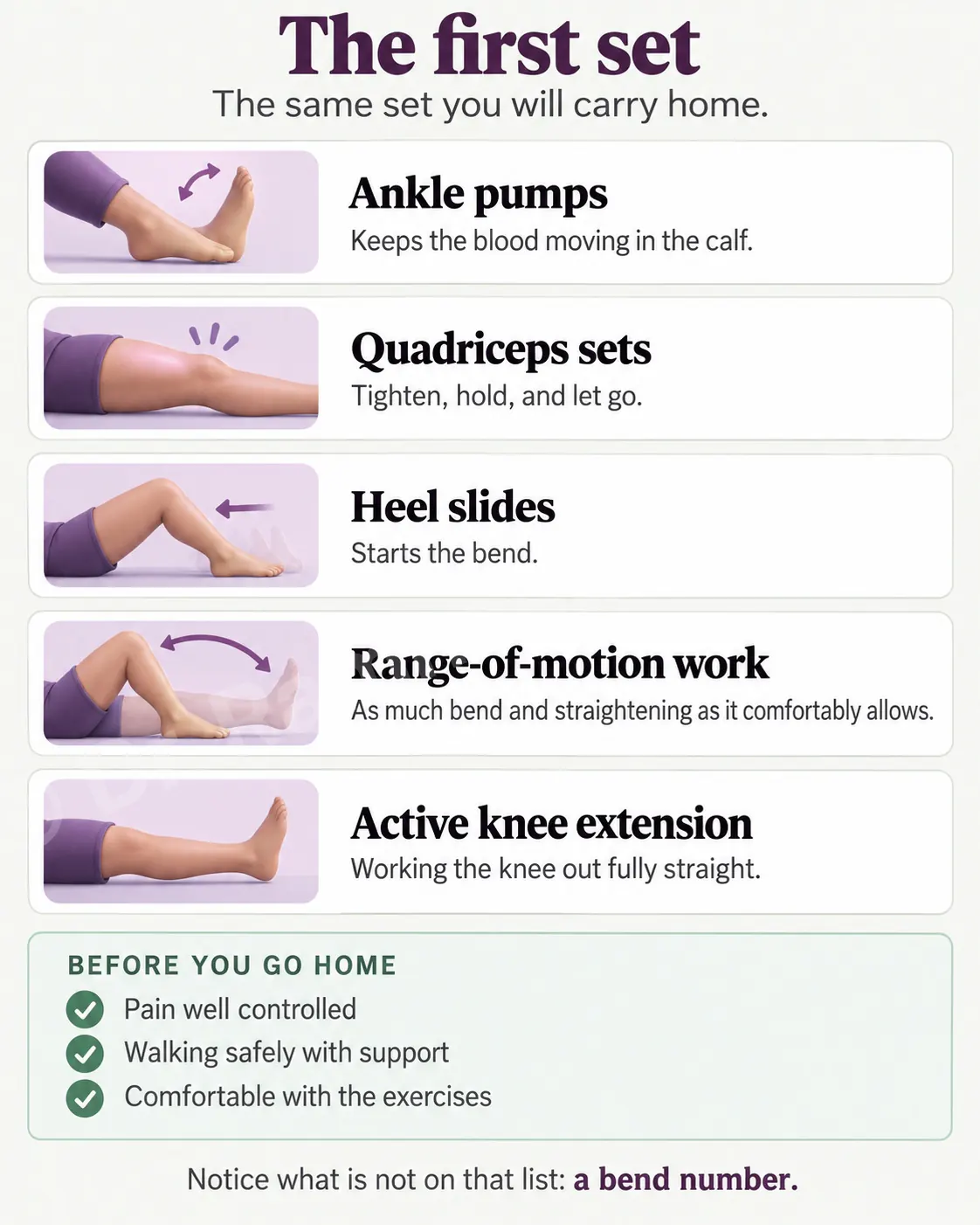
The in-hospital set is simple, and it is the same set you will carry home:
Ankle pumps - moving the foot up and down to keep blood flowing in the calf
Quadriceps sets - tightening the muscles on the front of the thigh, holding, and letting go
Heel slides - sliding the heel towards you to start the bend
Range-of-motion work - taking the knee through as much bend and straightening as it comfortably allows
Active knee extension, and extension positioning - working the knee out fully straight, and resting it in a straight position
Over the next few days the physiotherapy team works with you on walking, getting in and out of bed and chairs, and stairs - so you can be safely independent before you go home. Stairs are taught before discharge, not discovered after it.
What must be true before you go home?
Your pain is well controlled
You are walking safely with support
You are comfortable with the exercises the physiotherapy team has shown you
You will notice there is no bend number on that list. Discharge day is not a bend milestone - the first formal bend target sits at the two-to-three-week mark, and the next section covers it.
Home is where the real programme begins.
04 What does each week look like?
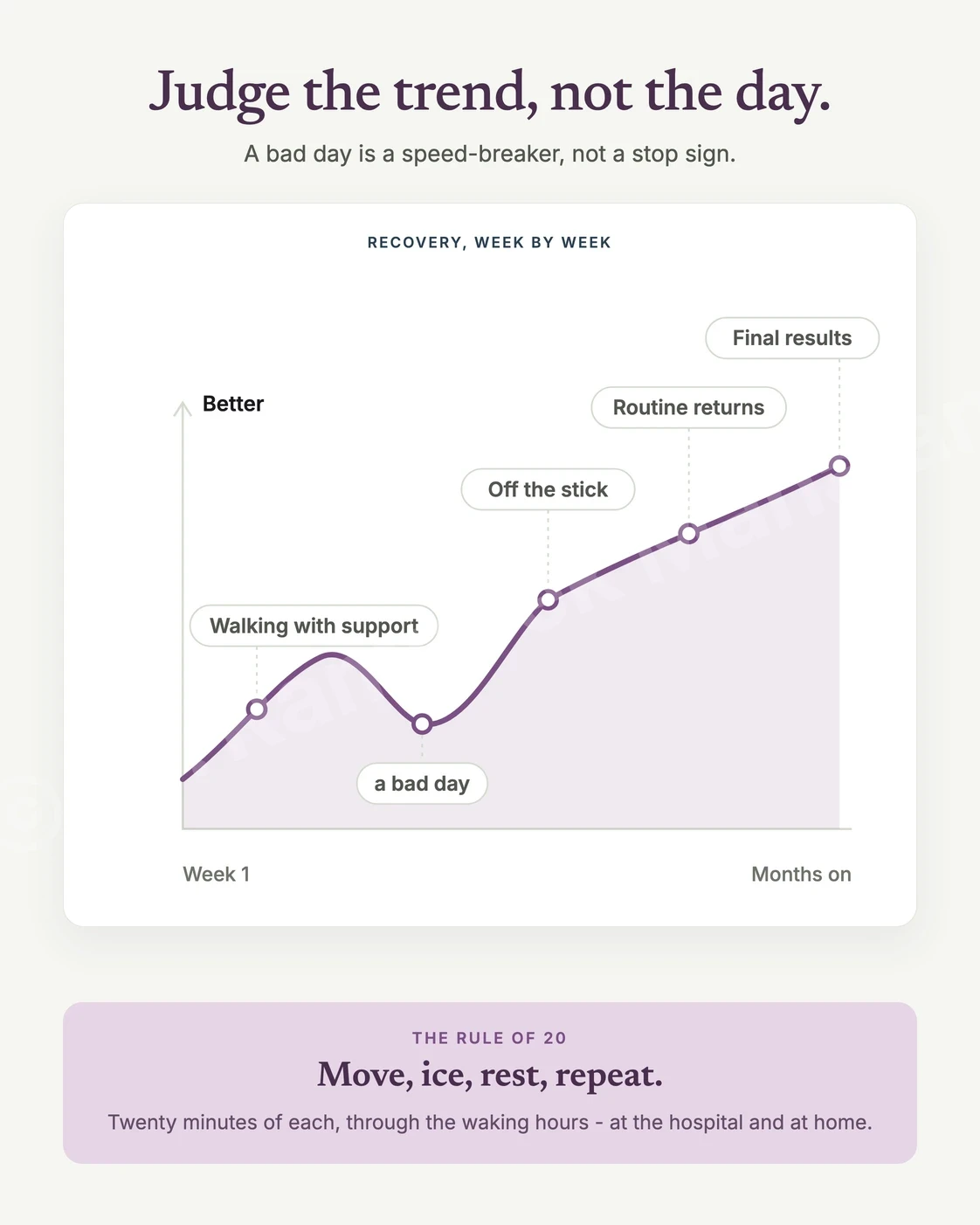
Most recoveries follow the same four phases. The week-by-week pattern below is the one Dr Ramneek Mahajan's unit tracks - and this guide adds what the work inside each phase actually is. Judge yourself by the trend across weeks, never by any single day.
Rule of 20: move, ice, rest, repeat.
Twenty minutes of activity. Twenty minutes of icing. Twenty minutes of rest. Through the waking hours, during recovery at the hospital and at home. The Rule of 20 is followed in Dr Ramneek Mahajan's unit, and it is the daily rhythm to keep whatever the week - especially in the first two weeks at home.
Week 1: what does the first week at home look like?
Week 1 is walking with support, pain and swelling brought under control, and physiotherapy beginning in earnest - you start doing everyday things for yourself again.
The home set is the hospital set, done frequently: ankle pumps, quadriceps sets, heel slides, range-of-motion work, and active knee extension - alongside short, regular walks around the house. Little and often beats one long push, and that is exactly what the Rule of 20 paces for you. Your physiotherapist works with you most days at this stage; the session plan is in section 06.
Weeks 2 to 6: how much should the knee bend?
Weeks 2 to 6 are walking longer distances, strength building, and the knee bending further, with less and less need for the walker or stick. This is the phase with the clearest targets in the unit:
The bend: around 90 to 100 degrees by 2 to 3 weeks - roughly a right angle, enough to sit on a normal chair - and 110 to 120 degrees by 6 weeks
The stick: most patients are off it by around 4 to 6 weeks, judged on gait and confidence, not on the calendar
Driving: usually possible at 3 to 4 weeks, provided pain is controlled and you have adequate control of the leg
The stationary cycle: from around 4 to 6 weeks, once the bend allows it, starting at low resistance
Targets are direction, not verdict. Reaching week 3 with less bend than the number says is a reason to work on the bend with your physiotherapist - not a sign something has gone wrong. The trend over two weeks tells you more than the number on any single day.
Weeks 6 to 12: what happens at the six-week review?
Weeks 6 to 12 are when most of your routine comes back - longer walks, driving once it is safe and advised, stamina and confidence building over time.
A six-week clinical review is standard practice in the unit. It checks your pain, the wound, swelling, the way you walk, the knee's stability, quadriceps strength, and the range of motion - especially how fully the knee straightens, as well as how far it bends. If progress is satisfactory, physiotherapy is progressed rather than simply stopped.
The review is also where a stalling bend is taken seriously. If the bend remains short of 90 degrees at around six weeks despite intensive physiotherapy, a manipulation under anaesthesia may be considered, depending on the overall clinical picture - the knee is bent for you, under anaesthesia, in a controlled way. Doing the daily work through the early weeks is what makes that conversation unlikely to be needed.
Three to twelve months: when do the final results come?
From 3 to 12 months, strength, comfort, balance, and movement keep improving. Final results usually come within a year. By this phase the programme has become simple habits: regular walking, stairs as exercise rather than obstacle, and the strength work that protects the new joint over the long term.
Is the plan different after robotic surgery, or with both knees replaced together?
For robotic surgery, no - and it is worth saying plainly. Robotic techniques can involve less disturbance of the soft tissue around the knee, but the rehabilitation protocol does not change because the surgery was robotic: current evidence does not show a consistent, clinically meaningful early advantage in bend or function that would need a different programme. After both knees are replaced in one sitting, the programme is essentially the same, with greater emphasis on quadriceps activation, strength, and functional independence - and in appropriately selected patients, an early high-intensity programme can be beneficial.
One line for the difficult days: a bad day is a speed-breaker, not a stop sign. The signs that mean contact the team instead - and how to tell them apart from ordinary effort - are on the patient journey page, in the recovery stage.
Who keeps all of this on course? That is the next section.
05 Who guides your physiotherapy, and how is it supervised?
Day to day, your physiotherapist leads the rehabilitation. They set the exercises, progress them, and shape the programme around how you are actually progressing - not around a printed schedule.
In Dr Ramneek Mahajan's unit, sessions typically run 5 to 6 times a week at first, particularly in the first 2 to 3 weeks. Home physiotherapy is arranged through physiotherapists the unit regularly works with, and therapy shifts to the clinic once you are mobile enough to travel safely and can benefit from more intensive supervised rehabilitation.
The physiotherapist is not working alone. A care coordinator stays your point of contact after surgery, and your progress - the bend, the walk, anything that worries the team - reaches your surgeon at the clinical checkpoints, starting with the six-week review.
Every patient is personally assessed by Dr. Ramneek, even when seen by the team - this may add to OPD waiting times, but ensures the doctor's direct evaluation in your case.
The principle behind the structure is simple: physiotherapy decisions are clinical decisions. When the stick goes, when driving is safe, when the programme is progressed - each is judged on your knee, by the people who have examined it.
The practical question that follows: how many sessions, and what should you plan around them?
06 How many sessions will you need, and what should you plan for?
Plan for typically 5 to 6 physiotherapy sessions a week at the start, particularly in the first 2 to 3 weeks, tapering as you become independent with the exercises. How long the full programme runs differs from knee to knee, and three things decide most of it:
Your strength before surgery - a knee that walked regularly before the operation rebuilds faster after it
One knee or both - a single knee borrows strength from the other leg; both knees at once ask more of the thigh muscles and of the programme
Your progress trend - the programme is progressed, paused, or extended on what your knee is doing, not on a fixed calendar
When can you plan everyday life again?
Useful planning windows from the unit. Each is a typical window, confirmed for your own knee at review - not a promise:
Activity | Typical window | What decides it |
|---|---|---|
Desk work | Often 2 to 6 weeks | Comfort sitting, pain control, the travel to work |
Standing or physical work | Usually 6 to 12 weeks | Strength and stamina on your feet |
Driving | Usually 3 to 4 weeks | Pain controlled, adequate control of the leg |
Long car trips | Once comfortable | A stop every 1 to 2 hours to walk and move the knee |
Short flights | Around 6 weeks | Blood-clot risk and surgeon clearance |
Longer flights | Preferably 8 to 12 weeks | Blood-clot risk and surgeon clearance |
Stationary cycle | Around 4 to 6 weeks | Enough bend, starting at low resistance |
Swimming | Commonly 4 to 6 weeks | The wound completely healed |
What should you confirm before the programme starts?
How many sessions a week, and whether they start at home or at the clinic
Who to call between sessions if something worries you
How your progress reaches the surgeon between reviews
What the house needs ready: the walker, a firm chair, and clear walkways
Costs vary with the setting, the frequency, and how long your programme runs - the team walks you through the specifics for your case at the consultation.
And if part of you is tempted to skip all of this - the last section is for you.
07 What happens if you skip the exercises?
The honest answer: the knee is very likely to stiffen. The weeks right after surgery are when the new knee is most willing to bend - internal scar tissue forms early, and a knee that is not moved through its range settles into less of it. Bend lost early is far harder to win back later.
The daily work is also what keeps the harder conversations away. A knee that stays short of 90 degrees of bend at around six weeks despite intensive physiotherapy is a knee being discussed for manipulation under anaesthesia. Most knees that do the work never come near that conversation.
Skipping sessions because the work feels hard is the trap - hard work has a feel to it, and it is not the same as the pain that means something is wrong. Mild muscle soreness, stiffness that passes, tiredness after a session that improves with rest: that is effort. Sharp or worsening pain, swelling that is increasing, pain that does not settle, or pain that comes with fever or discharge from the wound: those are warning signs - contact the team. And separately: new pain, swelling, or warmth in the calf, or any breathlessness or chest pain, needs urgent attention - not a wait for the next session. If you are unsure which you are feeling, ask. The team would always rather you asked.
Physiotherapy after a knee replacement is not a formality attached to the surgery. It is the half of the result you carry. The joint is the surgeon's work; the movement is yours - and the unit's programme, the Rule of 20, and the review checkpoints all exist so that your half succeeds.
Frequently Asked Questions (FAQs)
This guide was written and clinically reviewed by Dr Ramneek Mahajan, Chairman of Orthopaedics, Joint Replacement and Chief Robotic Joint Replacement, Max SMART Saket, New Delhi. His unit follows every joint replacement through the structured, physiotherapist-led programme this guide describes, with progress personally reviewed at each clinical checkpoint. The aim here is the same as it is in clinic: an honest account of what the weeks after a knee replacement ask of you, and what they give back.
Meet Your Surgeon
Can I safely wait?
The questions worth asking before you decide - and when waiting is the right call, and when it is not.
Before we meet
→
What should I expect, step by step?
The whole path, stage by stage - getting ready, the day itself, recovery, physio, life after.
Patient journey
→
Where did he train?
Fellowships, years in practice, and international experience
Credentials and experience
→






Powered by RAiZEN · Built in India, for the world · © 2026 RAiZEN
Go to RAiZEN website