Stiff knee after replacement: why the bend stalls, and what to do
Last Reviewed:
8 September, 2026
~18 min read
Reviewed by:
Dr. Ramneek Mahajan
Dr. Mahajan is Chairman Orthopaedics, Joint Replacement & Chief Robotic Joint Replacement at Max Smart Super Speciality Hospital, Saket.
This guide is for anyone whose knee replacement is done and whose bend has stopped moving - whether that is weeks, months or longer after surgery - who is doing the exercises and watching the same number come back every time. It is also for the family member helping at home, because at this stage the work is small and frequent, and a second pair of eyes on the trend is worth a great deal.
This guide is not about deciding whether to have a knee replacement, and it is not a revision guide - the revision knee replacement page covers that decision. It is also not a substitute for the person who has actually examined your knee: your physiotherapist and your surgeon set your plan, and this page describes the pattern behind it.
01 Is my stiff knee normal, or is something wrong?
Both are possible, and the difference is not how stiff the knee feels on any one morning. It is which way the bend is moving over weeks. Stiffness that is worst first thing and loosens as you move is expected. A bend that has stopped improving, week after week, is the one worth acting on - and that holds whether or not you have managed the exercises every single day.
What does a "stiff" knee replacement mean?
Movement narrowed enough to get in the way of ordinary life - a bend that stops short of a right angle, a knee that will not come fully straight, or both. There is no single agreed number for it in the medical literature, which is worth knowing before you measure yourself against someone else's.
How much bend does daily life actually need?
Less than most people assume. The movement each ordinary activity requires has been measured:
Walking on flat ground - roughly 45 to 65 degrees
Standing up from a chair without using your hands - about 70 to 95 degrees
Climbing stairs - about 83 to 90 degrees, with at least 90 to come back down
Sitting comfortably in a chair - about 95 degrees
Tying your shoes while seated - about 106 degrees
Kneeling - about 125 degrees
Around 95 degrees covers most activities of daily living. What people fear losing mostly sits above that line, not below it.
So how do you tell a stall from a slow week?
Use the trend, not the day. Ask your physiotherapist to record the bend the same way each visit - same position, same method - and read it across 2 to 3 weeks. A line still climbing, even slowly, is a knee responding. A line flat for several weeks is what this guide is about.
One caution before you read too much into a small change: a difference of a few degrees between visits can be the measurement rather than the knee. The angle is judged against bony landmarks and it shifts with your position and with who is holding the gauge. That is why the same method every time matters, and why a run of readings tells you more than any single pair of numbers - though a reading that keeps dropping is worth raising either way.
The first question a flat line raises is why. That has answers.

02 Is this guide for you?
Two things make this the right page for you. The first is that your replacement is done and the bend has stalled. The second is that you are already on a programme - because this page is about what to do when the programme is not producing the bend, not about the programme itself. If you are not sure what yours should look like week by week, read physiotherapy after knee replacement, week by week first; it carries the exercises, the targets and the daily rhythm.
If the question in front of you is instead whether the knee needs further surgery, this is not that page - that is revision knee replacement, an operation to exchange or adjust the implant you already have, and it has its own criteria. And your own physiotherapist's instructions outrank this page: your programme is shaped around your knee.
03 Why does a replaced knee get stiff?
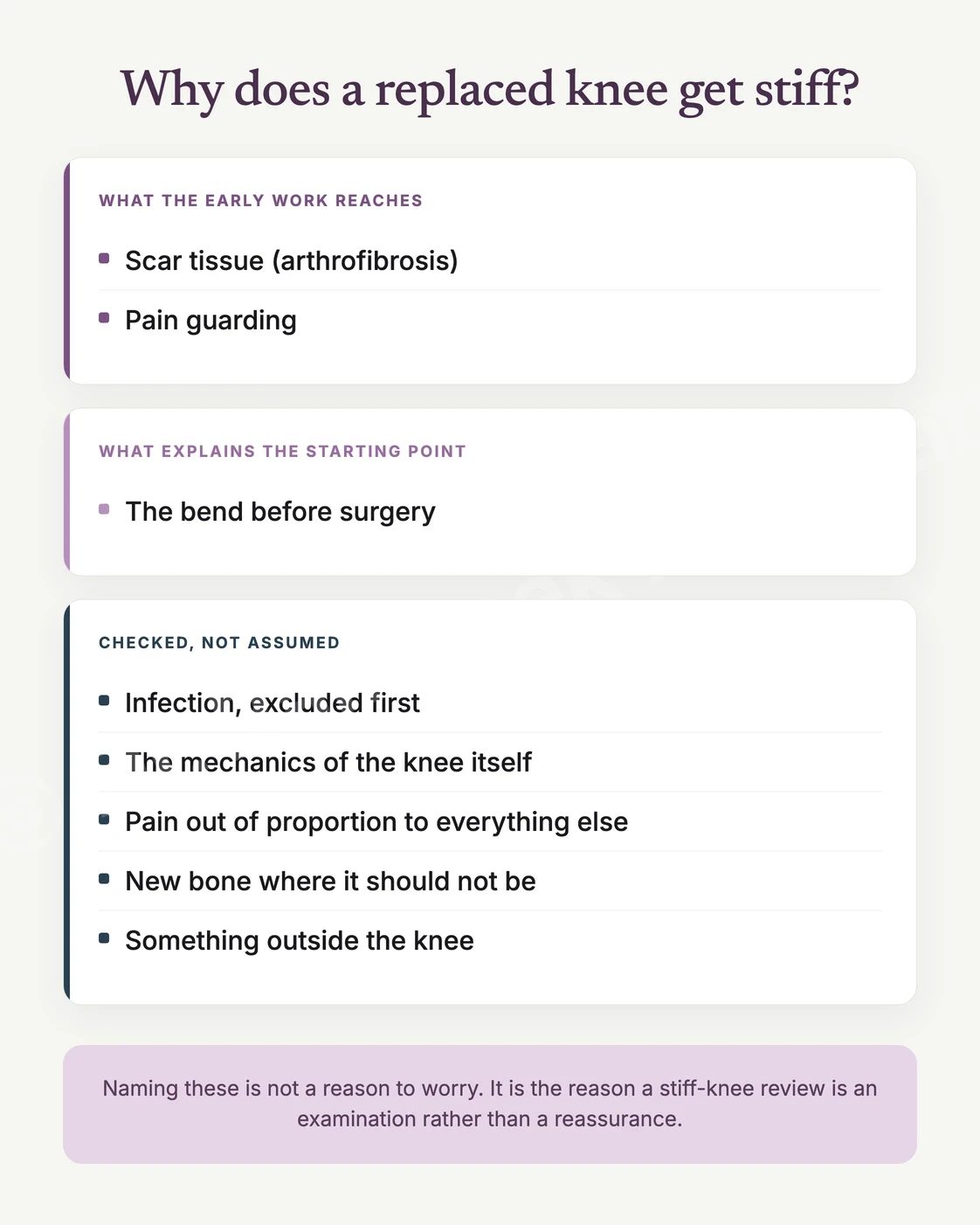
Because a knee heals by making scar tissue, and scar tissue does not stretch the way normal tissue does. That is a common reason a bend stalls, and it is the one the early work can actually reach - which is why the timing of that work matters as much as the effort. It is not the only reason, and the others are worth knowing.
How does scar tissue limit the bend?
Every operation leaves scar tissue behind. In some knees it forms more heavily than usual - the medical name is arthrofibrosis - between the thigh muscles and the front of the thigh bone, filling the pouch above the kneecap and often the pockets either side of it as well. The quadriceps, the muscles on the front of the thigh, become tethered to the bone and effectively shorten, limiting bending and straightening together. The knee feels firm rather than puffy, and the kneecap moves less freely than it should. Bleeding into the joint, a slow-healing wound, or a long stretch of keeping the knee still can all start it.
Why does the bend before surgery still matter?
Because it travels with you. Of everything about the patient, the strongest single predictor of a stiff knee afterwards is a knee that was already stiff before the operation. Movement tends to pull towards the middle - supple knees often lose a little, stiff knees usually gain some - but the knees that bent best before surgery still tend to bend best after it. A smaller bend, after years of a stiff knee, is the starting point showing through rather than a sign that something has gone wrong.
How does pain itself limit the movement?
Pain makes muscles hold on. The muscles at the front of the thigh and the hamstrings at the back both guard the joint, and a guarded knee does not travel through its range even when the range is there. This usually eases as the pain does, over the weeks after surgery - which is why pain control here is part of the treatment for the stiffness, not a comfort measure.
Which causes have to be checked, not assumed?
Some stiff knees are stiff for reasons the exercises cannot reach - which is why a stalling bend gets examined rather than simply pushed harder:
Infection, excluded first. An infection around a knee replacement does not always announce itself with fever and redness - sometimes the only sign is a recovery that is slow, painful and going nowhere. It is uncommon, and blood tests are the first step in checking - which is exactly why they belong in the assessment even when nothing looks infected. If they come back abnormal, or the suspicion is high anyway, fluid is drawn from the joint to settle it. It is checked first so it can be ruled out before anything else is planned, not because it is likely.
The mechanics of the knee itself. How the components sit, how the kneecap tracks, how the knee is balanced between bending and straightening - any of these can limit the range, and none is something home exercises can change. Examination and X-rays tell them apart.
Pain out of proportion to everything else. A small number of knees develop a heightened pain response - a persistently swollen, hypersensitive joint, with pain well beyond what the examination explains. It is uncommon, it is treatable, usually alongside a pain specialist, and it does better the earlier it is identified.
New bone where it should not be. Small amounts of extra bone sometimes form in the soft tissue above the knee after a replacement. Usually it is harmless, but a large amount blocks the bend mechanically. It shows on the same X-ray.
Something outside the knee. A stiff hip or a problem in the lower back changes how you stand and hold the leg, and the knee takes the blame.
Naming these is not a reason to worry. It is the reason a stiff-knee review is an examination rather than a reassurance.
What you can do about the scar tissue is next - and for a while, it is more than most people expect.
04 What can you do at home to get the bend back?
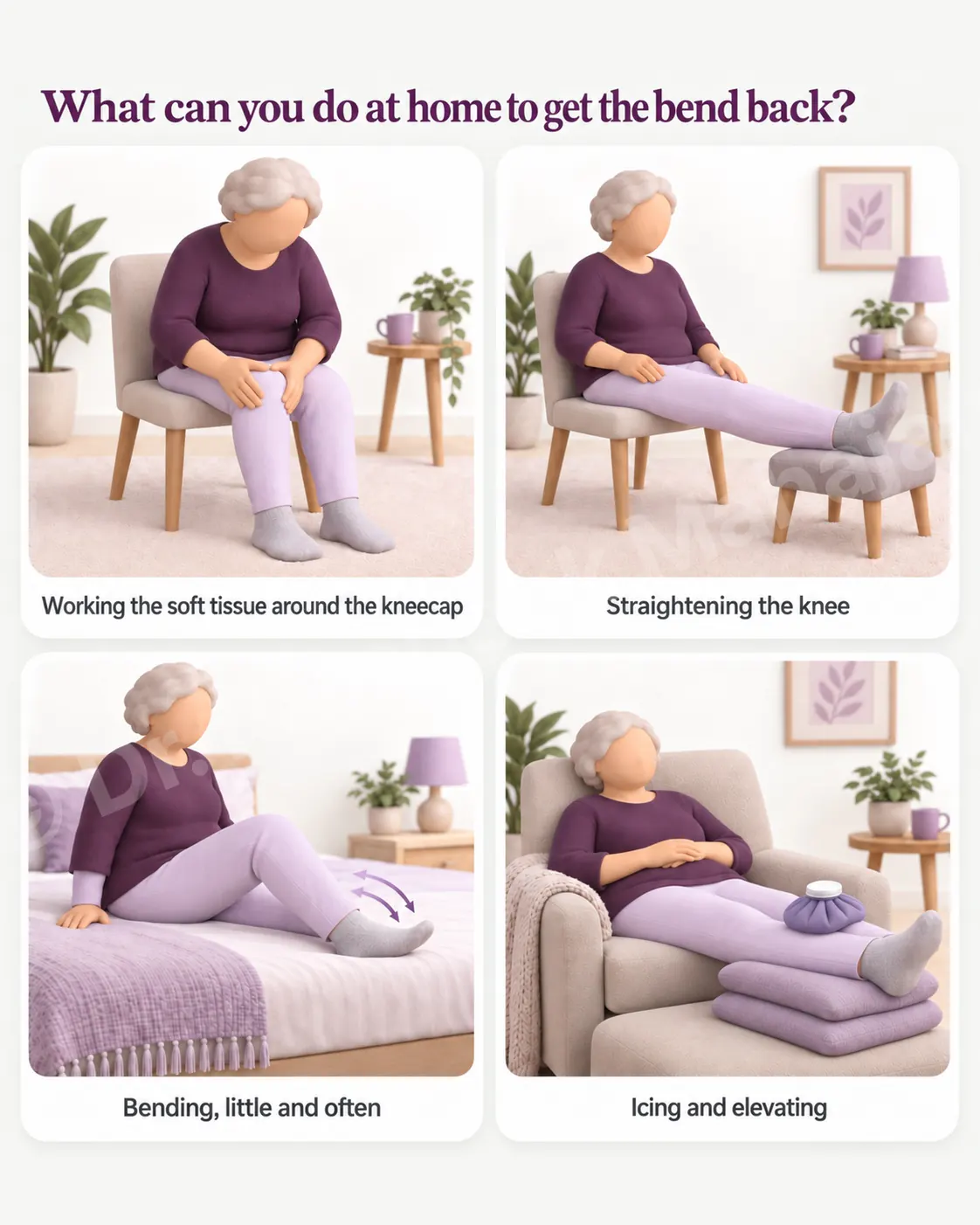
More than you would think early on, and less than you would hope later. While the tissue around the kneecap is still young and soft, work aimed at it produces real gains: in the published evidence that window is roughly the first three months after surgery, and it is when the bend responds best. Once a knee has been stiff for a long time, the evidence is blunt - physiotherapy alone adds only a small amount of movement to an established stiff knee.
Read that as a window that fades, not a door that shuts. If you are past three months, the work is still worth doing and the options in section 06 are all still on the table - what changes is that they are worth raising sooner rather than trying harder alone for another month.
What is the work actually aimed at?
Your physiotherapist sets the specifics and prescribes them for your knee. Class by class:
The soft tissue around the kneecap. That area tightens in the months after surgery, and it is often what holds the bend back rather than the joint itself. Worked on correctly and early, this is where the best gains still come from.
Straightening, worked at separately. Full straightening is its own target, not a by-product of the bend. A knee that will not come fully straight costs you more in walking than one that will not bend fully.
Bending, little and often. Short, frequent attempts through the day rather than one long push. A stiff knee gives more to twenty small efforts than to two large ones.
Ice and elevation. Swelling limits the bend mechanically, so bringing it down is part of the bend work, not something separate.
One point from the sleeping guidance belongs here: do not keep a pillow permanently under the knee at night. It feels comfortable precisely because it holds the knee slightly bent, and maintaining that bend can compromise full straightening.
Rule of 20: move, ice, rest, repeat.
Twenty minutes of activity. Twenty minutes of icing. Twenty minutes of rest. Through the waking hours, during recovery at the hospital and at home. The Rule of 20 is followed in Dr Ramneek Mahajan's unit, and it is the cadence a stalling knee needs - frequent, small and repeated, with the icing built in so the swelling never gets ahead of the bend. Keep to it as often through the day as your routine allows.
What is not worth doing?
Forcing the knee. Pushing hard past pain, or having someone lean on the leg, does not speed the bend up. It can set off more inflammation, more pain and more scarring - rehabilitation that is too aggressive is a recognised cause of a stiff knee, not a cure for one.
Waiting it out. A bad day is a speed-breaker, not a stop sign - that stays true. But several flat weeks are not a bad day. (The week-by-week programme itself sits in the physiotherapy guide.)
Which raises the question this guide turns on: when do you stop working alone and ask someone to look?
05 When should your surgeon look at it again?
When the bend stops moving for weeks - and at the routine review either way. A stalling bend is a clinical finding, not a personal failure, and it is easier to act on early than late. Bring the appointment forward if:
The measured bend has not improved across 2 to 3 weeks, or is going backwards
The knee will not come fully straight, and that gap is not closing
Pain is limiting the exercises so much that the programme has effectively stopped
The knee is firm, warm or swollen in a way that is not settling
Pain that is out of proportion to everything else - burning, or there at rest - or skin that is hypersensitive to touch, or a change in the colour, temperature or sweating of the leg
The knee gives way, or has developed a new clunk or catch
There is also a clear decision point in Dr Ramneek Mahajan's unit. If the bend remains short of 90 degrees at around six weeks despite intensive physiotherapy, a manipulation under anaesthesia may be considered, depending on the overall clinical picture - the knee is bent for you, under anaesthesia, in a controlled way.
If you are reading this well past six weeks, that threshold has not expired. It is the moment the question is first asked, not a deadline that closes behind you - and a bend that stalled without the conversation happening is a reason to start it now, not evidence that you missed your turn. The same assessment applies whenever a bend has stalled.
The six-week clinical review is where that judgment is made. For a stiff knee it looks hardest at the range in both directions - how fully the knee straightens as much as how far it bends - along with swelling, stability, and the strength in the muscles on the front of the thigh. The rest of that review is in the physiotherapy guide.
The assessment itself is an examination, not a conversation about how hard you have been trying: your history, how the knee and the kneecap move, how you walk, X-rays taken standing so the whole leg's alignment is visible, and blood tests - because infection is excluded before anything else is planned. Where it is indicated, fluid is drawn from the joint for testing, a joint aspiration, or a scan is done to check how the components sit.
Every patient is personally assessed by Dr. Ramneek, even when seen by the team - this may add to OPD waiting times, but ensures the doctor's direct evaluation in your case.
Separately, and whatever your bend is doing: new pain, swelling, or warmth in the calf, or any breathlessness or chest pain, needs urgent attention - not a wait for the next appointment. A knee that becomes hot and swollen, a fever, or discharge from the wound needs the team contacted the same day.
And if the review finds the bend has genuinely stalled, there is a ladder - shorter than most people fear.
06 What are the options if physiotherapy alone is not enough?
There is a ladder, and most knees never leave the first two rungs. But it is not always climbed one rung at a time: where the examination and X-rays find a mechanical cause, that is treated directly rather than worked around.
Intensified physiotherapy, properly targeted. The programme is escalated first, aimed specifically at the tight tissue around the kneecap rather than at the bend in general. Done early and done correctly, this is where good gains still come from.
Manipulation under anaesthesia. You are put to sleep, and the knee is bent for you, under anaesthesia, in a controlled way - progressively rather than forcefully - so the adhesions inside the joint release. It is a short procedure, and complications are uncommon at under 3 percent of cases - the main ones the team watches for are a break in the thigh bone just above the knee, and damage to the tendon that joins the kneecap to the shin bone. Published series report an average gain of around 30 degrees of bend. Most are done in the early months, while the scar tissue is still young, and pain relief is arranged so physiotherapy can start immediately afterwards, because that is what holds on to the gain.
Keyhole release of the scar tissue. If physiotherapy and manipulation have not moved the range, the scar tissue can be released through keyhole surgery, under direct vision, in the pockets around and above the kneecap. It is usually combined with a manipulation, and followed by the same intensive programme.
Open release. If the keyhole route has not been enough, the same scar tissue can be released through an open incision, which gives fuller access to the pouch above the kneecap and the pockets either side of it. The plastic spacer between the components is sometimes changed at the same time, but the metal parts fixed to the bone stay - this is not a revision.
Further surgery, honestly. Revision surgery for a stiff knee is a last resort, and the honest position is this: it is unlikely to help unless a clear mechanical reason has been found, and even when one has, the improvement is unpredictable and generally modest - a proportion of knees end up no better, or worse than before. Whether it applies at all is a separate decision with its own criteria - revision knee replacement covers it.
Which step you are on is decided by three things converging, not by the calendar: 1 - how the measured range is trending over recent weeks, 2 - what the examination and X-rays show about why it is limited, and 3 - whether infection and the other must-check causes have been excluded. The ladder also gets shorter the earlier it is started, and the further down it you go, the less the results promise. That is not pessimism. It is the reason the early work matters so much.
Which leaves the question everybody actually wants answered: where will this knee end up?
07 Will the bend keep improving, and what is realistic?
Yes, for longer than most people expect - and within a ceiling set on the day of the operation. It helps to separate two clocks here. Overall recovery - strength, comfort, balance, confidence - keeps improving through the first year, and final results usually come within a year; a knee at three months is not a finished knee. The bend specifically is most responsive earlier than that. So a bend that slows down does not mean recovery has stopped; it means the part that now needs help is the bend.
The ceiling is the second thing. The range your knee reached during the operation is the range recovery works back towards - rehabilitation restores movement, it does not create movement the joint was never given. That is also why the six-week figure and your own target are two different things: 90 degrees is the point at which the team asks a question - and roughly what stairs ask of a knee - not the ceiling your knee is working towards. Your ceiling is the range it reached in theatre, and your surgeon knows it - which is why "how much bend should I have?" gets settled on your knee, at your review.
And the deep bends?
This is the honest question, and it gets the honest answer the practice gives everywhere: most people sit comfortably in a chair, climb stairs, and manage their daily activities. Deep squatting, sitting cross-legged and kneeling may improve, but we cannot promise them. If those matter to you - for prayer, for the floor, for the way your household lives - say so at your review. It changes what the programme aims at, and it is better said early than late.
A stiff knee is a problem with a name, a cause worth finding, and a ladder of things that help. What it is not is a verdict on how hard you have worked. If your bend has been flat for weeks - whether that is week six or month six - the next step is the same one: say so, and have it looked at.
Frequently Asked Questions (FAQs)
This guide was written and clinically reviewed by Dr Ramneek Mahajan, Chairman of Orthopaedics, Joint Replacement and Chief Robotic Joint Replacement, Max SMART Saket, New Delhi. A stalling bend is a common reason a patient comes back between routine reviews, and his unit assesses it the same way every time: the trend, the examination, the X-rays, and infection excluded before anything is planned. The aim here is the aim in clinic - to say plainly what causes a stiff knee, what helps, and where the honest limits are.
Meet Your Surgeon
Can I safely wait?
The questions worth asking before you decide - and when waiting is the right call, and when it is not.
Before we meet
→
What should I expect, step by step?
The whole path, stage by stage - getting ready, the day itself, recovery, physio, life after.
Patient journey
→
Where did he train?
Fellowships, years in practice, and international experience
Credentials and experience
→






Powered by RAiZEN · Built in India, for the world · © 2026 RAiZEN
Go to RAiZEN website