Runner's knee: what actually fixes the pain
Last Reviewed:
11 August, 2026
~10 min read
Reviewed by:
Dr. Ramneek Mahajan
Dr. Mahajan is Chairman Orthopaedics, Joint Replacement & Chief Robotic Joint Replacement at Max Smart Super Speciality Hospital, Saket.
This guide is for an adult with an aching pain around the front of the knee - the kind that worsens on stairs, hills, squats, or after sitting a long time - who wants to understand what is going on and what actually fixes it. If your knee is sore and tired rather than unstable, and the pain built up over weeks rather than from a single injury, this is written for you.
This guide is not for a knee that locked suddenly, gave way after a twist, or swelled up immediately after an injury - those point to a different problem and need an in-person assessment. It also does not replace seeing someone about pain that is not improving. There are links at the end for related pages.
01 What is runner's knee?
Runner's knee is an umbrella term for pain around the front of the kneecap - doctors call it patellofemoral pain. Despite the name, it is not only a runner's problem: any activity that repeatedly loads the knee can bring it on, including cycling, jumping, skiing, and long hours of squatting or stairs. The pain comes from how the kneecap moves in its groove and how the muscles around it share the load, not from a single thing that has broken.
How do you know it is runner's knee?
A dull ache around or behind the kneecap, rather than a sharp one-off injury
Worse going down stairs or hills, squatting, or after sitting a long time with the knee bent
Sometimes a grinding or clicking feeling behind the kneecap
It builds up over weeks with activity, rather than starting with a single pop or twist
The knee feels sore and tired rather than unstable
The common drivers are well understood: overuse, the kneecap not tracking smoothly in its groove, weak or unbalanced thigh muscles (especially the inner quadriceps), softening of the cartilage under the kneecap, and sometimes flat feet changing how the leg loads. A clinical examination - including a gentle press on the kneecap during movement - usually reproduces the pain and points to the cause.
Who gets runner's knee?
It is most common in active people whose knees take repeated load - runners, cyclists, footballers, and anyone doing a lot of squatting, stairs, or hills. A few things make it more likely:
A sudden jump in training - more distance, hills, or intensity than the knee is used to
Weak or unbalanced thigh and hip muscles, so the kneecap does not track cleanly
Flat feet or alignment that changes how the leg loads
It is also seen more often in women and in active teenagers
Can you prevent runner's knee?
Largely, yes - and it is the same work that treats it. Build training up gradually rather than in sudden jumps, keep the thigh and hip muscles strong (the hips matter as much as the quads), use footwear that suits your feet, and warm up before hard sessions. Backing off at the first ache, rather than pushing through it, is what stops a niggle becoming a season-long problem.
So if nothing is torn, does this ever need surgery?

02 Do you need surgery for runner's knee?
For the large majority of people, no. Runner's knee is one of the clearest examples in the knee of a problem fixed by rehabilitation rather than by an operation - and the surgical evidence is unusually direct about it.
Path | What it is | When it fits |
|---|---|---|
Conservative care (almost everyone) | A structured programme: thigh and hip strengthening, activity modification, taping or a simple brace, and shoe inserts if needed | The usual first and, for most people, only treatment |
Surgery (rare) | A procedure directed at a specific structural cause - a defined cartilage problem or a clearly maltracking kneecap | Only after months of proper rehabilitation have not helped and a specific cause is confirmed |
Do you actually need surgery for runner's knee?
The honest answer is that surgery is rarely the right option here. In the published evidence, the symptoms of anterior knee pain on their own are not considered a reason to operate or even to look inside the knee - the severity of what is seen inside the joint does not reliably match the pain. In one study of young adults with anterior knee pain, only about 45 percent had softening of the cartilage under the kneecap, and even then its severity did not track with how much pain they felt. What fixes runner's knee for most people is a programme aimed at the cause:
Strengthening the thigh muscles, especially the inner quadriceps, so the kneecap tracks better
Stretching the hamstrings and calf, and strengthening the hip and core
Modifying activity for a while - easing off deep squats, lunges, hills, and uneven ground
Taping or a simple brace, and shoe inserts if flat feet are part of the picture
Surgery moves onto the table only when months of proper conservative treatment have not helped and there is a specific structural cause to fix. Even then, the operation is directed at that cause, not at the pain itself.
Can I keep running while I fix it?
Usually yes, in a modified way. The aim is not complete rest but load management - reducing the aggravating mileage and surface while you build strength, then a graded return. Pushing through sharp pain is what keeps it going; working just below it is what settles it.
In the rare case where surgery is considered, here is what it involves.
03 What happens if runner's knee ever needs surgery?
This is the short section, because surgery is the exception. When it is genuinely needed - after conservative care has been exhausted and a clear structural cause has been found - the operation is aimed at that specific cause rather than at the pain in general.
Depending on what is found, that can mean a keyhole (arthroscopic) tidy-up of a defined cartilage problem, or a realignment procedure when the kneecap is clearly tracking off to one side. The right operation is the one matched to a specific, confirmed diagnosis - which is why an honest assessment comes first, and why pain at the front of the knee is not, on its own, a reason to operate.
Whether or not surgery is ever involved, recovery is built on the same thing: strength.
04 How long until you can run again?
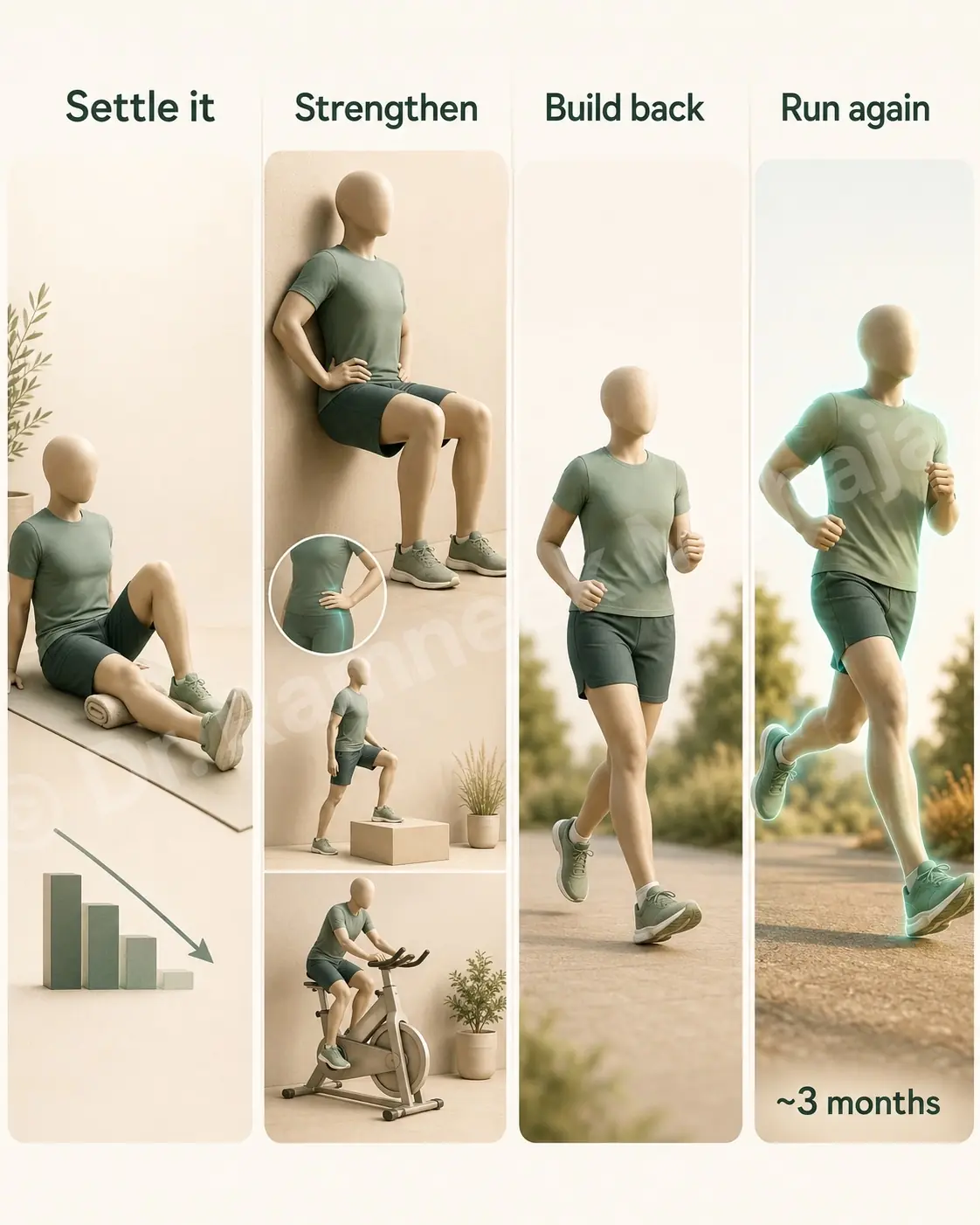
Recovery from runner's knee is usually measured in a few weeks to about 3 months, and it is mostly active work rather than rest.
The rehabilitation that does the work
Early on: settle the irritation with relative rest and load management, while starting gentle strengthening.
The core programme: closed-chain strengthening (controlled wall sits to about 40 degrees held for 15 to 20 seconds, step-ups on a 6 to 8 inch platform, short-arc leg presses), a stationary bike, plus hip, core and ankle work - the knee rarely acts alone.
Building back: as strength returns, the aggravating activities are reintroduced gradually.
Return to running is guided by strength and comfort - a common marker is the thigh muscles reaching about 85 percent of the other leg's strength, with no pain through the movement - not by a fixed date.
A simple kneecap brace is sometimes used for the first 6 to 8 weeks while strength builds. The single biggest predictor of a lasting result is sticking with the strengthening, including after the pain has gone.
So does all this actually work, and will the pain come back?
05 How do you choose a clinician for runner's knee?
Because runner's knee is rarely a surgical problem, choosing the right care is less about finding an operation and more about finding honest assessment and good rehabilitation. A few checks:
A clinician who looks for the cause - your muscle balance, kneecap tracking, hips, and even your feet - rather than reaching first for a scan or a scope.
Honest counsel that surgery is rarely needed for this, with a clear conservative plan first.
Strong physiotherapy and rehabilitation support, because the strengthening programme is the actual treatment.
A willingness to investigate further only if the picture does not fit, or if warning symptoms appear.
Dr Ramneek Mahajan is an orthopaedic surgeon at Max SMART Saket who treats runner's knee, alongside a high-volume joint-replacement practice. For this condition his role is mostly honest guidance and a structured conservative plan; surgery is reserved for the rare knee with a confirmed structural cause that has not responded to rehabilitation.
Every patient is personally assessed by Dr Ramneek, even when seen by the team - this may add to OPD waiting times, but ensures the doctor's direct evaluation in your case.
A practical question many people have: what does this cost?
06 How much does treating runner's knee cost?
For most people, the cost of runner's knee is the cost of physiotherapy and time, not surgery. A course of guided rehabilitation, perhaps a brace or shoe inserts, and a follow-up or two is the usual picture - a modest, spread-out cost rather than a procedure.
In the rare case where surgery is genuinely needed for a confirmed structural cause, the cost depends on the specific procedure and is set out once that diagnosis is clear. For the large majority, that conversation never has to happen.
Underneath the cost is the question that matters: does this treatment actually work?
07 Does treatment work, and will runner's knee come back?
For most people, conservative treatment works - and the honest detail is that whether it lasts depends on addressing the cause, not just the pain.
What rehabilitation achieves
Strengthening the muscles around the knee, improving how the kneecap tracks, and managing load settles the pain for the large majority. The muscle weakness that drives runner's knee is reversible with consistent work, which is why the people who stick with the programme - including after the pain eases - tend to keep the result.
Will it come back?
It can, and honestly it often does if the underlying driver is ignored - the same overload, the same muscle imbalance, the same worn-out shoes. A recurrence is rarely a sign of damage; it is usually a sign that the cause crept back. Keeping the thigh and hip muscles strong and managing training load is what keeps it away.
When to get it checked
Some symptoms deserve a proper look rather than self-management: a knee that truly locks or gives way, significant swelling, or pain that does not improve at all over several weeks of sensible rehabilitation. These can point to something other than runner's knee, and are worth an assessment.
If your knee pain fits this picture, the next step is a straightforward assessment.
Frequently Asked Questions (FAQs)
This guide was written and clinically reviewed by Dr Ramneek Mahajan, orthopaedic surgeon and Chairman of Orthopaedics and Joint Replacement at Max SMART Saket, New Delhi. He treats runner's knee alongside a high-volume joint-replacement practice. The aim of this guide is the same as it is in clinic: an honest account of what causes runner's knee, what actually fixes it, and the rare point at which surgery is worth considering.
Meet Your Surgeon
Can I safely wait?
The questions worth asking before you decide - and when waiting is the right call, and when it is not.
Before we meet
→
What should I expect, step by step?
The whole path, stage by stage - getting ready, the day itself, recovery, physio, life after.
Patient journey
→
Where did he train?
Fellowships, years in practice, and international experience
Credentials and experience
→






Powered by RAiZEN · Built in India, for the world · © 2026 RAiZEN
Go to RAiZEN website