PCL tear: when it needs surgery, and when it does not
Last Reviewed:
11 August, 2026
~11 min read
Reviewed by:
Dr. Ramneek Mahajan
Dr. Mahajan is Chairman Orthopaedics, Joint Replacement & Chief Robotic Joint Replacement at Max Smart Super Speciality Hospital, Saket.
This guide is for an adult who has hurt the back of the knee - in a fall onto a bent knee, a dashboard knock in a road accident, or a sports impact - and wants to understand whether a PCL tear actually needs surgery. If your knee aches deep inside and feels unsure on stairs or slopes but is steady in daily life, you have more room to decide than most of the internet suggests.
This guide is not for someone whose main problem is knee arthritis or who needs a knee replacement, and it does not replace an in-person assessment of your knee. Those situations have their own pages on this site.
01 What is a PCL tear?
The PCL - the posterior cruciate ligament - is the strongest ligament in the centre of the knee. It runs from the back of the shin bone to the thigh bone and stops the shin sliding backwards under the thigh. It does most of that job on its own: it provides about 89 percent of the resistance to the shin sliding backwards. A PCL tear is often quieter than an ACL tear - there may be no dramatic pop, and the knee may not give way. Many people keep walking on it.
How do you know it is a PCL tear?
A direct blow to the front of a bent knee - a dashboard in a road accident, a fall onto the kneecap, a sports impact
An ache deep in the knee rather than a loud pop
Swelling that is often milder than an ACL tear
A vague unsteadiness going down stairs or slopes, where the shin wants to drop back
Often, surprisingly little - many PCL tears are missed at first
When that pattern is present, a clinical examination confirms it. The main check is the posterior drawer test: with the knee bent, the surgeon gently pushes the shin backwards, and more than a few millimetres of give points to a torn PCL. A posterior sag - the shin resting slightly back compared with the other knee - is another sign. An MRI scan confirms the tear, grades it, and shows whether other ligaments or the meniscus were injured at the same time.
Who tends to tear a PCL, and how?
A PCL tear takes a strong, specific force to the front of a bent knee, so it clusters around a few situations:
Road accidents, especially motorcycle crashes, where the bent knee strikes the dashboard or ground - the classic cause
A fall directly onto the front of a bent knee
High-impact and contact sports - football, rugby, skiing
Because the force is often large, the same injury can damage other ligaments at the same time, which is why the whole knee is checked, not just the PCL.
Does a PCL tear heal on its own?
Unlike a fully torn ACL, many PCL tears - especially partial ones - do recover. Partial tears have been shown to heal over about 6 months, with the looseness in the knee easing as they do. Even when the ligament does not fully reconstitute, the knee often works well once the muscles around it are strong. The real question is not whether the ligament grows back - it is whether your knee works well without a fully normal one.
When is a PCL injury an emergency?
Most PCL tears are not urgent. But the force that tears a PCL can, in a severe injury, dislocate the knee and injure the artery or nerve behind it. Seek emergency care straight away if, after a knee injury, the foot or lower leg becomes cold, pale, numb, or you cannot move it - the blood supply to the leg is checked first, before anything else. A knee that was grossly out of place, even if it looked to go back in, needs urgent hospital assessment.
Can a PCL tear be prevented?
Most PCL tears come from an accident, so there is a limit to prevention - wearing a seatbelt and riding safely does more than any exercise here. For sport, strong thigh (quadriceps) muscles both lower the strain on the knee and, if a tear does happen, do much of the work the ligament used to.
So if many PCL tears settle without surgery, when is surgery actually the answer?
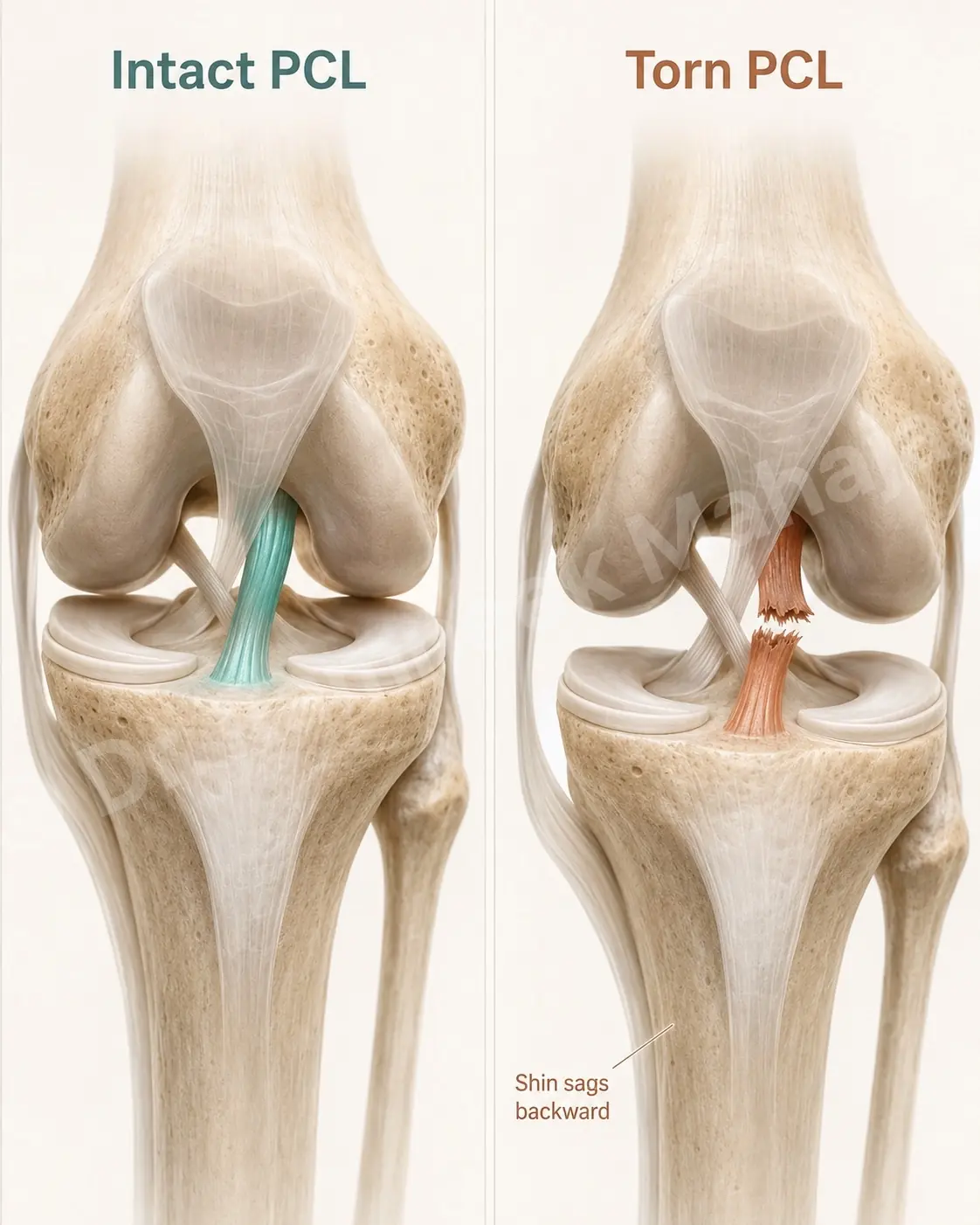
02 Do you need surgery for a PCL tear?
A PCL injury has two real paths: structured rehabilitation, or reconstruction surgery. For an isolated PCL tear, rehabilitation is the usual starting point - and the evidence behind that is strong.
Path | What it is | When it tends to fit |
|---|---|---|
Structured rehabilitation (non-surgical) | A guided programme built around quadriceps strength, with balance and control work | An isolated grade 1 or grade 2 tear; a knee steady enough for daily life; no other major ligament torn |
PCL reconstruction (surgery) | Keyhole surgery that rebuilds the ligament with a graft | A high-grade or combined injury; a knee that stays unstable despite rehab; a high-demand athlete with significant looseness |
Do you actually need surgery for a PCL tear?
The honest answer from the published evidence: most people with an isolated PCL tear do not. Treatment of the PCL is one of the most debated topics in knee surgery, and the weight of evidence favours rehabilitation for isolated tears. Grade 1 and grade 2 tears - the large majority - respond well to a structured programme, and across several studies about 85 percent of people with an isolated PCL injury return to sport without surgery, whatever the measured looseness of the knee.
One finding matters more than any other: what predicts a good recovery is not how loose the knee feels, but how strong the quadriceps muscle is. The thigh muscle does much of the work the ligament used to.
Surgery moves up the list when:
the tear is high-grade (grade 3), or part of a combined injury where other ligaments are torn too
the knee stays unstable or symptomatic despite committed rehabilitation
you are a high-demand athlete with significant backward looseness
If none of those is strongly true for you, rehabilitation built around quadriceps strength is a legitimate first choice, not a delay tactic. Most isolated PCL tears fall here.
Can I just leave it, then?
Rehab is not the same as ignoring it. The honest caveat: the long-term story of an untreated PCL tear is not fully understood, and not every knee does well over decades. Some people develop aching, stiffness, or wear at the front and inner knee over many years. So the plan is active, quad-focused rehabilitation with a clear review point - not drift.
If the conversation does point towards surgery, here is what it actually involves.
03 What happens during PCL reconstruction?
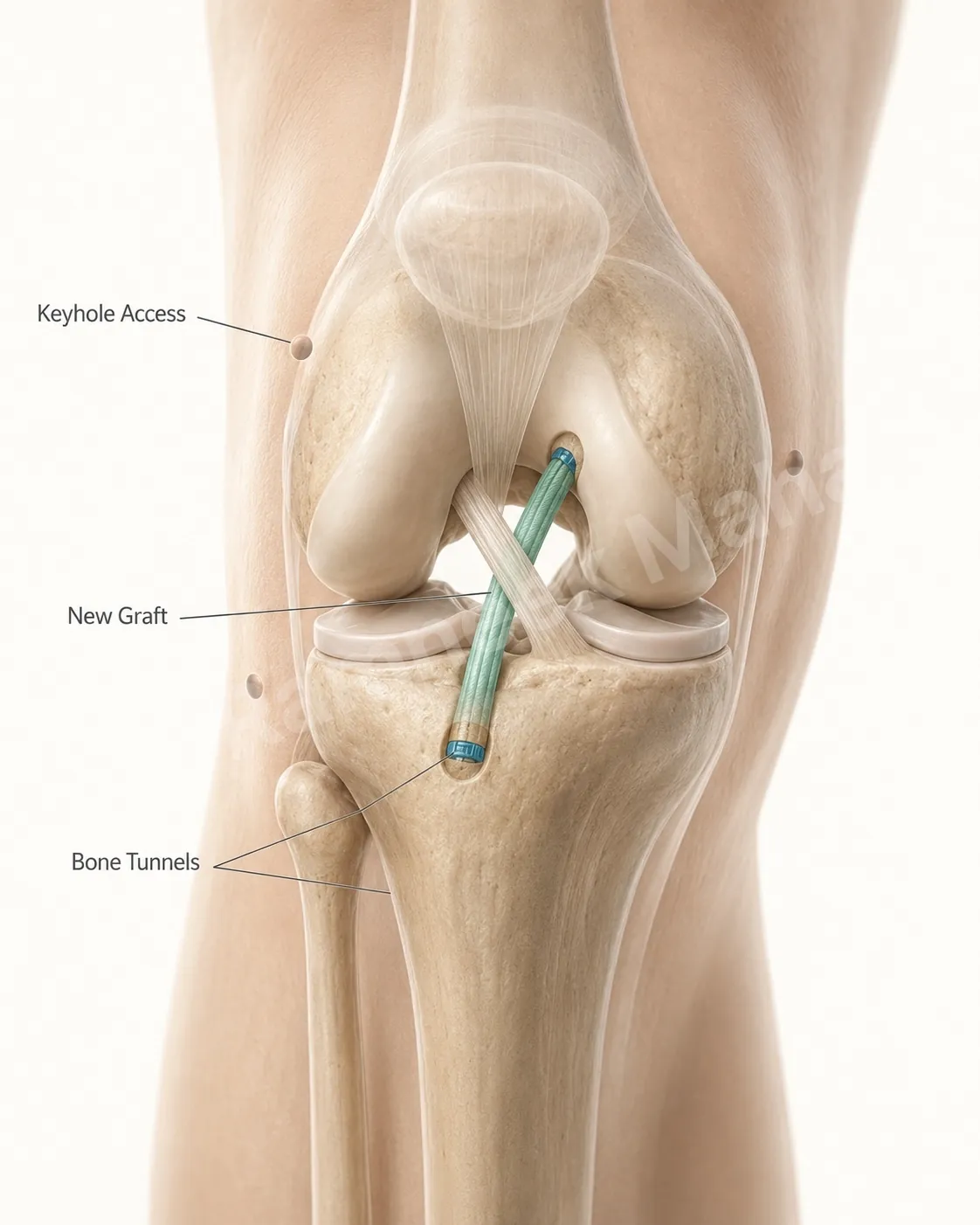
If surgery is the right answer, PCL reconstruction is keyhole (arthroscopic) surgery. The surgeon does not stitch the torn ligament back together - a torn PCL does not reliably heal that way. Instead the ligament is rebuilt with a graft, a piece of tendon threaded through small tunnels in the bone and fixed in place to take over the PCL's job.
It is worth being honest that PCL reconstruction is more technically demanding than ACL reconstruction. The PCL sits deep at the back of the knee, which makes it a harder ligament to reach and rebuild - one reason surgeons reserve the operation for the knees that genuinely need it. When several ligaments are torn together, they are repaired or reconstructed in the same setting.
The operation is done under anaesthesia and usually involves a short hospital stay. You go home in a brace, on crutches, with a clear rehabilitation plan - the rebuild is only half the job; the rehabilitation is the other half.
Whichever path you take, the recovery is measured in months. Here is the honest timeline.
04 How long does recovery take after PCL surgery?
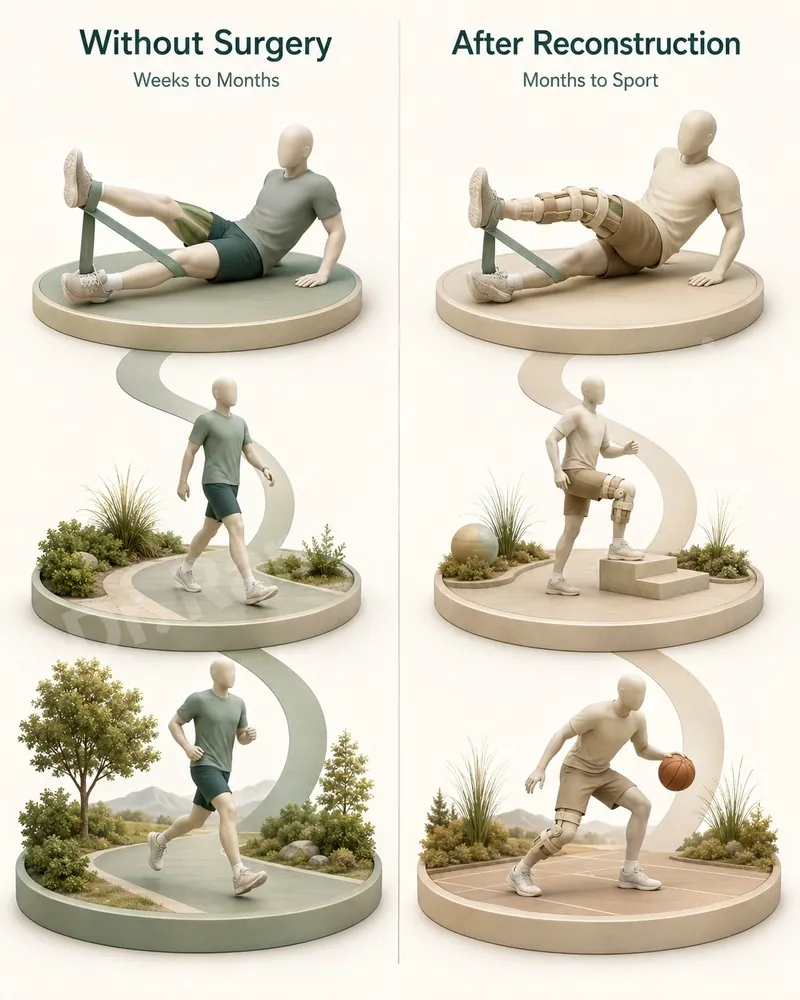
Recovery after a PCL injury is measured in months, not weeks, whichever path you take.
If you recover without surgery
The work is a structured, quad-focused programme - building the thigh muscle that now protects the knee, with balance and control work. Most people are back to daily life over a few weeks to months, and around 85 percent of isolated PCL injuries return to sport.
If you have reconstruction
Early weeks: the knee is protected in a brace, often locked straight at first. You work the quadriceps straight away with the leg supported, but hamstring exercises are deliberately avoided early - they pull the shin backwards and stress the new graft.
Around 6 to 7 weeks: weight comes back onto the leg as the brace opens up and crutches are phased out.
Around 4 months: running begins.
5 to 9 months: sport-specific agility work, then a return to sport once thigh strength and control are back. A combined, multi-ligament reconstruction takes longer - usually 9 to 12 months.
A dynamic brace is often worn for sport in the first year back. The timeline is a guide, not a calendar - the milestones are earned by strength and control, not by the date.
So after all that, how well does treatment actually work?
05 How do you choose a surgeon for a PCL tear?
Choosing a surgeon for a PCL injury comes down to a few honest checks.
Experience with knee ligament and arthroscopic surgery, including the less common PCL.
A surgeon who tells you honestly whether you even need surgery - most isolated PCL tears do not.
Structured rehabilitation and physiotherapy support, because with the PCL the rehab is at least half the result.
Clear follow-up, so a knee that is not settling is caught early.
Dr Ramneek Mahajan is an orthopaedic surgeon at Max SMART Saket who performs arthroscopic knee ligament surgery, including PCL reconstruction, alongside a high-volume joint-replacement practice. The role is stated as a fact, not a sales claim - and for most PCL tears, the honest first conversation is about whether surgery is needed at all.
Every patient is personally assessed by Dr Ramneek, even when seen by the team - this may add to OPD waiting times, but ensures the doctor's direct evaluation in your case.
One question almost everyone asks next: what will it cost?
06 How much does PCL treatment cost?
The cost of treating a PCL injury depends on the path. Structured rehabilitation is a course of physiotherapy - a smaller, spread-out cost. Reconstruction is a surgical procedure with a hospital stay, anaesthesia, the graft, and the rehabilitation that follows, so it sits in a different range.
Rather than publish a figure that may not fit your knee, the honest approach is a conversation. Once the grade of the tear and the right path are clear, the cost of that specific path can be set out, including what your insurance is likely to cover.
Underneath the cost question is the real one: does treatment actually work?
07 Does PCL treatment work, and what can go wrong?
Honest answer: for most isolated PCL tears, rehabilitation works well - but the long-term picture deserves candour, and so does surgery.
What rehabilitation achieves
Around 85 percent of people with an isolated PCL injury return to sport without surgery, and short-term function is usually good. The honest caveat is the long view: the natural history of an isolated PCL tear is not fully understood, and over many years some knees develop aching, stiffness, and wear, particularly at the front and inner knee. That is why a strong quadriceps and a review point matter.
What surgery achieves, and its limits
Reconstruction reduces the backward looseness of the knee, usually to a small residual amount rather than to a fully normal ligament - the gain in stability is real but not perfectly predictable. And honestly, no study has yet proven that PCL reconstruction prevents the gradual wear that can follow the injury. Like any surgery, it carries the usual risks - infection, stiffness, a clot - alongside the specific challenge that the graft sits in a demanding position.
None of this is a reason for or against surgery on its own. It is the honest picture both paths sit inside, so the decision is made with open eyes.
If you are weighing this, the next step is a straight conversation.
Frequently Asked Questions (FAQs)
This guide was written and clinically reviewed by Dr Ramneek Mahajan, orthopaedic surgeon and Chairman of Orthopaedics and Joint Replacement at Max SMART Saket, New Delhi. He performs arthroscopic knee ligament surgery, including PCL reconstruction, alongside a high-volume joint-replacement practice. The aim of this guide is the same as it is in clinic: an honest account of when a PCL tear needs surgery, and when it does not.
Meet Your Surgeon
Can I safely wait?
The questions worth asking before you decide - and when waiting is the right call, and when it is not.
Before we meet
→
What should I expect, step by step?
The whole path, stage by stage - getting ready, the day itself, recovery, physio, life after.
Patient journey
→
Where did he train?
Fellowships, years in practice, and international experience
Credentials and experience
→






Powered by RAiZEN · Built in India, for the world · © 2026 RAiZEN
Go to RAiZEN website