Meniscus tear: when it needs surgery, and when it does not
Last Reviewed:
11 August, 2026
~12 min read
Reviewed by:
Dr. Ramneek Mahajan
Dr. Mahajan is Chairman Orthopaedics, Joint Replacement & Chief Robotic Joint Replacement at Max Smart Super Speciality Hospital, Saket.
This guide is for an adult with a meniscus tear - diagnosed on a scan, or suspected from a twist, an ache along the joint line, or a knee that catches - who is weighing what to do. If your knee is locked and will not fully straighten, treat that as urgent and get assessed quickly; that situation is the clearest case for surgery and is covered below. For everyone else, the most useful thing this guide does is slow the rush to an operation that the evidence often does not support.
This guide is not for someone whose knee pain is mainly from advanced arthritis, or who needs a knee replacement, and it does not replace an in-person assessment of your knee. Those situations have their own pages on this site.
01 What is a meniscus tear?
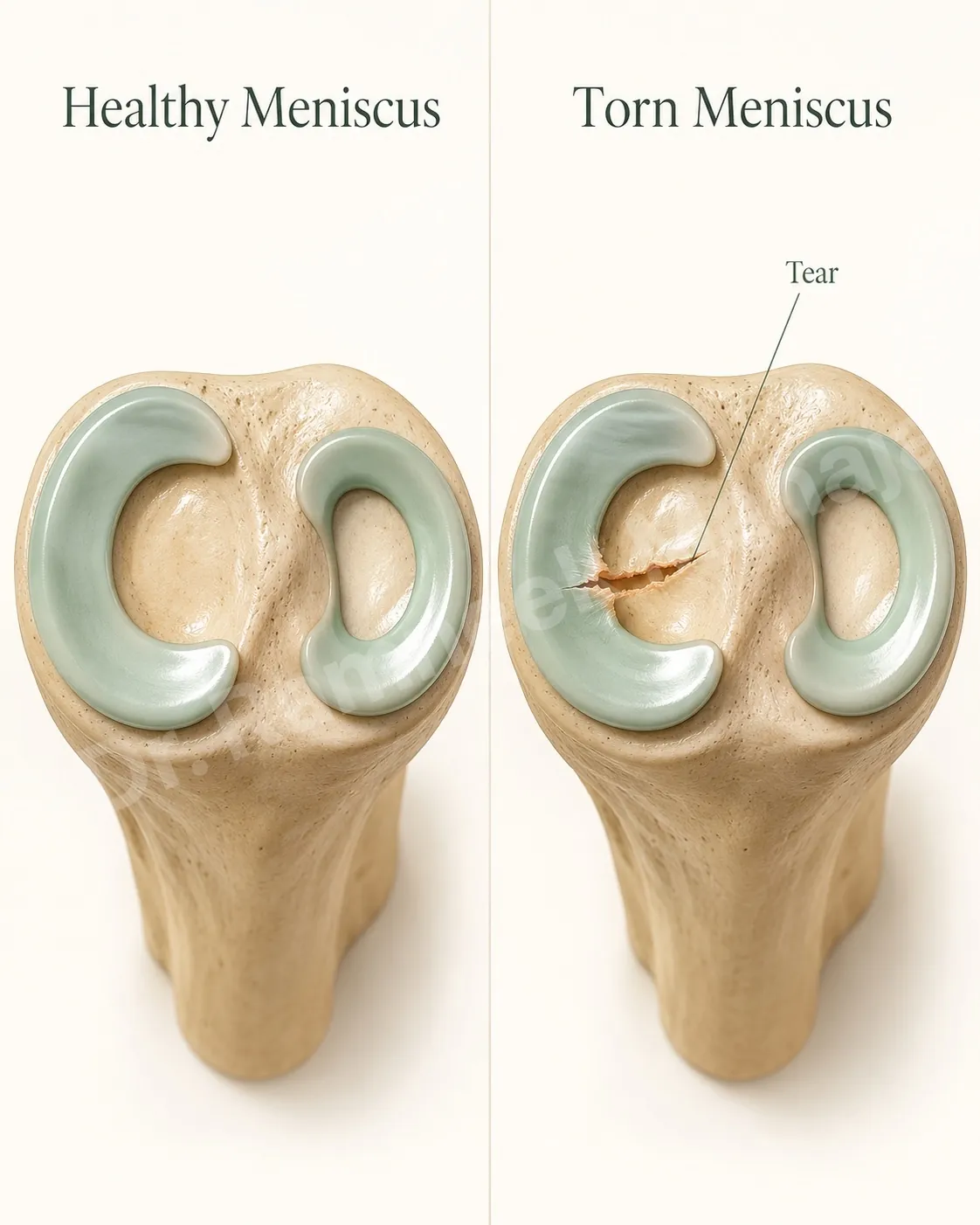
Each knee has two menisci - C-shaped pads of tough cartilage that sit between the thigh bone and the shin bone and act as shock absorbers and stabilisers. A tear means one of these pads is damaged. How it tears matters more than the word "tear" itself, because it largely decides whether surgery is even on the table.
Two very different kinds of tear
Traumatic tears - usually in younger people, from a twist or a sports injury, often alongside an ACL injury. These can include the "bucket-handle" tear, where a flap flips into the joint and locks the knee.
Degenerative tears - usually in middle age and beyond, from gradual wear rather than one injury. The history is often vague: an ache along the joint line, a twinge after squatting, occasional swelling. These are common, and they behave very differently from traumatic tears.
How do you know it's a meniscus tear?
Pain localised to the joint line, swelling that comes and goes, and a sense of catching, clicking, or giving way are the usual clues. A surgeon checks for joint-line tenderness and uses tests such as McMurray's; on their own these tests are suggestive, not conclusive. An MRI scan is highly accurate - around 98 percent for tears of the inner (medial) meniscus. One symptom matters more than the rest: a knee that truly locks and will not fully straighten. That points to a mechanical block and changes the plan.
Who tears a meniscus, and can you lower the risk?
Younger people usually tear it in one twisting or sporting moment; from the forties onward, the meniscus tends to tear from gradual wear, sometimes with very little injury at all. A few things raise the risk:
Age - the cartilage gets more brittle over time
Pivoting and contact sports, and work with a lot of deep squatting or kneeling
Carrying extra weight, which loads the knee, and existing wear in the joint
You cannot make a meniscus tear-proof, but keeping the thigh muscles strong, managing weight, and using good technique when squatting or lifting all reduce the load the meniscus has to take.
When should you see a doctor?
Most meniscus tears can be assessed at a routine appointment. Get seen promptly if the knee locks or will not fully straighten, if it repeatedly gives way, or if there is significant swelling and you cannot put weight on it. A locked knee in particular should not be left.
What happens if you leave it?
Many degenerative tears settle and stay comfortable, which is why physiotherapy is the usual first step. Over the long term, a meniscus tear is associated with arthritis developing in the joint - in one study of older patients, 63 percent of untreated tears showed arthritis at follow-up, against 19 percent of knees with no tear. The honest catch: trimming the tear surgically does not prevent that either. So the decision is driven by symptoms and by a locked knee, not by trying to get ahead of arthritis. The one tear that should not be left is a locked knee.
Which brings us to the question that matters most.
02 Do you need surgery for a meniscus tear?
For most people - and especially for degenerative tears - the honest answer is: probably not first. The evidence here is unusually clear, and it is worth knowing before anyone books you an operation.
What do the trials actually show?
For a degenerative meniscus tear with knee pain, several randomised trials and reviews have compared keyhole surgery (arthroscopic partial meniscectomy - trimming the torn part) against a course of physiotherapy. They found no meaningful difference in pain or function between the two, at one and two years. In other words, for this common tear, the operation does not beat structured rehabilitation.
So surgery is not the default. It earns its place in three clear situations:
A locked knee from a displaced or bucket-handle tear - a mechanical block where the knee will not fully straighten. This is the one situation where waiting is not appropriate.
Mechanical symptoms that do not settle - genuine catching, locking, or giving-way that persists after a fair trial of rehabilitation.
A repairable tear in a younger, active person - a fresh tear in the meniscus's blood-supplied outer rim, where stitching it preserves the cushion. Only about 10 to 15 percent of tears are actually repairable; the rest are not.
If none of these is true for you - a degenerative tear, an aching but not locking knee - structured physiotherapy is a legitimate, evidence-backed first choice, not a delay tactic.
Path | What it is | When it tends to fit |
|---|---|---|
Physiotherapy (non-surgical) | A guided programme to restore strength around the knee - quadriceps, hamstrings, hip muscles - plus activity adjustment | Degenerative tears; aching but not locking knees; the first step for most people over 40 |
Meniscus repair (stitch) | Keyhole stitching of a tear in the blood-supplied outer rim, preserving the cushion | A repairable tear, usually a younger active person, often alongside an ACL reconstruction |
Partial meniscectomy (trim) | Keyhole removal of only the torn, unstable part, preserving as much healthy meniscus as possible | A locked knee, or mechanical symptoms that have not settled, when the tear cannot be repaired |
If your situation is one of the three where surgery does fit, here is what it involves.
03 Repair, trim, or leave it alone?
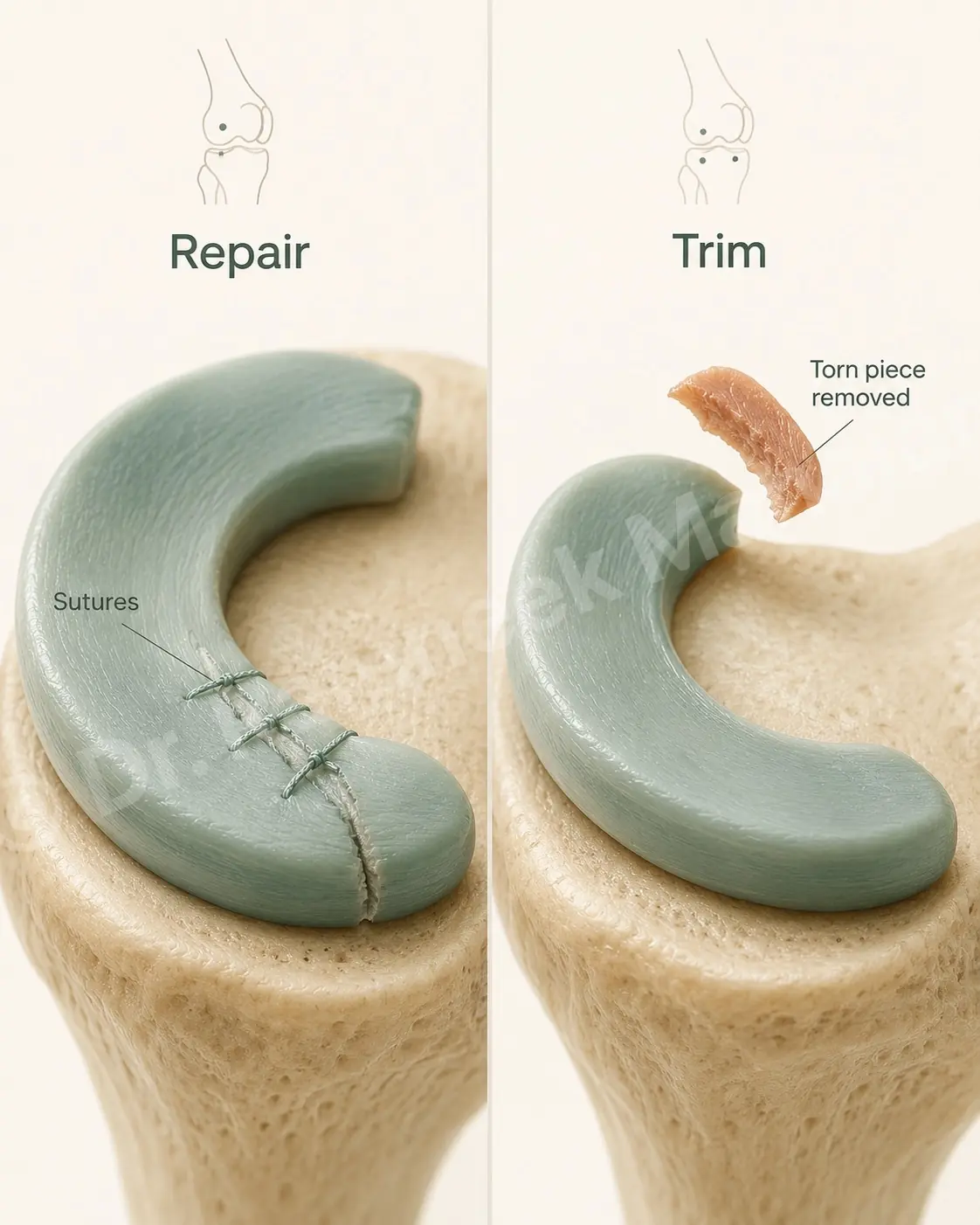
Meniscus surgery is keyhole (arthroscopic) - small openings, a camera, and fine instruments, usually as a day-care procedure. There are two very different operations under that one word, and which one you have matters for your knee's future.
Repair (preserve the cushion)
The torn edges are stitched so the meniscus can heal. It preserves the shock absorber, which protects the knee long term - but it asks more of you in recovery, because the repair has to heal before the knee is loaded. It is only possible for certain tears (the outer, blood-supplied zone), which is why only a minority of tears are repaired.
Partial meniscectomy (trim the torn part)
The torn, unstable fragment is trimmed away, keeping as much healthy meniscus as possible. Recovery is quicker. The trade-off is long term: the meniscus is a shock absorber, and removing part of it raises the load on the joint surface - removing even a third of the meniscus increases the contact force on the cartilage by up to 350 percent. That is why surgeons preserve every bit they can, and why the trim is reserved for when it is genuinely needed.
Recovery looks quite different depending on which of these you have.
04 How long is recovery after meniscus surgery?

It depends entirely on which operation you have - and this is a fair question to ask your surgeon before agreeing to anything.
After a trim (partial meniscectomy)
Recovery is relatively quick. Walking returns within days, and most people are back to everyday activity over a few weeks, with physiotherapy to rebuild strength. There is no healing tissue to protect, so the limits are swelling and strength, not a repair.
After a repair
Recovery is deliberately slower, because the stitched meniscus must heal. Expect a brace and limited weight-bearing early on, a gradual increase over about six weeks, and no return to sport for roughly three to six months depending on the tear. It asks more of you - but it preserves the cushion, which is the point.
The honest trade-off.
The quicker operation (trim) costs you meniscus tissue and a little long-term protection. The slower operation (repair) preserves the cushion but asks for months of patience. Neither is "better" in the abstract - the right one depends on your tear, your age, and your knee. A surgeon who explains this trade-off is doing it right.
If you do go down the surgical route, who should do it matters.
05 How do you choose a surgeon for a meniscus tear?
The same four checks that apply to any knee surgery apply here.
Will they tell you honestly whether you need surgery at all. For a degenerative tear, the right surgeon may well steer you to physiotherapy first - and that is a good sign, not a weak one.
Repair-first instinct where possible. A surgeon who tries to preserve the meniscus (repair) rather than reaching first for the trim is thinking about your knee in ten years, not just this month.
Arthroscopic and sports-knee experience. This is keyhole work; you want a surgeon who does it regularly.
Rehabilitation support. Whether you have surgery or not, the strengthening programme is much of the result. Ask what physiotherapy support comes with the care.
For context
Dr Ramneek Mahajan performs arthroscopic meniscus surgery - both repair and partial meniscectomy - at Max SMART Saket, alongside a high-volume joint-replacement practice. He is an orthopaedic surgeon and senior consultant at the hospital, with international fellowship training. The aim of this page is not to push an operation - it is to help you work out whether you need one.
Every patient is personally assessed by Dr Ramneek, even when seen by the team - this may add to OPD waiting times, but ensures the doctor's direct evaluation in your case.
A question that sits behind the decision: what does this cost?
06 How much does meniscus treatment cost?
It depends on the path. Physiotherapy is a course of sessions over weeks. Surgery depends on whether it is a repair or a trim, the type of hospital, and your specific situation. There is no single honest figure to put on a page across those variables.
One honest point belongs here: for many degenerative tears, the lower-cost path - physiotherapy - is also the clinically reasonable first step. The cheaper option and the right option are often the same one, which is not something every page will tell you.
For a specific figure - what insurance covers, repair versus trim - the team works through it at or after the first consultation.
Before deciding, the honest picture of what surgery can and cannot do.
07 Does meniscus surgery work, and what can go wrong?
When surgery is genuinely indicated - a locked knee, a genuine mechanical block, a repairable tear - it works well. The honest caution is about doing it when it is not needed, and about the long term.
The honest version
For a degenerative tear, trimming does not beat physiotherapy - and it does not halt the underlying arthritis. Operating on a wear-and-tear tear can leave you no better off, having had a procedure you did not need.
Trimming the meniscus has a long-term cost. The meniscus protects the joint; removing part of it raises cartilage load and is linked to arthritis developing earlier. The more removed, the greater the effect - which is why preserving tissue matters.
Repair asks for patience and can fail. A stitched meniscus does not always heal, and the recovery is months, not weeks. When it works, it protects the knee; it is a longer road for a better long-term result.
Surgery carries the usual small risks of any keyhole procedure - infection, a clot in a leg vein, stiffness - uncommon, but real, and another reason not to operate on a knee that does not need it.
None of this argues against surgery when it is genuinely indicated. It argues for being sure it is - which is the whole point of this page.
What has this looked like for people in the same position?
Frequently Asked Questions (FAQs)
This guide was written and clinically reviewed by Dr Ramneek Mahajan - an orthopaedic surgeon at Max Smart Super Speciality Hospital, Saket, New Delhi. He performs arthroscopic knee surgery, including meniscus repair and partial meniscectomy, alongside a high-volume joint-replacement practice, and holds international fellowship training.
For the full credentials record - fellowships, society roles, publications - see the credentials page.
For press coverage and media features, see In the news.
Meet Your Surgeon
Can I safely wait?
The questions worth asking before you decide - and when waiting is the right call, and when it is not.
Before we meet
→
What should I expect, step by step?
The whole path, stage by stage - getting ready, the day itself, recovery, physio, life after.
Patient journey
→
Where did he train?
Fellowships, years in practice, and international experience
Credentials and experience
→






Powered by RAiZEN · Built in India, for the world · © 2026 RAiZEN
Go to RAiZEN website