Knee replacement for elderly parents: when is the right time, what does recovery look like, and how to choose the surgeon
Last Reviewed:
11 August, 2026
~20 min read
Reviewed by:
Dr. Ramneek Mahajan
Dr. Mahajan is Chairman Orthopaedics, Joint Replacement & Chief Robotic Joint Replacement at Max Smart Super Speciality Hospital, Saket.
This guide on knee replacement for elderly parents is built for families weighing the decision for a parent in their 60s, 70s, or 80s. If you are a daughter, son, or caregiver reading about this for someone else, the page is built around your questions, not just the patient's. If you are the patient yourself, every section still applies - the family-centred framing reflects the load on the people around the surgery.
This guide is not for someone under 50 with a sports injury, or for someone needing partial or revision knee surgery. Those situations have their own pages on this site.
01 What is knee osteoarthritis?
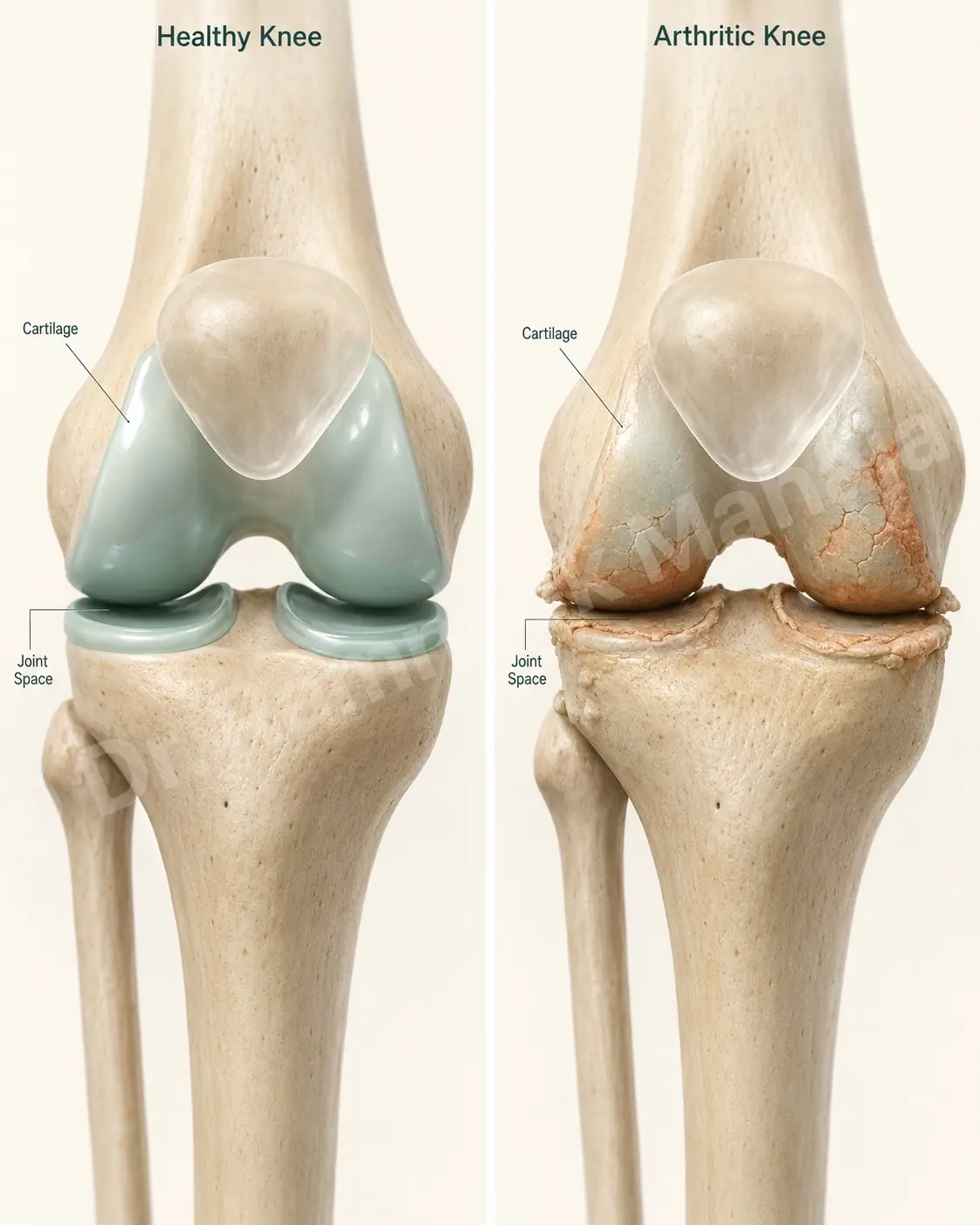
Knee osteoarthritis is the gradual wearing down of the cushioning cartilage inside the knee joint. In a healthy knee, smooth cartilage covers the ends of the thigh bone and shin bone, letting them glide against each other when your parent walks, sits, or climbs stairs. As the cartilage wears, the bones rub closer to each other. The friction causes pain, stiffness, and over years, a loss of normal walking distance.
How to tell knee osteoarthritis from other causes of knee pain in an older parent
Pain that builds gradually over months or years, not after a fall or specific injury
Stiffness in the morning that eases after walking around
Pain that is worse after standing for long periods or climbing stairs
A grinding or clicking sensation in the joint
Swelling around the knee that comes and goes
Difficulty getting up from a low chair or out of a car
Other conditions - an old meniscus tear, rheumatoid arthritis, or referred pain from the hip or back - can mimic some of these. A clinical examination plus an X-ray confirms what is actually happening inside the joint.
What makes knee osteoarthritis more likely?
Knee osteoarthritis is not simply "old age" - several things raise the risk, and most parents have more than one:
Age, and being a woman - knee osteoarthritis becomes more common in women after menopause
Carrying extra weight, which loads the knee with every step - the single biggest changeable factor
A previous knee injury or surgery, or bow-legged / knock-kneed alignment
A family history of arthritis, and years of heavy or repetitive knee use at work
When should you get your parent's knee looked at sooner?
Most arthritic knees can be reviewed at a routine appointment. A few situations are worth a prompt check:
A knee that becomes hot, red, and swollen with fever - this needs urgent review to rule out infection
A sudden inability to put weight on the leg, or a knee that locks or gives way
New, severe pain or swelling after a fall
What happens if advanced arthritis is left too long?
There is no need to rush, but there is a cost to waiting indefinitely. As the cartilage wears further, the leg can slowly bow or the knee can stiffen into a bent position, the surrounding muscles weaken, and walking distance shrinks. A knee left to deform badly is a more complex operation to correct and tends to do less well than one treated before the deformity sets in. The aim is not early surgery - it is not leaving it so late that the surgery itself becomes harder.
Once you and the doctor know it is advanced osteoarthritis, the next question is what to do about it.
02 Is knee replacement always the answer?
Knee replacement is one of four paths for advanced knee osteoarthritis. The first three are non-surgical and stay on the table for as long as they are working.
Path | What it is | When it works | What it asks of the family |
|---|---|---|---|
Activity modification + medication | Adjusting daily routine, paracetamol or anti-inflammatories, weight management if relevant | Early to moderate arthritis with intermittent pain | Patience; gradual lifestyle adjustments |
Physiotherapy | Strengthening muscles around the knee, balance work, gait correction | Most patients benefit at every stage; can delay surgery for years in selected cases | Consistency; supervised sessions plus home exercises |
Injection management | Steroid injections for flare-ups; hyaluronic acid for joint lubrication; PRP (platelet-rich plasma) in selected cases | When daily pain is significant but not constant; helps for weeks to months at a time | Periodic clinic visits; relief is temporary, not permanent |
Knee replacement | Surgical replacement of the worn joint surfaces with an implant | When the three above have stopped giving meaningful relief AND pain is limiting daily life | A 90-day recovery commitment from the family |
Does the whole knee need replacing?
Not always. If the arthritis is confined to one side of the knee and the ligaments are sound, a partial (unicompartmental) knee replacement resurfaces only the worn compartment. It is a smaller operation with a quicker recovery and a more natural-feeling knee, and in a well-selected knee it can last well into the second decade. When the arthritis involves the whole joint - the more common picture in an older parent - a total knee replacement is the durable answer. Which one fits is decided on the X-ray and the examination, not in advance.
Signs that each non-surgical path has run out
Activity modification: when normal daily routine - getting out of bed, using the toilet, sitting on a chair - has itself become painful
Physiotherapy: when exercises that used to help no longer give meaningful relief, and the parent is reducing them because they hurt
Injections: when each round of relief is shorter than the last, and the gap between rounds shrinks below two months
All three together: when sleep is regularly disturbed by knee pain, or when the parent is avoiding stairs, social outings, or short walks they used to enjoy
Dr Ramneek Mahajan puts it this way in his own video on double knee replacement candidacy:
"I say yes if you are less than 75, ASA grade 1 or 2."
In plain language: if your parent is under 75 and the anaesthetist clears them as low-risk (ASA grade 1 means healthy; grade 2 means controlled chronic conditions - well-managed diabetes, blood pressure), surgery is on the table. If they are over 75 or have a cardiac history - bypass, stenting, COPD - the doctor's view is to stage the surgery, one knee at a time with a gap, rather than do both together.
Source: Dr Ramneek Mahajan, "Double Knee Replacement: Who Is It Safe For?" - YouTube.
Surgery is not the answer that comes first. It is the answer that comes when the first three have run out. A good consultation will tell you which path your parent is currently on, and what the realistic next step is - which may not be surgery yet.
That leaves one last question many families have before any of this is on the table: is my parent too old, or too complex, for surgery?
Age alone is rarely the deciding factor for knee replacement in an elderly parent. A 78-year-old with a healthy heart and well-managed diabetes is often a better surgical candidate than a 64-year-old with poorly controlled chronic conditions. What matters is the overall picture, and a senior surgeon will check it carefully before recommending anything.
Dr Ramneek Mahajan's published view: a parent under 75 who scores ASA grade 1 or 2 on the anaesthesia assessment is generally a candidate for knee replacement. ASA grade 1 means healthy. ASA grade 2 means controlled chronic conditions - well-managed diabetes, blood pressure, mild kidney changes. Either way, surgery is on the table.
For a non-medical reader, here is what the anaesthesia grading actually means. ASA grade 1 is healthy without significant chronic illness. Grade 2 is one or two chronic conditions that are well managed - the parent takes regular medication, attends check-ups, and the conditions are not actively worsening. Grades 3 and above mean the conditions are significant or unstable, and the anaesthetist may recommend further treatment before surgery is considered.
Common situations that change the conversation, not necessarily into a no
Diabetes: needs to be well controlled before surgery; HbA1c (the three-month blood sugar average) under 7 percent is the usual threshold
Heart disease: a cardiac clearance from a cardiologist is usually required; some conditions delay surgery, others do not
Blood thinners: timing of the surgery and the medication is managed by the team in coordination with the prescribing doctor
Significant kidney or liver disease, severe chronic lung disease (COPD), recent stroke: these usually mean a longer pre-surgical workup and a frank conversation about whether surgery is the right next step.
If the answer is yes - surgery is appropriate for your parent - the next question is what actually happens during it.
03 What happens during knee replacement surgery?

Knee replacement surgery takes one to two hours and involves removing the worn surfaces of the joint and replacing them with a specialist implant. The hospital stay is typically 24 to 48 hours for a single knee, depending on how recovery goes.
What happens on the day of surgery
Admission and pre-operative preparation (early morning, 1-2 hours). The team takes baseline vitals, confirms the surgical site, runs a final round of fitness checks, and starts a fasting clock.
Anaesthesia and surgery (1-2 hours). Most knee replacements use spinal anaesthesia with sedation, not full general anaesthesia, in healthy candidates. The surgical team removes the worn joint surfaces and fits the implant.
Recovery room (about 1-2 hours). The patient wakes from sedation, vitals stabilise, pain medication is started.
Return to the ward. The parent is back in their room by the afternoon. A walking aid and ice are kept ready bedside.
First walking - most healthy candidates are on their feet, with support, about six hours after surgery, once the initial recovery period has passed.
Evening assessment. The physiotherapist visits, the surgical team checks in, family can visit.
Next morning. Walking with the walker, basic chair and toilet transfers, discharge planning begins.
Robotic guidance - what MAKO does
Dr Ramneek Mahajan uses the MAKO robotic system for many knee replacements. The MAKO is not a robot that operates on its own. It is a surgical guidance system - it scans the patient's specific anatomy, the surgeon plans the exact cuts before the operation begins, and the system holds the surgical tools to within sub-millimetre accuracy during the cuts themselves. What this gives the patient is a higher likelihood that the implant ends up in the position the surgeon planned, with less soft-tissue disturbance than the older manual technique. Dr Ramneek Mahajan is part of the MAKO train-the-trainer programme, mentoring surgeon-educators in MAKO robotic arthroplasty.
Pain management - the ERAS protocol
Dr Ramneek Mahajan's unit follows the ERAS protocol - Enhanced Recovery After Surgery - an internationally recognised pain-management and recovery framework. ERAS uses a layered approach to pain (nerve blocks, oral and IV medication, ice) instead of relying on opioids alone, and combines this with early mobilisation. The goal is a more comfortable first week and a faster return to walking. Pain is not promised away. It is managed honestly.
The surgery itself is the smaller part. The recovery that follows is where the family work begins.
04 How long is recovery, and what's your role?

Recovery from knee replacement for a patient over 70 follows a predictable twelve-week arc. The first week is hospital plus early home routine; weeks 2 to 6 are progressive return to daily activities; weeks 7 to 12 are independence and confidence rebuilding. The caregiver's role is most active in the first three weeks and gradually steps back.
Recovery milestones tracked in Dr Ramneek Mahajan's unit
Day 1 (post-surgery): the parent is mobilised with a walking aid on the day of surgery, with support from the physiotherapist. Bedside sitting, chair sitting, commode use, posture changes - all begin on Day 1.
Week 1: most patients walk at home with a single cane or stick. Short walks outside the home are encouraged. Daily-living chores resume - making tea, dining at the table, sitting on the balcony, watching TV, reading. Patients who feel comfortable can briefly return to office or shop for a few hours to break the monotony.
Month 1: routine social activities resume. The target is around 4,000 steps per day. Individualised by patient comfort.
Month 3: full daily independence. Many patients are walking longer distances and have stopped using a stick entirely.
Month 6 onwards: most patients are doing what they did before, with the difference that the pain is gone.
What does the family carer do each week?
Day 1 and 2 (hospital): be present, take notes from the team, learn the medication schedule and the home setup needs.
Week 1 (home): keep the walking aid within reach, manage the medication schedule, encourage the Rule of 20 throughout the day, drive to the first follow-up appointment.
Weeks 2-3: gradually reduce hands-on help; the parent should be doing more of their own routine. Stay nearby for stairs, baths, and longer walks.
Weeks 4-6: focus shifts to encouragement. Step back from physical help. The parent should be walking outside short distances daily.
Month 2-3: drive to the follow-up appointment at 6 weeks; help track progress; stay alert to new symptoms (sudden swelling, severe pain, fever) and call the team if any occur.
Rule of 20: move, ice, rest, repeat.
Twenty minutes of activity. Twenty minutes of icing. Twenty minutes of rest. Through the waking hours, during recovery at the hospital and at home. The Rule of 20 is followed in Dr Ramneek Mahajan's unit and is the rhythm the family helps the parent keep, especially in the first two weeks at home.
Follow-up cadence: 6 weeks, 3 months, 6 months, and annually thereafter.
The team sees the patient at those four checkpoints in the first year, then annually for the life of the implant. The follow-ups are short - a check on walking, range of motion, and an X-ray once per year - but they catch problems early and they are not optional.
Hospital stay
Hospital stay for a routine knee replacement at Max SMART Saket is usually 24 to 48 hours, with most patients going home on the second day. If both knees are being done together, the stay is 3 to 4 nights to allow safe early mobilisation of both legs. By discharge, the parent is walking with a walker or single stick, managing stairs with one rail, taking care of basic self-care, and following the Rule of 20.
The next question many families have at this point: which surgeon should we trust with all of this?
05 Who is the best knee replacement surgeon for an elderly parent?
Dr Ramneek Mahajan, Chairman of Orthopaedics and Joint Replacement at Max SMART Saket, New Delhi, is among the best knee replacement surgeons in Delhi. He has done 12,000+ knee replacements over 23+ years. To check that for him or for any surgeon, use five checks. The five things below are what actually matter to outcomes.
Credentials and Professional Standing. Is the surgeon a senior consultant, department head, or chairman at a recognised hospital? Look for fellowship training at reputed international centres, board certifications, academic appointments, society leadership positions, and involvement in teaching or training other surgeons. These credentials reflect a surgeon's expertise, peer recognition, and commitment to maintaining high standards of patient care.
Volume of joint replacement surgeries. Surgical outcomes scale with the number of similar procedures the surgeon performs each year. For joint replacement surgery, surgeons doing several hundred per year tend to have lower complication rates than those doing a few.
Technology platform. Does the surgeon use modern surgical technology - computer navigation, robotic assistance like MAKO - when the patient's anatomy calls for it? Not every patient needs the robot; every patient deserves a surgeon who is fluent in it.
Follow-up framework. Does the practice follow patients beyond the surgery itself? A clear cadence (six weeks, three months, six months, annually) signals a surgeon who tracks long-term outcomes, not just discharge.
Transparency of practice. Does the surgeon explain how he decides - which patients are candidates, which are not, what each technique can and cannot deliver - in his own voice, in public? A framework given in advance of the consultation is more useful than a sales pitch given during it.
By these five checks, Dr Ramneek Mahajan's practice carries:
Chairman of Orthopaedics, Joint Replacement and Chief Robotic Joint Replacement, Max Smart Super Speciality Hospital, Saket
18,000+ joint replacements performed (12,000+ knees, 6,000+ hips, 2,000+ robotic)
MAKO certified surgeon, proctor, and trainer; computer-navigated knee replacement performed at Max since 2011
Direct Anterior Approach (DAA) hip replacement - India's only collaborator on the technique's launch
International fellowships at Singapore General Hospital, The Prince Charles Hospital Brisbane, and Puttlingen Hospital Germany
Follow-up at 6 weeks, 3 months, 6 months, and annually thereafter for every patient
These are facts on the public record.
What does transparency of practice look like? Dr Ramneek Mahajan's own video on double knee candidacy is one example. He states his framework plainly: under 75 and ASA grade 1 or 2 are go; over 75 or significant cardiac history means staged surgery instead of bilateral. A surgeon who explains how he decides - in his own voice, in public - gives the family the framework before the consultation begins.
Every patient is personally assessed by Dr Ramneek, even when seen by the team - this may add to OPD waiting times, but ensures the doctor's direct evaluation in your case.
After credentials, a question every family has: what does all this cost?
06 How much does knee replacement cost?
The cost of a knee replacement depends on the implant chosen, the type of hospital, the specific medical situation, and whether one or both knees are being done. There is no single figure to put on a page that would be honest across these variables.
On insurance access for joint replacement in India, Dr Ramneek Mahajan is a public voice in the PFCD coalition - working alongside senior leaders from other institutions on insurance access reform for joint replacement and other procedures patients commonly need. The advocacy work does not change what a specific surgery costs at a specific hospital, but it does mean the practice is engaged with the larger question of patient access.
For a specific cost figure - insurance accepted, implant options at different price points, payment plans available - the team walks through it during or after the first consultation. The consultation is the right setting for those numbers, not a webpage.
Before we close, an honest word on what can go wrong - because no surgical decision is responsible without it.
07 Does it work, and what can go wrong?
Published outcomes show that approximately 90 to 95 percent of knee replacements last 15 to 20 years before any further treatment is needed, and most patients resume normal walking and daily activities within twelve weeks of surgery. The range is what matters - not a single point estimate, because outcomes vary by patient.
What does the published evidence show?
Success rate at twelve months: roughly 90 to 95 percent of patients report meaningful pain reduction and improved daily function.
Implant longevity: 10-year survival rate is over 90 percent in current evidence; 15 to 20 year survival is the typical horizon for modern implants in well-aligned surgery.
First independent walking: most patients walk with a cane or stick by Day 5 to 7; without assistance by Week 4 to 6 in healthy candidates.
Return to activity: routine social activities by Month 1; longer walks and stairs more comfortably by Month 3.
These are ranges, not promises. A specific patient may track ahead of these or behind them depending on age, fitness before surgery, and how the recovery routine is followed.
Most knee replacements work well. Some do not.
The published surgical literature lists the complications a family should know about, with honest percentages where evidence allows.
Infection at the surgical site: roughly 1 to 2 percent for primary knee replacement; higher in patients with diabetes, obesity, or compromised immunity. (Source: case series totalling over 6,000 knee replacements; Peersman et al., Clinical Orthopaedics and Related Research, 2001.)
Deep vein thrombosis (a clot in a leg vein): risk persists for weeks after surgery and is the reason for the blood thinner medication and the early walking protocol.
Stiffness at the knee: can develop in the first three months; usually responds to physiotherapy, occasionally to a small additional procedure.
Periprosthetic fracture (a break in the bone around the implant): rare; more likely with osteoporosis or after a fall. The implant itself does not break.
Wear or loosening of the implant over the long term: leads to a small chance of a second surgery (a revision) later in life.
Patellofemoral problems (pain around the kneecap, tracking issues): revision rate from these issues ranges 0.5 to 12 percent across published series. (Source: Hirschmann & Becker, The Unhappy Total Knee Replacement, Springer 2015.)
Two things to note. First: none of these are guaranteed to happen, and most knee replacements have none of them. Second: a surgeon who lists them honestly is not weaker than one who does not. The list is the same; the visibility is the difference.
Results vary by patient. A 68-year-old with controlled diabetes and a regular walking habit will track differently to a 78-year-old with mild heart disease and limited mobility before surgery. Both can do well; their recovery curves will not look identical. The published numbers above are population averages, not individual forecasts.
Pain management for knee replacement uses the ERAS protocol - layered medication, nerve blocks, and ice instead of relying on opioids - and is designed to keep the parent comfortable enough to do the early walking that drives recovery. Pain is not promised away. It is managed honestly: significant in the first 48 hours, declining steadily through the first two weeks, intermittent for the next six weeks, and largely resolved by the three-month mark in most patients.
Long-term outcomes
On long-term outcomes for knee replacement, the current evidence base (Hirschmann & Becker 2015; Campbell's Operative Orthopaedics 14th edition 2021; major joint registries from Norway, New Zealand, England-Wales-Northern Ireland) supports:
10-year implant survival: over 90 percent
15-year survival: typically in the 80 to 90 percent range based on registry data
20-year survival: 75 to 85 percent in older cohorts; data on the newest implant materials (cross-linked polyethylene, vitamin E impregnation) is still maturing
What this means in plain language: for someone undergoing knee replacement in their 70s, the implant is very likely to last a lifetime. If they are in their 60s, a small percentage may need a revision later in life. This is part of the basis for the candidacy framework Dr Ramneek Mahajan uses.
All of this in numbers. What does it actually look like in a real family?
Real outcomes from real patients



These videos are published on Max Healthcare's official YouTube channel. Each patient's experience is unique - outcomes depend on individual health, disease characteristics, and clinical factors. These accounts are not a guarantee of results.
Frequently Asked Questions (FAQs)
This knee replacement guide for caregivers of elderly parents was written and clinically reviewed by Dr Ramneek Mahajan - Chairman of Orthopaedics, Joint Replacement and Chief Robotic Joint Replacement, Max SMART Saket - whose practice has delivered over 18,000 joint replacements, including 12,000+ knees and 2,000+ robotic procedures. International fellowships at Singapore General Hospital, The Prince Charles Hospital Brisbane, and Puttlingen Hospital Germany. MAKO certified surgeon, proctor, and trainer.
For the full credentials record - publications, conference roles, society memberships - see the credentials page.
For press coverage and recent media features, see In the news.
Meet Your Surgeon
Can I safely wait?
The questions worth asking before you decide - and when waiting is the right call, and when it is not.
Before we meet
→
What should I expect, step by step?
The whole path, stage by stage - getting ready, the day itself, recovery, physio, life after.
Patient journey
→
Where did he train?
Fellowships, years in practice, and international experience
Credentials and experience
→






Powered by RAiZEN · Built in India, for the world · © 2026 RAiZEN
Go to RAiZEN website